

Audio By Carbonatix
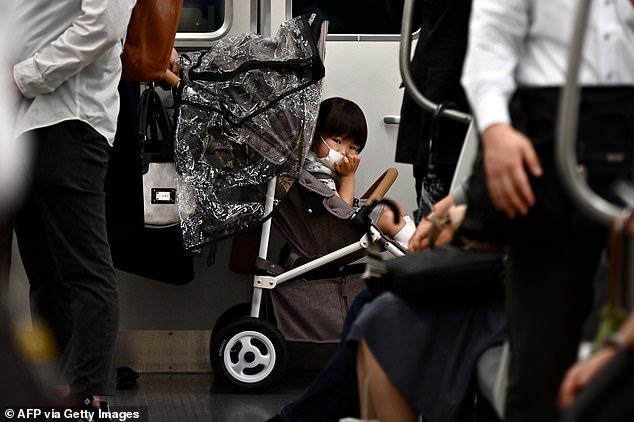
Children under the age of two should not wear face masks as they make it difficult for them to breathe and increase their risk of heat stroke, Japanese experts warn.
The Japan Paediatric Association has advised parents not to place masks on infants under two - despite Japan's coronavirus guidelines urging every individual to wear a mask.
In a leaflet issued to the Japanese public the medical body warned that infants could experience an increased burden on their lungs due to the covering of their mouths, reports CNN.
They added that the masks also obstruct the child's face, making it more difficult for parents to notice changes in expression or the colour to the face which could indicate breathing issues.
The leaflet reads: 'It is possible that masks make it difficult for infants to breathe and increase the risks of heat stroke'.
Due to their narrower air passages the mask poses a risk of suffocation, especially if a young child vomits behind a mask, states the advice.
As children have a relatively low risk of contracting coronavirus the Japanese board found that they had no logical reason to face the risks posed by wearing the mask itself.
On Monday Japan's Prime Minister Shinzo Abe lifted the coronavirus state of emergency in Tokyo and four other remaining areas, ending the restrictions nationwide.
Experts on a government-commissioned panel approved the lifting of the emergency in the capital, neighbouring Kanagawa, Chiba and Saitama prefectures, and in Hokkaido to the north, which had remained under the emergency declaration after it was removed in most of Japan earlier this month.
Japan, with about 16,600 confirmed cases and 850 deaths, has so far avoided the large outbreaks experienced in the US and Europe despite softer restrictions.
Mr Abe said the lifting of the emergency does not mean the end of the outbreak. He said the goal is to balance preventive measures and the economy until vaccines and effective drugs become available.
But the world's third largest economy has fallen into a recession, and public discontent over his handling of coronavirus has sent his support ratings tumbling.
Recent media surveys show public support for his cabinet has plunged below 30 per cent, the lowest since he returned to office in December 2012.
Mr Abe declared the state of emergency on April 7 in several parts of Japan including Tokyo, expanded it to the entire nation later in the month, and then extended it until the end of May.
Under the emergency, people were asked to stay at home and non-essential businesses were requested to close or reduce operations, but there was no enforcement.
Since May 14, when the measures were lifted in most of Japan, more people have left their homes and stores have begun reopening.
Economy minister Yasutoshi Nishimura said recent data suggests infections have slowed enough and pressure on the medical system has fallen enough to allow a gradual resumption of social and economic activity.
He said Tokyo, Kanagawa and Hokkaido, where the number of infections is still fluctuating, need to be watched closely.
Individual prefectures are allowed to impose their own measures.
Tokyo governor Yuriko Koike said last week that the capital will reopen in three phases starting with schools, libraries, museums, and longer service hours for restaurants.
She said theatres, sports facilities and other commercial establishments will be next, with nightclubs, karaoke and live music houses in the final phase.
Mr Abe said the swift development of vaccines and effective treatments for Covid-19 are priorities towards achieving the Tokyo Olympics next year.
Experts say developing an effective and safe vaccine by the Games next year would be difficult. Mr Abe acknowledged that the fight against the virus 'would be an endurance battle'.
Latest Stories
-
Gramps Morgan names Ghanaian business leader Monalisa Effah as Ghana-Jamaica Homecoming Ambassador
6 minutes -
CAF President urges faith in African football despite AFCON 2025 issues
24 minutes -
AFCON U-17: Black Starlets’ aim is to win trophy – Head Coach Prosper Ogum
28 minutes -
ENFA expands access to global capital for Ghanaian SMEs
36 minutes -
Beyond security: Why mobile payment fraud has become a customer experience crisis
37 minutes -
Former Effia MP demands full disclosure of Truedare AI deal, warns of ‘hidden risks’
1 hour -
Joseph Cudjoe raises alarm over potential revenue loss in Truedare AI Customs deal
1 hour -
Video: Awoshie-Anyaa Highway: Years of fatal crashes caused by faulty traffic lights
1 hour -
No financial transactions with Ghana Card yet, says NIA
1 hour -
Former Netherlands Fire Chief engages GNFS Tema Command on capacity building
1 hour -
Finance Ministry defends Publican AI rollout amid stakeholder concerns
1 hour -
Police arrest 5 in Asankrangwa robbery; cash and guns retrieved
1 hour -
Why I joined NPP – Jeneral Ntatia
1 hour -
Three UDS students remanded over alleged armed robbery
1 hour -
Kudus Mohammed at risk of missing World Cup 2026 after fresh injury blow
1 hour