


Audio By Carbonatix
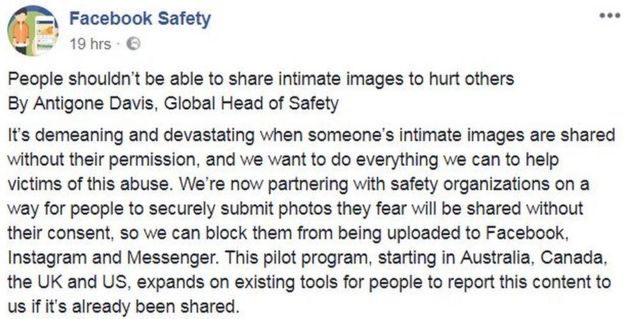
Facebook is asking British users to send naked photos of themselves to the social network, to try to stop revenge porn.
If you're worried an intimate photo of you could be shared by someone else, the idea is to get it blocked before it appears online.
Similar technology is used to try to stop the spread of child abuse images.
Facebook's been testing the system in Australia and is extending the trial to the UK, the USA and Canada.
A spokesman told Newsbeat the idea is open to people in the UK now.
Facebook hasn't revealed any details about how the trial in Australia went - but obviously, the idea requires a huge leap of faith.
Would you send sexually explicit photos of yourself to Facebook?
Could you be certain the image would be handled sensitively - and crucially, not shared?
How it works
If there's an image you're worried about, Facebook says you should contact its partner for the trial. In the UK, it's the Revenge Porn Helpline.
Staff there will then get in touch with Facebook and you'll get sent a link to upload the photo.
Who will see my naked photo?
Facebook's Global Head of Safety Antigone Davis told Newsbeat that photos will only be seen by "a very small group of about five specially trained reviewers".
They'll give the photo a unique digital fingerprint - something called hashing.
That code will then be stored on a database. If anyone else tries to upload the same photo, the code will be recognised and it'll be blocked before it appears on Facebook, Instagram and Messenger.
The original photos will not be stored.
Will the idea definitely work?
Antigone Davis admits there's "no 100% guarantee when it comes to photo-matching technologies".
That's because it's possible to manipulate images so they're different to the original. But she says they are getting better at it.
This whole system only works if you actually have the image you're worried about.
If, for example, your ex took a load of photos on their phone and you don't have them, this idea doesn't help.
The UK's Revenge Porn Helpline has seen huge year-on-year increases in reported incidents since it was launched in 2015.
The hotline received just over 500 reports in 2015 and more than 1,000 in 2017.
Latest Stories
-
Iran war lands ‘triple blow’ to flood-ravaged Sri Lankans
23 minutes -
Gunmen kill at least 11 people at Afghanistan picnic spot
36 minutes -
Woman, 25, in court for stealing baby at Bogoso
37 minutes -
Trump unveils giant gold-accented victory arch design for US capital
40 minutes -
We spoke to the man making viral Lego-style AI videos for Iran. Experts say it’s powerful propaganda
45 minutes -
Hungarians vote in big numbers on whether to end Orbán rule and elect rival
46 minutes -
At least 30 feared dead in crush at Haitian tourist site
46 minutes -
Boxing: Abdul Ahmed wins WBA Africa Cruiserwight title after dispatching Nigeria’s Eradeye
60 minutes -
Nearly 2,000 displaced, schools damaged as windstorm wreaks havoc in Gushegu
1 hour -
Ghana’s Derrick Kohn to work under Marie-Louise Eta as she becomes first woman to coach men’s Bundesliga team
1 hour -
Accra Open Championships conclude with strong performances ahead of African Championships
2 hours -
Ghana to begin camping with 12 athletes after Accra Open Championships – Bawa Fuseni
2 hours -
Anthony Joshua declines showdown with Tyson Fury but admits they ‘probably’ clash next
2 hours -
Tyson Fury dominates Makhmudov, calls out Joshua next
2 hours -
I have supported highway authority financially to fix roads in my constituency – A Plus
3 hours