

Audio By Carbonatix
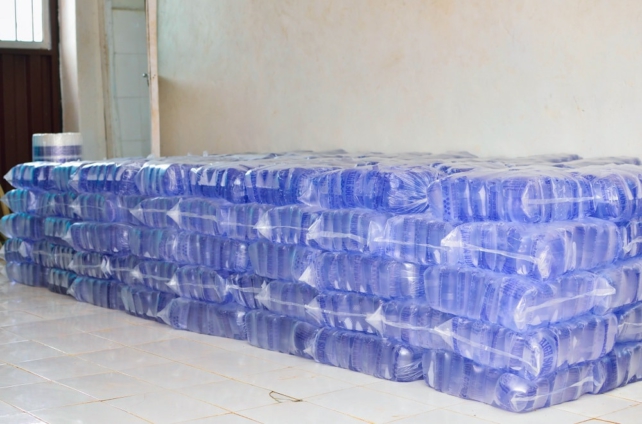
Ghana’s Food and Drugs Authority (FDA) has debunked claims that sachet water on the market is contaminated with faecal matter.
The Authority said the outcome of its regular surveillance of sachet water producers is not in conformity with observations by the Ghana Statistical Service.
A study by the Ghana Statistical Service revealed that most sachet water on the market was contaminated with faecal matter.
The multiple indicator cluster survey conducted in 2017 revealed 34.1% of households in Ghana which relied on sachet water as a drinking water source had an appreciable amount of Esherichia coli, a contamination indicator.
In a response to media reports on the poor quality and safety of sachet water, the FDA assured of regular inspection of manufacturing facilities premised on the Authority’s guidelines.
The Authority said it inspects packaging materials to ensure they meet their respective standards.
They inspection includes E. coli, total coliforms, aerobic plate count, Pseudomonas aeruginosa, Streptococcus faecalis and Clostridium perfringens.
The FDA stressed that its laboratory facilities conduct periodic water safety tests and product quality analyses on packaged water on the market.
The statement signed by the Chief Executive Officer of the FDA said “the Authority wants to remind the public of its responsibility to protect consumers, as mandated by the Public Health Act, 2012 (ACT 851). With regard to packaged water (bottled and sachet), the FDA ensures this through the licensing of the manufacturing premises and the registration of these products. The inspection covers the starting material (water) to packaging materials to ensure they meet their respective Ghana standards: and the finished products to meet the requirements of GS175-1:2002 (for drinking water) and GS220:2014 (for mineral water). All inspections are done in accordance with the current Codes of Good Manufacturing Practices (GMP) where end products are released in accordance with the above-stated specifications”.
"The FDA also ensures producers comply with the production process which includes Filtration/Reverse Osmosis which rids water sources of extraneous material, and UV sterilization for destroying deadly disease-causing microorganisms," the regulatory body said.
The Authority is however urging the public to patronize only registered sachet and bottled water manufactured in Ghana.
The public is also admonished to report any unregistered sachet and bottled water at any of its nearest offices across the country.
“The public is strongly advised to patronize only registered sachets and bottled water manufactured in Ghana that bear the FDA product registration numbers,” the statement read.
Latest Stories
-
Prudential Life settles GH¢100,000 medical bills under its PRUCares Valentine Experience Initiative
3 hours -
Wa West Picnic: Peter Lanchene Toobu champions peace, health and unity in landmark celebration
3 hours -
Dr Mensah Market flooded after downpour in Kumasi
3 hours -
Armed men reportedly storm Adjen Kotoku Onion Market amid tensions
4 hours -
Tecco Mensah writes: Why football fans must look beyond statistics
5 hours -
Police recover stolen Honda CR-V in Kumasi within 48 hours
6 hours -
Apetorku Gbodzi 2026 Festival opens in Dagbamete with development focus
6 hours -
President Mahama arrives in Lyon to co-chair One Health Summit
6 hours -
Beverly View Plus Hotel draws crowds amid coastal Easter rush in Volta
6 hours -
Maiden Zongo Festival held in Wa amid calls to tackle drug abuse among the youth
6 hours -
FDA warns of fake HIV test kits on Ghanaian market
7 hours -
Africa urged to build resilient health systems as donor support tightens
7 hours -
Easter gesture: Ablakwa settles medical bills for 85 North Tongu constituents
9 hours -
Africa must harness its population strength—Titus-Glover
9 hours -
Visa-free access doesn’t mean unlimited stay – Lom Ahlijah
9 hours