

Audio By Carbonatix
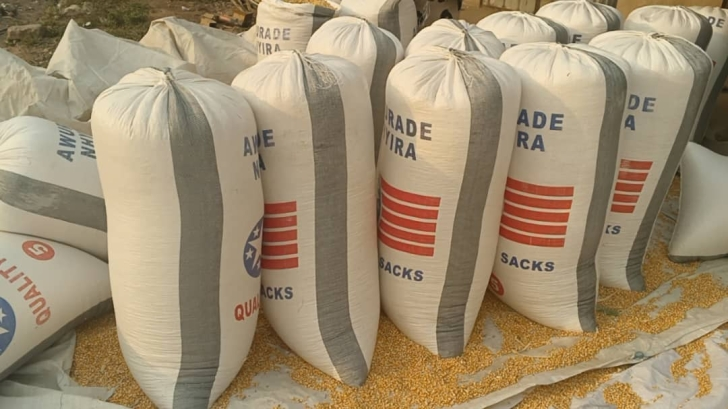
Farmers in the Atebubu-Amantin Municipality of the Bono East Region are grappling with a sharp decline in maize and bean prices despite a bumper harvest, raising concerns about their livelihoods, future production, and the stability of the local rural economy.
Checks by the Daily Graphic at Akokoa and surrounding farming communities in the municipality show that prices of the two major staples have dropped by more than half compared to previous years.
Beans, which sold for between GH₵2,500 and GH₵3,000 per bag in 2024, are now selling for between GH₵700 and GH₵1,000 while maize has declined from GH₵1,000 and GH₵1,200 to GH₵300 and GH₵400 per bag.
Farmers say the price dip has left many unable to recover production costs, especially those who relied on loans or personal savings to cultivate their farms.
“Even last year, when prices were not good, it was still better than this year,” a farmer at Akokoa Ebenezer Wayome told the Daily Graphic.
“Now we are forced to sell at a loss or keep our produce at home.”
High input costs
The impact of the falling prices is being compounded by high production costs. Farmers report that a box of agrochemicals or weedicide sells for about GH₵1,200, fertiliser costs between GH₵350 and GH₵500 per bag, while tractor services remain expensive, ranging from GH₵350 to GH₵400 per acre.
As a result, many farmers say they are reconsidering their scale of operation ahead of the next farming season.
A farmer, Baye-Uchan, in the municipality said he plans to reduce his cultivated land by half this year.
“Last year, I cultivated about 50 acres, but this year, I’m considering reducing it to 20 because of the price fall and the high cost of inputs,” he said.

Market slowdown
Produce buyers in the municipality said the depressed market has affected their operations, as financiers are reluctant to release funds due to the risk of losses.
This has led to reduced purchasing activity in farming communities.
The slowdown, farmers said, has affected transport operators, casual labourers, and petty traders who depend on the movement of grain for income.
Pressure on rural banks
Rural and community banks in the municipality are also feeling the effects of the downturn.
With farmers earning less, savings have declined, while loan repayments have slowed, weakening the financial position of some institutions.
Bank officials said the situation could limit the availability of credit for farming and small businesses if it persists.
Social impact
At the household level, falling incomes are affecting the ability of families to meet basic expenses, including school fees, health care and utility bills.
Community members also report an increase in youth idleness as farming-related jobs decline.
“We, the youth working as loading boys here, are out of jobs.
The low prices of grains over the past two years have hit us hard, and many young people are turning to crime or facing police harassment out of frustration.
The government must intervene to address the situation,” one of the loading boys said.
Calls for intervention
Farmers and produce buyers are therefore calling on the government and relevant agencies to intervene to stabilise prices through improved storage facilities, expanded market access, and structured buying arrangements to absorb surplus during bumper harvests.
They warn that without intervention, reduced farm investment could affect future production and food security in the municipality.
Latest Stories
-
Monetise Idiocy In Ghana
1 minute -
The Ghanaian prophet and the mysterious death of his scottish wife Charmain Speirs
47 minutes -
Nearly 400 sentenced in Nigeria for links to militant Islamists
1 hour -
Ghana’s recovery supported by gold strength despite global oil price pressures – Standard Bank Research
1 hour -
‘Excellence is our inheritance’ – Nana Sam Brew-Butler hails Mfantsipim’s 150-year reign in leadership
2 hours -
Kwaku Azar writes: A-G vs OSP
2 hours -
Mfantsipim–Adisadel rivalry built excellence, not division – Sam Jonah
2 hours -
Vice President launches Mfantsipim’s 150 years of shaping Ghana’s greatest mind
2 hours -
I assure Otumfuo, Mahama will join him to commission KNUST Teaching Hospital by end of this year – Haruna Iddrisu
3 hours -
Barcelona dominate derby to extend La Liga lead
3 hours -
Gov’t to roll out free special education for persons with disabilities from July 1 – Education Minister
4 hours -
Importers and Exporters Association declares full support for Publican AI port system
4 hours -
“We used it to test our officiating officials’ readiness” – Bawah Fuseini after CAA Athletics event
4 hours -
Volleyball emerges as Ghana’s fastest rising sport
4 hours -
National Sports Fund needs strong leadership from the top – Administrator David Wuaku
4 hours