

Audio By Carbonatix
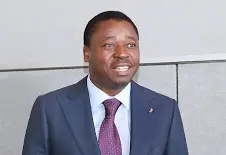
Togolese President Faure Gnassingbé has been sworn in as the first-ever Chairman of the Council of Ministers, assuming the highest executive position in the country following a contentious transition from a presidential to a parliamentary system.
This development marks a significant political transformation in the small West African nation, where Gnassingbé’s family has held power for nearly six decades.
The constitutional reform, passed amid strong opposition and public outcry, has redefined Togo’s governance structure, with executive authority now vested in the Chair of the Council of Ministers, while the presidency becomes a largely ceremonial role.
In a parallel move, the Togolese National Assembly has elected Jean-Lucien Kwassi Lanyo Savi de Tové, a former Minister of Trade (2007–2009) and seasoned opposition figure, as President of the Republic.
Under the new constitution, his role is largely symbolic, stripped of executive powers.
The revised constitution, adopted by the National Assembly in April 2024 and officially promulgated the following month, stipulates that the Chairman of the Council of Ministers must come from the majority party in Parliament.
That position currently belongs to Gnassingbé’s Union for the Republic (UNIR) party, which secured 108 out of 113 seats in legislative elections last year, elections widely condemned by the opposition as a “masquerade”.
Critics argue that the constitutional overhaul is a calculated manoeuvre by Gnassingbé to extend his grip on power indefinitely, especially as his final presidential term under the old constitution approaches its end in 2025.
“Fully aware that his current mandate is his last under the previous system, Faure Gnassingbé, with the support of a National Assembly whose mandate has already expired, engineered this reform to retain power indefinitely,” said Professor Aimé Gogué, leader of the opposition Alliance for Democracy and Integral Development (ADDI). “Under this new parliamentary arrangement, he can rule for decades, unchecked.”
The reform has drawn strong condemnation from opposition parties and civil society organisations, locally and internationally, who view the process as undemocratic and designed to consolidate authoritarian rule.
Gnassingbé, who turns 59 on 6th June, first assumed the presidency in 2005 following the death of his father, Gnassingbé Eyadéma, who had ruled Togo with an iron fist for 38 years.
As the political dynamics shift under the new parliamentary framework, questions remain about democratic accountability, institutional legitimacy, and the future of opposition politics in Togo.
Latest Stories
-
Gov’t is set to issue a 7-year cedi bond on March 30, first since 2022
51 minutes -
Graduates flood the workforce without practical skills – Auba Consult CEO
1 hour -
GCB Bank strengthens market leadership with record GHS3.2 billion profit in 2025
1 hour -
Luv FM Primary Schools Quiz: Manna International School books finals slot
2 hours -
Universal Hospitals Group marks Ghana month with donation to children at Ridge Hospital
2 hours -
Senegal to parade Afcon trophy despite title being stripped
2 hours -
A-Plus announces plans to build port, launch Free Zones and new city in Gomoa Central
2 hours -
Elon Musk’s X advertising boycott lawsuit dismissed by US judge
2 hours -
Fear of losing elections shouldn’t stop you from doing right — A-Plus
2 hours -
‘It’ll come back to hunt you’ – Senanu warns Minority against politicising Damang Mine lease
2 hours -
Mahama welcomes UN resolution declaring slavery gravest crime against humanity
2 hours -
Paramount Chief of Asante Akyem Agogo, Nana Akuoko Sarpong passes on
2 hours -
NIA announces early closure of registration centres for Heritage Month activities
3 hours -
My focus is industrialisation, not parliamentary debates—A-Plus
3 hours -
Inclusivity and accountability key to Ghana’s development – NDPC Chairman
3 hours