

Audio By Carbonatix
Researchers at the University of Ghana have concluded that some fish that washed ashore last week was as a result of low oxygen concentration in the waters.
Preliminary investigations conducted by the Marine and Fisheries Sciences Department revealed that “most parameters required for life in the ocean were within acceptable limits, with the exception of Chemical Oxygen Demand (COD), which was significantly higher than expected.”
This comes on the back of tons of fish washed ashore in Accra which attracted many residents, some of whom picked them up either for consumption or for sale during the Easter festivities.
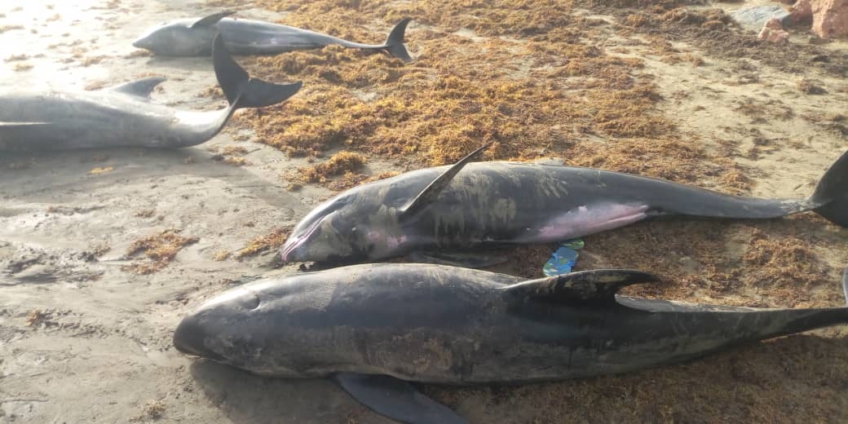
Similarly, some 60 dead dolphins were sighted at the shores of Axim-Bewire in the Nzema East Municipality of the Western Region.
The Fisheries and Aquaculture Minister, Mavis Hawa Koomson had revealed that fish stress is what caused the mass fish deaths that washed ashore at Osu beach per preliminary investigations by Veterinary Doctors of the Fish Health Unit of the Fisheries Commission.
Fresh information from the University of Ghana researchers corroborates this as it explains that “this oxygen demand would most likely create a condition of stress on living organisms that depend on dissolved oxygen in the water body.”
The department's press press release on April 11 says it observed a sudden drop in sea surface temperature in the coastal waters from Cote d’Ivoire to Togo a few days to the washing ashore of the fish.
Although it is not yet clear what may have triggered this development, “this is most likely an indication of upwelled water from the bottom of the ocean, probably carrying low oxygen concentration,” per the reseachers.
The statement signed by the head of department used the opportunity to appeal to government to procure a ferries geared towards monitoring marine for research purposes as global warming presents new challenges within the field.
"We depend very much on the marine living and non-living resources for a significant portion of our national wealth. It is implicit that we protect this asset through regular monitoring so as to avert any future calamity. The impact of global climate change and its vulnerability is real and coastal states are the worst to be affected," the statement added.
Latest Stories
-
Gov’t to establish Prison Industrial Hub to equip inmates with income-generating skills – Prison Service boss
12 minutes -
Alhassan Tampuli donates cement, roofing sheets to support storm victims in Gushegu
12 minutes -
Alhassan Tampuli appeals for urgent support for storm victims in Gushegu
15 minutes -
The hypocrisy must stop; pass Anti-LGBTQ+ Bill now – Alhassan Tampuli to Mahama
19 minutes -
Imprisonment should be rehabilitative, not punitive – Ghana Prisons boss at UNGA
41 minutes -
Ga Adangbe traditional priests petition Mahama over McDan aviation licence revocation
52 minutes -
Anti-LGBTQ Bill: NDC’s arrogance is worrying – Hassan Tampuli
1 hour -
Let’s give OSP time to mature, not to scrap it – Hassan Tampuli
1 hour -
Nigeria convicts 386 Islamist militants in mass trials
1 hour -
Djibouti president wins election with 97.8% of vote, state media says
1 hour -
We don’t have mandate to deduct tax from rent allowance of security services personnel – Interior Ministry clarifies
2 hours -
Ablakwa receives Presidential Special Envoy on Reparations to advance global agenda
2 hours -
Christina Koch becomes first woman to travel around the moon on Artemis II
2 hours -
Epstein survivors’ calls to meet King Charles and Queen harder to ignore as US visit approaches
2 hours -
UN Secretary-General names Ghana’s Anita Kiki Gbeho as South Sudan envoy
2 hours