

Audio By Carbonatix
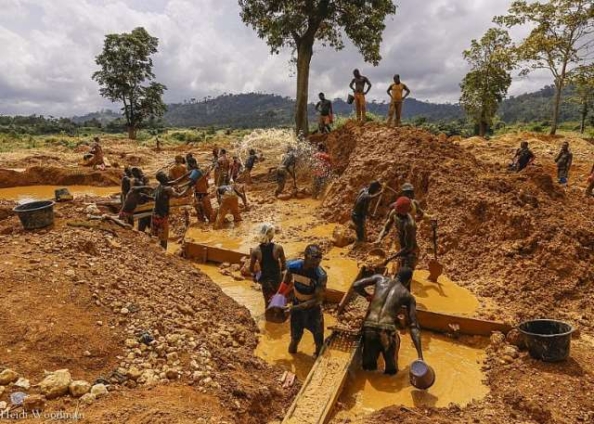
Air Commodore David Anetey Akrong, the Commandant of the Kofi Annan International Peacekeeping Training Centre (KAIPTC), has described illegal small-scale mining, popularly known as galamsey, as an existential threat to Ghana’s survival.
He warned that the menace had evolved into a national crisis with grave implications for the country’s environment, economy, and human security.
Speaking at the “Reflections on Security Series” seminar held at the KAIPTC in Accra, Air Commodore Akrong said the widespread degradation of forests, pollution of rivers, and destruction of arable lands had placed Ghana’s water security, public health, and sustainable development at serious risk.
The seminar, on the theme: “Galamsey as an Existential Threat to Ghana: A Call for Reflection and Action,” brought together policymakers, academics, security experts, civil society organizations, and media practitioners to deliberate on the multi-dimensional challenges posed by illegal mining and explore collaborative strategies to curb it.
Air Commodore Akrong said illegal mining, once seen as a livelihood activity, had transformed into a deeply entrenched network of organised criminality involving corruption, money laundering, and the exploitation of vulnerable populations.
He cautioned that, “If left unchecked, these dynamics threaten not only the sustainability of the country’s natural resources but also the legitimacy of governance institutions and the stability of local communities.”
He cited the contamination of major water bodies such as the Pra, Ankobra, Birim, and Offin with toxic chemicals, including mercury, cyanide, and arsenic, as evidence of the alarming scale of environmental destruction.
The Commandant said, “Entire communities are at risk, while the siltation of reservoirs is jeopardising access to potable water for several towns and cities,” emphasising that the crisis had far-reaching public health consequences.
According to him, galamsey had triggered a “silent public health emergency,” contributing to kidney diseases, respiratory ailments, birth defects, and the spread of waterborne and vector-borne diseases across mining communities.
He noted that the threat extended beyond environmental degradation, as illegal mining was now intertwined with transnational criminal networks that facilitate illicit financial flows and smuggling of industrial equipment and weapons, potentially fueling broader insecurity.
Air Commodore Akrong commended successive governments for their various interventions, including the establishment of the Inter-Ministerial Committee on Illegal Mining, Operation Vanguard, Operation Halt, the National Anti-Illegal Mining Operations Secretariat (NAIMOS), and the Responsible Community Mining Scheme.
However, he admitted that the persistence of illegal mining pointed to deeper governance and institutional challenges.
Participants examined how illegal small-scale mining had become a magnet for both local and foreign actors, driven by lucrative returns and weak enforcement mechanisms. The practice continues to undermine national security and development due to its links with organised criminality, corruption, and illicit financing.
Experts at the seminar interrogate several key issues, including the true extent of illegal mining, its existential threat to the nation, the effectiveness of response mechanisms, and reasons behind the limited success of past interventions.
Discussions also focused on identifying realistic, actionable measures that could galvanize cooperation between state and non-state actors to stem the tide.
Air Commodore Akrong reiterated that as a Centre of Excellence in research, training, and policy dialogue, the KAIPTC remained committed to providing an open and trusted platform for constructive engagement on national and regional security challenges.
He expressed optimism that the deliberations would “generate actionable insights that contribute meaningfully to the fight against illegal mining.”
The seminar formed part of KAIPTC’s ongoing “Reflections on Security Series,” a platform designed to promote open and evidence-based discussions on complex national and regional security challenges.
It brought together stakeholders from academia, civil society, the media, the security services, the extractive sector, and traditional authorities.
Latest Stories
-
Fourth edition of SBE Cup set to uncover Ghana’s next football stars on March 16
2 minutes -
Doctor raises concern over rising UTI cases among children from affluent homes
2 minutes -
Regular check-ups key to early diagnosis of medical condictions – Little Angels Trust founder
5 minutes -
Four injured Ghanaian soldiers responding to treatment, likely to be managed in Lebanon — GAF
10 minutes -
Temporary traffic changes announced on Accra–Tema Motorway for major construction works
11 minutes -
New UCC E-Campus to be launched in August 2026; set to admit 10,000 students annually
15 minutes -
IMCC engages Roads Ministry on strengthening devolved sector functions
16 minutes -
One dead in crash at Teacher Mantey on Accra–Kumasi highway
25 minutes -
Istanbul’s ex-mayor to stand trial on corruption charges
26 minutes -
Contractors supplying school feeding programme import rice instead of buying from local farmers — Dr Nyaaba
30 minutes -
Nkoko Nkitinkiti initiative to cut Ghana’s poultry imports — John Dumelo
37 minutes -
The mirage of president’s special initiatives—Mahama’s “legacy projects” or another monument of waste?
52 minutes -
Thousands face long queues at airports in Houston and New Orleans
55 minutes -
‘Night turned into day’: Iranians tell of strikes on oil depots
1 hour -
Prof. Douglas Boateng commends govt’s value for money agenda, urges passage of Procurement Bill
1 hour