

Audio By Carbonatix
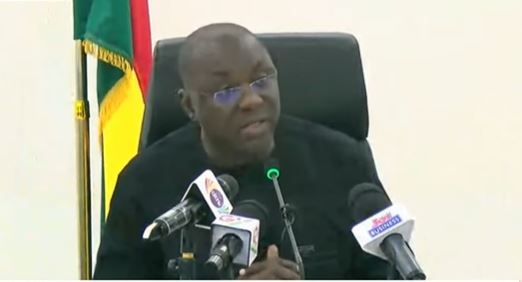
Ghana has made “significant progress” in debt-restructuring negotiations and the latest snag that sent its eurobonds tumbling on Monday will be ironed out in further talks with bondholders, Finance Minister Mohammed Amin Adam said.
Negotiations that started mid-March resulted in an interim deal last week with international investors holding about 40% of Ghana’s $13 billion of defaulted eurobonds. Still, Adam conceded in an interview that agreement breaches the International Monetary Fund’s debt sustainability parameters “slightly.”
“This is not a failure but an ongoing process to arrive at an agreement consistent with debt thresholds” under the IMF’s debt sustainability analysis, or DSA, Adam said. The government will “regroup with our bondholders to continue to tweak the terms until we have final terms that work for all parties,” he said.
Ghana’s eurobonds plunged by the most since Dec. 2022, with notes due in June 2035 falling as much as 3 cents to 47.55 cents on the dollar before paring the decline.
The IMF said in a statement that the “working scenario” presented by the government of Ghana “is not in line with program parameters.”
“The IMF will continue to support the ongoing restructuring negotiations between the authorities and their external commercial creditors with the view to reach an agreement that is consistent with program parameters,” the lender said.
The latest development brought more clarity on the broad outline of the eurobond restructuring, though the terms of an agreement would have to be “fine-tuned” to meet the IMF thresholds, said Samir Gadio, head of Africa strategy at Standard Chartered Plc. Bond prices are now not far from recovery levels implied by the restructuring proposal, he said.
International bondholders had agreed to a 33% effective nominal haircut, according to one of two options provided for the restructuring.
Above Target
To meet its IMF target, the $77 billion economy needs to reduce debt to 55% of gross domestic product by 2028, compared with a burden of 109% that was projected for the year before Ghana began restructuring. The current bondholder agreement would leave debt slightly above that target.
Ghana’s economy fared better than the IMF expected, expanding 2.9% in 2023 compared to an initial IMF target of 1.5%. That means a revised DSA would accommodate the agreement with bondholders, Adam said.
Ghana began working to revamp its debt a little over a year ago as part of a deal with the International Monetary Fund, reaching an agreement in principle with bilateral creditors in January to rework $5.4 billion of obligations under the Group of 20 Common Framework for Debt Treatment. That agreement set the tone for the restructuring of eurobond debt.
Latest Stories
-
Challenging Heights rescues 22 from human trafficking
38 seconds -
Oil traders bet millions minutes before Trump’s Iran talks post
7 minutes -
GMA calls for National Emergency Command Centre after Korle Bu overcrowding incident
12 minutes -
TMPC marks one year of reforms under acting registrar Dr Yakubu Tobor Yusuf
24 minutes -
Minority threatens disruption if Ato Forson fails to appear over Gold-for-Reserve
43 minutes -
Annoh-Dompreh criticises Majority Leader over failure to schedule Minority’s motions
50 minutes -
Ghana, EU sign landmark Security and Defence partnership
51 minutes -
Police arrest 77 suspects in anti-drug operation in Tamale and Savelugu
1 hour -
A Wrinkle In Time
1 hour -
Joy News journalist Ivy Setordjie, 14 others selected for prestigious Imperial College London Science Journalism Programme
1 hour -
Visal Re celebrates first anniversary of its innovative reinsurance platform; placeIT
1 hour -
Why transfer pricing matters? – The “How” in a brukina story
1 hour -
Gov’t moves to protect jobs and sustain operation as Damang mine lease nears expiry
1 hour -
Wealth management in Ghana: Understanding taxation for high-net-worth individuals
1 hour -
EU warns Ghana over Russian “unethical” recruitment as 55 Ghanaians reported dead
2 hours