

Audio By Carbonatix
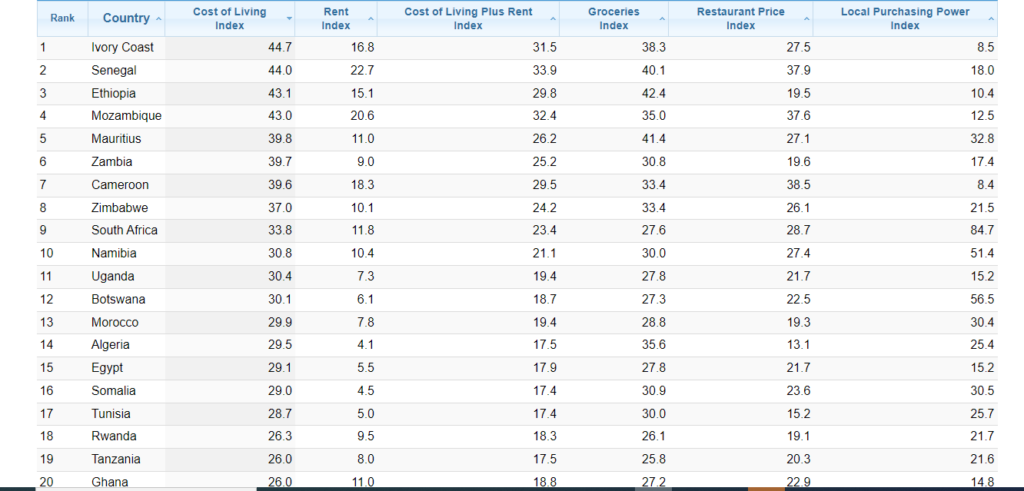
Ghana has been ranked 20th in Africa out of 24 countries with the lowest cost of living, a new data from Numbeo has revealed.
It is however ranked 3rd in West Africa with the highest cost of living.
The nation's overall Cost of Living Index was 26.0.
The ranking took into consideration Rent Index, Groceries Index, Restaurant Purchase Index and Local Purchasing Power Index.
For Rent Index, the nation scored 11.0.
In terms of Cost of Living Plus Rent Index, Ghana scored 18.8, whilst it obtained a score of 27.2 for Groceries Index.
With regard to Restaurant Purchase Index, it scored 22.9. However, it got a score of 14.8 for Local Purchasing Power Index.
Cote d'lvoire (44.7) was 1st in both Africa and West Africa with the highest cost of living. It was followed by Senegal with a score of 44.0.
Ethiopia placed 3rd with a score of 43.1, whilst Mozambique and Mauritius were 4th and 5th with scores of 43.0 and 39.8 respectively.
Ghana’s position, according to Numbeo, was largely due to a reduced inflation in 2023 and a slow down in the depreciation of the cedi.
The data revealed that cost of living in Ivory Coast is on average 72.3% higher than in Ghana. Similarly, rent in Ivory Coast is on average 53.6% higher than in Ghana.
However, cost of living in Nigeria is on average 53.5% lower than in Ghana. Similarly, rent in Nigeria is, on average, 8.5% lower than in Ghana.
Inflation ended 2023 at 23.2%
Ghana's end-of year inflation stood at 23.2% (December 2023).
Whilst food inflation rate stood at 28.7% in December 2023, non-food inflation recorded a rate of 18.7%. The Consumer Price Index data also revealed that inflation for locally produced items was slightly higher at 23.8%, while inflation for imported items remained at 21.9%.
The Ghana cedi also ended 2023 with a year-to-date depreciation of 15.57% to the US dollar in the retail market.
Currently, Ghana is under an International Monetary Fund programme with the need to improve its revenue outlook. This has led to the introduction of new taxes thereby burdening businesses subsequently.
This has the tendency to derail businesses and investor confidence in the medium to long-term.
Latest Stories
-
Friends of Bridget Bonnie Marks her 35th birthday with donation to Kasseh Model Health Centre
7 minutes -
Landfilling waste management creates no value, it’s an economic waste
34 minutes -
Photos: Speaker Bagbin Commissions MPs constituency office under parliamentary decentralisation programme
50 minutes -
Black Stars technical advisor Winfried Schäfer sacked as GFA shakes up backroom staff
54 minutes -
Wenchi water project almost complete, critical to gov’t agenda – GWL MD
1 hour -
Anti-LGBTQ+ bill not part of government’s legislative agenda – Inusah Fuseini
1 hour -
Anti-LGBTQ Bill: Forget the rumour mongers, I’m a man of action, and will pass the bill – Speaker
2 hours -
Women and children among those killed in Sudanese army shelling of wedding celebration
2 hours -
President Mahama is not sincere with Ghanaians on LGBTQ bill matter – Hassan Tampuli
2 hours -
Gov’t to establish Prison Industrial Hub to equip inmates with income-generating skills – Prison Service boss
3 hours -
Alhassan Tampuli donates cement, roofing sheets to support storm victims in Gushegu
3 hours -
Alhassan Tampuli appeals for urgent support for storm victims in Gushegu
3 hours -
The hypocrisy must stop; pass Anti-LGBTQ+ Bill now – Alhassan Tampuli to Mahama
3 hours -
Imprisonment should be rehabilitative, not punitive – Ghana Prisons boss at UNGA
3 hours -
Ga Adangbe traditional priests petition Mahama over McDan aviation licence revocation
3 hours