


Audio By Carbonatix
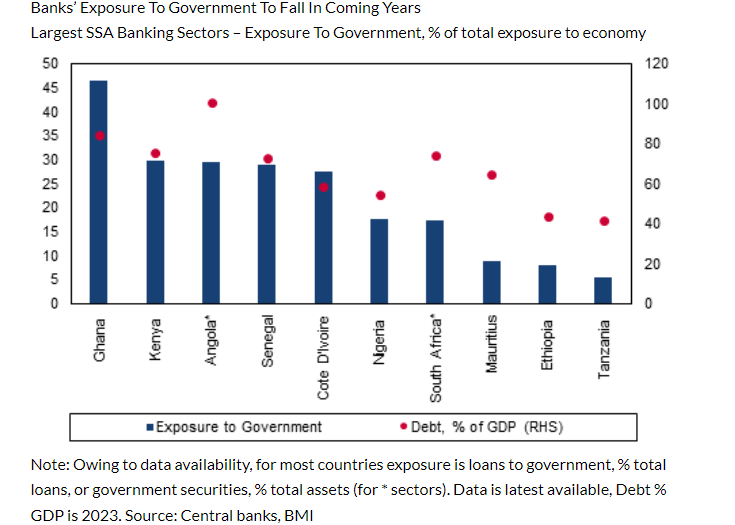
Ghana recorded the highest banks’ holdings of government debt in Sub Saharan Africa in 2023, Fitch Solutions has revealed.
In terms of government debt to Gross Domestic Product (GDP), the country came second behind Angola.
Kenya, South Africa and Senegal came 3rd, 4th and 5th respectively.
The report said banks in Sub-Saharan Africa including Ghana will continue to face risks associated with sovereign exposure throughout the forecast period. Nonetheless, these risks are expected to diminish over time.
During the Covid-19 pandemic, banks’ holdings of government debt and claims to the public sector surged as governments increased borrowing to fund additional expenditures.
With limited access to international markets owing to prohibitive costs, the report, said domestic banks became the main financiers. This dependence, it added, poses significant risks to banks, particularly when government finances are strained.
“This dependence poses significant risks to banks, particularly when government finances are strained. For instance, Ghana's default on its domestic and external debt in December 2022 led to considerable losses for banks participating in its domestic debt exchange programme”.
“As can be seen in the chart below, banking sectors in markets with elevated levels of government debt typically have the highest exposure to the government through loans or government securities holdings. We expect that the average debt-to-GDP ratio for the region will fall in the coming years, after peaking in 2023, boding well for our view that banks will reduce exposure to the sovereign”, it stressed.
Reopening of Africa’s Eurobond market in 2024 marks positive shift
The report continued that the reopening of Africa's Eurobond market in 2024, following a hiatus of more than a year, marks a positive shift, with successful, oversubscribed bond issuances from countries such as Côte d'Ivoire, Benin, and Kenya.
This resurgence, it said, provides government with a source of financing other than banks, offering banks the opportunity to lessen their exposure to sovereign debt, potentially liberating resources for increased lending to the private sector. However, this transition is expected to be gradual, as loan quality continues to be a concern and private sectors present higher risk profiles than sovereigns.
Latest Stories
-
Iran war lands ‘triple blow’ to flood-ravaged Sri Lankans
10 minutes -
Gunmen kill at least 11 people at Afghanistan picnic spot
23 minutes -
Woman, 25, in court for stealing baby at Bogoso
24 minutes -
Trump unveils giant gold-accented victory arch design for US capital
27 minutes -
We spoke to the man making viral Lego-style AI videos for Iran. Experts say it’s powerful propaganda
32 minutes -
Hungarians vote in big numbers on whether to end Orbán rule and elect rival
33 minutes -
At least 30 feared dead in crush at Haitian tourist site
33 minutes -
Boxing: Abdul Ahmed wins WBA Africa Cruiserwight title after dispatching Nigeria’s Eradeye
46 minutes -
Nearly 2,000 displaced, schools damaged as windstorm wreaks havoc in Gushegu
1 hour -
Ghana’s Derrick Kohn to work under Marie-Louise Eta as she becomes first woman to coach men’s Bundesliga team
1 hour -
Accra Open Championships conclude with strong performances ahead of African Championships
1 hour -
Ghana to begin camping with 12 athletes after Accra Open Championships – Bawa Fuseni
2 hours -
Anthony Joshua declines showdown with Tyson Fury but admits they ‘probably’ clash next
2 hours -
Tyson Fury dominates Makhmudov, calls out Joshua next
2 hours -
I have supported highway authority financially to fix roads in my constituency – A Plus
3 hours