

Audio By Carbonatix
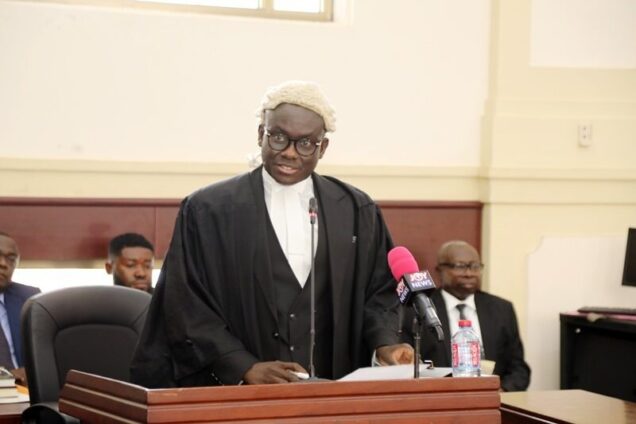
Former Attorney General, Godfred Yeboah Dame, has called on the Council of State and President John Mahama to adhere to the legal procedures regarding the potential removal of Chief Justice Gertrude Torkornoo.
He made these remarks to journalists shortly after the Supreme Court adjourned a case filed by the Member of Parliament for Old Tafo, Vincent Ekow Assafuah, challenging the processes for the removal of the Chief Justice.
The MP argues that the President violated the constitution and acted unfairly towards the Chief Justice by forwarding the petition to the Council of State without first notifying her of the allegations outlined in the petition.
Some three individuals have petitioned the President, John Mahama, to remove the Chief Justice over allegations of misconduct on her part as Justice of the country.
Background
Following the petition to remove her, President John Mahama held consultations with the Council of State. According to a statement from Minister for Government Communications, Felix Kwakye Ofosu, the three petitions were forwarded to the Council of State, in line with the constitutional process outlined in Article 146 of the 1992 Constitution.
The President subsequently gave 10 days to the Chief Justice to submit a preliminary response to the petitions after the lawsuit.
The Chief Justice has since submitted her preliminary response to President John Mahama.
Before John Mahama became president, President Akufo-Addo received a petition on December 17 seeking the removal of the Chief Justice from office over allegations of misconduct and incompetence.
The petition, filed by a Ghanaian, accused Justice Torkonoo of constitutional and administrative breaches. The petitioner argued that these alleged actions undermine the credibility and integrity of the judiciary.
In the petition, the complainant insisted that the Chief Justice’s removal is necessary to preserve public confidence in Ghana's judicial system.
The law that surrounds the removal of the Chief Justice is enshrined in Article 146 of the Constitution.
Article 146 - Removal Of Justices Of Superior Courts And Chairmen Of Regional Tribunals
1) A Justice of the Superior Court or a Chairman of a Regional Tribunal shall not be removed from office except for stated misbehaviour or incompetence or on ground of inability to perform the functions of his office arising from infirmity of Body or mind.
(2) A Justice of the Superior Court of Judicature or a Chairman of a Regional Tribunal may only be removed in accordance with the procedure specified in this article.
(3) If the President receives a petition for the removal of a Justice of a Superior Court other than the Chief Justice or for the removal of the Chairman of a Regional Tribunal, he shall refer the petition to the Chief Justice, who shall determine whether there is a prima facie case.
(4) Where the Chief Justice decides that there is a prima facie case, he shall set up a committee consisting of three Justices of the Superior Courts or Chairmen of the Regional Tribunals or both, appointed by the Judicial Council and two other persons who are not members of the Council of State, nor members of Parliament, nor lawyers, and who shall be appointed by the Chief Justice on the advice of the Council of State.
(5) The committee appointed under clause (4) of this article shall investigate the complaint and shall make its recommendations to the Chief Justice who shall forward them to the President.
(6) Where the petition is for the removal of the Chief Justice, the President shall, acting in consultation with the Council of State, appoint a committee consisting of two Justices of the Supreme Court, one of whom shall be appointed chairman by the President, and three other persons who are not members of the Council of State, nor members of Parliament, nor lawyers.
(7) The committee appointed under clause (6) of this article shall inquire into the petition and recommend to the President whether the Chief Justice ought to be removed from office.
(8) All proceedings under this article shall be held in camera, and the Justice or Chairman against whom the petition is made is entitled to be heard in his defence by himself or by a lawyer or other expert of his choice.
(9) The President shall, in each case, act in accordance with the recommendations of the committee.
(10) Where a petition has been referred to a committee under this article, the President may-
(a) in the case of the Chief Justice, acting in accordance with the advice of the Council of State, by warrant signed by him, suspend the Chief Justice;
(b) in the case of any other Justice of a Superior Court or of a Chairman of a Regional Tribunal, acting in accordance with the advice of the Judicial Council, suspend that Justice or that Chairman of a Regional Tribunal.
(11) The President may, at any time, revoke a suspension under this article.
Latest Stories
-
Kwaku Azar writes: A-G vs OSP
19 minutes -
Mfantsipim–Adisadel rivalry built excellence, not division – Sam Jonah
44 minutes -
Vice President launches Mfantsipim’s 150 years of shaping Ghana’s greatest mind
1 hour -
I assure Otumfuo, Mahama will join him to commission KNUST Teaching Hospital by end of this year – Haruna Iddrisu
2 hours -
Barcelona dominate derby to extend La Liga lead
2 hours -
Gov’t to roll out free special education for persons with disabilities from July 1 – Education Minister
2 hours -
Importers and Exporters Association declares full support for Publican AI port system
2 hours -
“We used it to test our officiating officials’ readiness” – Bawah Fuseini after CAA Athletics event
3 hours -
Volleyball emerges as Ghana’s fastest rising sport
3 hours -
National Sports Fund needs strong leadership from the top – Administrator David Wuaku
3 hours -
JoySports Exclusive: Steve McLaren in talks with GFA after expressing interest in Black Stars job
3 hours -
Fire guts auto parts warehouse at Bubuashie, one fire officer injured
3 hours -
I owe my victory to coach Ofori Asare – Allotey after winning WBA Africa Gold Super Flyweight belt
3 hours -
Church of Pentecost supports over 2,000 BECE candidates in Obuasi with career guidance seminar
5 hours -
Brandon Asante and Coventry all but promoted to Premier League despite Sheffield Wednesday draw
5 hours