


Audio By Carbonatix
Motorists across Ghana are breathing a sigh of relief as two of the country’s leading oil marketing companies—Goil and Star Oil—announce significant reductions in fuel prices, following the recent appreciation of the Ghanaian cedi against the US dollar.
The price cuts are expected to ease the financial burden on consumers and transport operators who have long called for downward reviews following the cedis strong gains.
Goil rolls back prices across all fuel types
Goil, Ghana’s largest and wholly indigenous oil marketing company, has revised prices downward across its entire fuel range. The new rates are as follows:
- Petrol: now selling at ₵12.52 per litre, down from ₵13.27
- Diesel: reduced to ₵12.98, from ₵13.87
- Premium: slashed to ₵14.34, previously ₵15.27
The move positions Goil as one of the first major players to respond proactively to the improved forex environment.
Star Oil joins price reduction wave
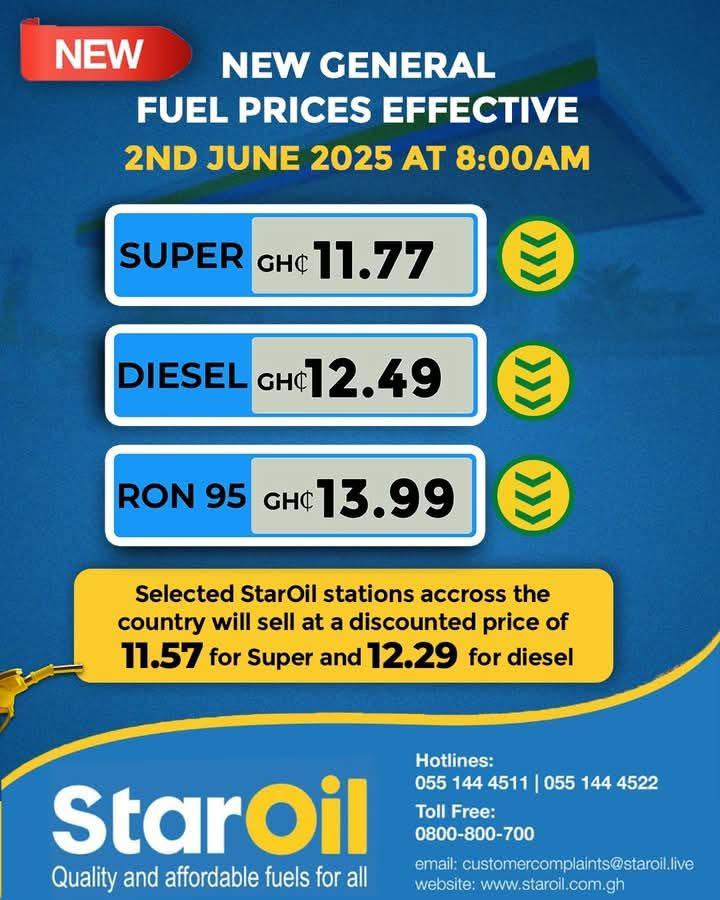
Star Oil has also made notable reductions, though its premium fuel remains unchanged. New prices at Star Oil stations are:
- Petrol: now ₵11.77, down from ₵12.57
- Diesel: now ₵12.49, reduced from ₵13.49
- Premium: holds steady at ₵14.89
This development places Star Oil’s petrol as among the most competitively priced on the market, likely influencing broader pricing trends in the coming days.
Cedi rebound drives change
The reductions come on the back of a strengthening Ghanaian cedi, which has recorded significant gains against the US dollar in recent weeks. As fuel imports are dollar-denominated, the improved exchange rate has provided room for oil marketing companies to lower prices at the pump.
Market watchers say this could signal the start of a broader downward trend in fuel pricing—provided the cedi’s stability is sustained and global crude prices remain relatively subdued.
Relief for consumers, pressure on others
Transport operators and consumers have welcomed the reductions, but are also calling on other oil marketing companies to follow suit to create a level playing field and further drive down transport fares.
Industry insiders suggest that competition and customer pressure may soon push more fuel retailers to adjust their prices accordingly.
Latest Stories
-
Keep the money in Ghana – Gov’t enforces local cargo insurance
45 minutes -
US Army veteran charged with leaking classified information to journalist
1 hour -
Dr. Dre joins Forbes billionaires list as second-richest hip-hop artist with $1 billion fortune
1 hour -
Trump administration cannot nix legal status of 5,000 Ethiopians, US judge rules
1 hour -
Libya announces new oil and gas discoveries with three major energy companies
1 hour -
Oil rises as investors remain wary US-Iran ceasefire will open supply flow
2 hours -
Police arrest suspect over church threat video
3 hours -
Eight appear in court as police intensify crackdown on illicit drugs in Tamale
4 hours -
Motorist remanded in custody for hitting four-year-old girl
4 hours -
Mobile money vendor robbed at Ziope
4 hours -
Benin’s Finance Minister Wadagni seeks his own mandate in election
4 hours -
GNFS retrieves body of unidentified man from Asylum Down drain
4 hours -
CAF’s Motsepe to visit both Senegal and Morocco amid AFCON fallout
5 hours -
Edmond Boateng takes up secretary role at Honorary Consular Corps of Ghana
5 hours -
Armed men kill 20 and abduct others in northwestern Nigeria villages
5 hours