

Audio By Carbonatix
The Centre for Policy Scrutiny (CPS) has expressed worry that despite gold sitting at the center of Ghana’s economic history, yet its role in shaping monetary policy has been underutilized.
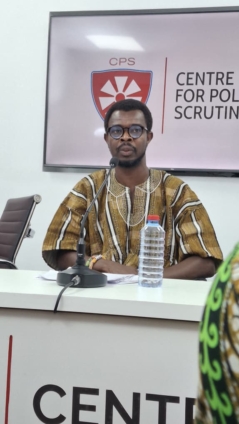
Professor Paul Alagidede, who is a fellow of the Center, therefore wants this to change if the country is to escape chronic liquidity constraints.
“Gold plays a very significant role as a store of value and an inflation hedge,” he said.
“It can also serve as a strategic reserve asset for emerging market economies like Ghana”, he added.
Ghana is the sixth-largest gold producer globally, producing about 440 tonnes annually. Yet only a small fraction of this wealth appears on the country’s balance sheet.
Speaking at a public lecture organised by the Centre for Policy Scrutiny (CPS) in partnership with Joy Business, the professor noted that while Ghana holds about 38 tonnes of gold in official reserves, proven in-situ reserves are estimated at around 1,000 metric tonnes.
“From an economic point of view, we can do much better by keeping the gold here rather than selling it for dollars,” he argued.
At current prices, the value of Ghana’s proven gold reserves alone is estimated at about US$146 billion, forming part of a broader natural asset base valued at roughly US$1.5 trillion.
Yet orthodox economics treats this wealth as dormant until it is extracted and sold.
“In the age of reductionism, gold in the ground is seen as dead,” he explained. “But in the age of regeneration, it is an opportunity for balance-sheet renewal", he added.
By activating just 40 to 60% of its in-situ gold equity, Professor Alagidede argued, Ghana could unlock between US$634 billion and US$952 billion in fiscal space.
“The illusion of poverty is very powerful,” he said.
“Orthodox thinking sees Ghana as a poor country that must always look outside for liquidity”, he added.
He acknowledged recent policy shifts, including the establishment of the GoldBod which has mobilized about US$10.8 billion from small-scale and artisanal mining within a year. But he described these as preliminary steps.
“These are baby steps unless they are supported by a deeper shift in monetary philosophy,” he cautioned.
Ultimately, he called for a transition from managing economic flows to managing the national balance sheet, anchored on sovereign assets.
“Ghana is not a poor nation,” he concluded. “It is a wealthy nation in a temporary state of amnesia. It is time to wake up.”
Latest Stories
-
National Sports Fund needs strong leadership from the top – Administrator David Wuaku
5 minutes -
JoySports Exclusive: Steve McLaren in talks with GFA after expressing interest in Black Stars job
11 minutes -
Fire guts auto parts warehouse at Bubuashie, one fire officer injured
17 minutes -
I owe my victory to coach Ofori Asare – Allotey after winning WBA Africa Gold Super Flyweight belt
21 minutes -
Church of Pentecost supports over 2,000 BECE candidates in Obuasi with career guidance seminar
2 hours -
Brandon Asante and Coventry all but promoted to Premier League despite Sheffield Wednesday draw
2 hours -
GPL 2025/26: Late Kwartemaa strike downs Hearts in Tema
2 hours -
Ghana Faces Sierra Leone Moment as Prosecutorial Powers come under strain
3 hours -
Don’t consume fish or seafood from Tema Shipyard until further notice – FDA warns
3 hours -
Why volunteering might be Africa’s most underrated career accelerator
3 hours -
ActionAid Ghana raises concern over gender gaps in Feed Ghana Programme
3 hours -
Windstorm wreaks havoc in Gushegu, displacing nearly 2,000 residents and damaging schools
3 hours -
Friends of Bridget Bonnie Marks her 35th birthday with donation to Kasseh Model Health Centre
4 hours -
From Ekumfi Kokodo to the Pulpit Stage: Essi Donkor’s gospel journey takes shape
4 hours -
Landfilling waste management creates no value, it’s an economic waste
4 hours