

Audio By Carbonatix
The Minority in Parliament has accused the Mahama administration of prioritising political optics over long-term economic sustainability, arguing that recent gains being touted by government mask deeper structural weaknesses.
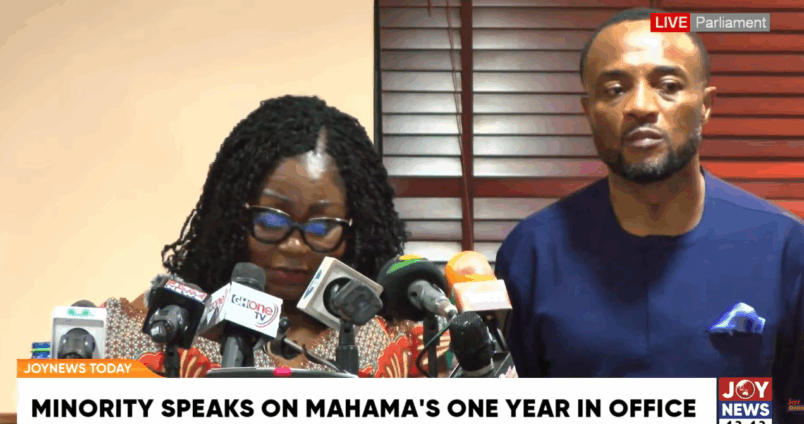
Speaking at a press briefing on Thursday, January 8, the Deputy Minority Leader and Member of Parliament for Asokwa, Patricia Appiagyei, dismissed the government claims of an economic turnaround as a “manufactured miracle” driven more by favourable headlines than sound policy foundations.
She questioned the narrative of success built around a reported 6 per cent GDP growth, falling inflation, and over 40 per cent appreciation of the cedi, asking what real benefits these gains have delivered to the ordinary Ghanaians.
According to her, much of the current recovery predates President John Mahama’s return to office and is largely anchored on external factors and policies initiated under the previous administration.
“Much of the recovery began before President Mahama returned to power. It is resting on an IMF programme we negotiated, fiscal consolidation we implemented, and a global gold boom we did not create,” she stated.
Madam Appiagyei further accused the government of selectively highlighting favourable aspects of the International Monetary Fund (IMF) programme while ignoring its cautionary notes.
She noted that while the government celebrates IMF-backed progress, the same reports also warn of fiscal risks, weaknesses in gold-related schemes, and underlying vulnerabilities within the economy.
“They publicise the headlines, but they downplay the warnings,” she said.
The Deputy Minority Leader also raised concerns about the sharp appreciation of the cedi, warning that such rapid gains, in the absence of strong structural fundamentals, could harm the productive sectors of the economy.
“A 40 per cent cedi appreciation in one year is not normal for an economy with structural weaknesses. It erodes competitiveness, hurts exporters, and damages farmers and manufacturers,” she argued.
She added that the government’s approach reflects a preference for short-term applause rather than policies aimed at securing long-term economic stability, insisting that sustainable growth must go beyond headline figures.
Latest Stories
-
Asanko Gold supports road rehabilitation to ease transport challenges in Amansie West
39 seconds -
Serial killer pleads guilty to eight murders in case that haunted Long Island, New York
4 minutes -
NPP used Bosomtwe road as ‘election machine’ but failed to dedicate funds for its completion – Dr Amoakohene
10 minutes -
CSOs warns of contraceptive crisis as $500k UNFPA supplies stall at port
16 minutes -
Africa’s youth bulge a ‘defining moment’ that requires urgent action – NYA CEO Osman Ayariga
23 minutes -
No looming power crisis; Ghana’s electricity supply remains stable – Energy Ministry PRO insists
39 minutes -
Mahama should reset his stance on LGBTQ -Clinton Baffour
45 minutes -
Rising sachet water costs should spark a bigger conversation on plastic waste
48 minutes -
Two-week ceasefire takes effect as US and Iran prepare for talks in Pakistan
51 minutes -
Dr. Amoakohene debunks claims Sewua and other Agenda 111 hospitals are ready for operationalisation
59 minutes -
AMA rolls out new shift system for street sweepers to improve sanitation
1 hour -
Focus on capacity, not connections in Damang lease decision – Paa Kwesi Schandorf
1 hour -
Teen defender Eric Mensah undergoes trial at Malaga CF after standout ROC Cup display
1 hour -
Journalism out loud: Why silence is no longer an option
1 hour -
NYA boss identifies unemployability as Africa’s core youth challenge
1 hour