

Audio By Carbonatix
A Member of the Education Committee in Parliament, Kingsley Agyemang, has called for a comprehensive review of how tertiary education in Ghana is funded, saying the current situation in public universities is troubling and requires urgent national attention.
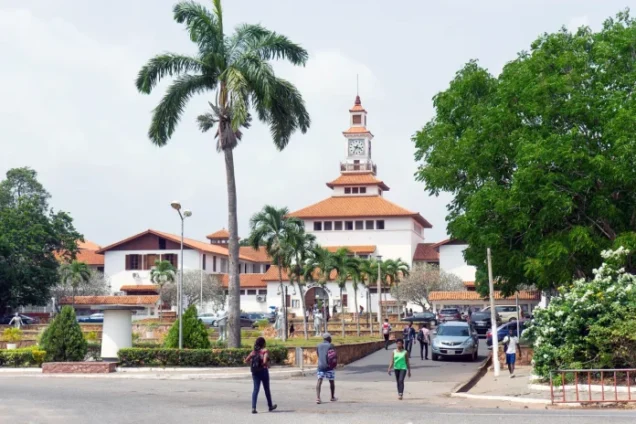
Speaking on Newsnight on Joy FM on Monday, January 5, discussing the University of Ghana's 25% increment of fees, Mr Agyemang said there is a need for the entire government machinery to rethink the country’s approach to funding tertiary education.
“If you have had the opportunity to teach in our universities or interact with our public universities, you will understand the situation,” he said.
“I teach at GIMPA, and I teach at KNUST, and there’s a need for the whole government machinery to re-look at our tertiary education funding. It’s something we really need to have a national discourse about.”
He explained that universities and colleges require adequate resources to function properly, adding that the current conditions on many campuses are worrying.
“Every university or college needs a lot of resources to be able to function properly. You don’t even need the students to tell you. The situation is quite troubling.”
Mr Agyemang pointed to challenges such as poor lecturer-to-student ratios, limited access to teaching and learning spaces, and inadequate library facilities.
“The lecturer-to-student ratio, how students even get spaces for teaching and learning to happen, access to libraries, both online and electronic databases, these are basic things that every student needs, but they are very lacking,” he said.
Despite these challenges, he said that universities must still operate within the law. “In spite of these difficulties, it does not mean that we have to break the law and do what we want to do,” he said.
Addressing concerns about the fee increment of the University of Ghana, he stated clearly that Parliament has not approved any such increases.
“We have written to the University of Ghana to confirm or deny if the increment has happened. What I can also confirm is that before we went on recess, we had not increased fees and charges of all public universities and colleges.”
He explained that public universities cannot act independently when it comes to fees. “They cannot operate in isolation, and that fee has to be approved by Parliament,” he said.
According to him, any fee increase implemented without parliamentary approval would be unlawful. “If it comes out that they have not had parliamentary approval, it means that it cannot stand. It means it’s illegal,” he stated.
He added that the law requires institutions to submit proposed fees to Parliament for approval. “It is a statutory provision that institutions will have to place these matters before Parliament for Parliament to approve or decline. But no such thing came to us before we went on recess.”
He said that would depend on the response from the University of Ghana to ongoing enquiries.
“If indeed they went ahead to charge such fees or announce the charging of such fees, it means they are in breach of the law, and the law will take its course,” he said.
Mr Agyemang urged stakeholders to take part in a national discussion on tertiary education funding and reforms, including how graduates are prepared for the job market.
“We need to begin to have a national discourse on how our tertiary education needs to be funded. There is a gap between academia and industry, and we need to get things right.”
He said that Ghanaian graduates are competing globally and must be equipped accordingly.
“If you are graduating from a tertiary institution, you are competing with people from the West. By virtue of the internet, everything is out there.”
Read also: GTEC directs University of Ghana to reverse 2025/2026 academic year fee increases
Latest Stories
-
Anti-LGBTQ Bill: NDC’s arrogance is worrying – Hassan Tampuli
1 minute -
Let’s give OSP time to mature, not to scrap it – Hassan Tampuli
5 minutes -
Nigeria convicts 386 Islamist militants in mass trials
10 minutes -
Djibouti president wins election with 97.8% of vote, state media says
15 minutes -
We don’t have mandate to deduct tax from rent allowance of security services personnel – Interior Ministry clarifies
29 minutes -
Ablakwa receives Presidential Special Envoy on Reparations to advance global agenda
47 minutes -
Christina Koch becomes first woman to travel around the moon on Artemis II
57 minutes -
Epstein survivors’ calls to meet King Charles and Queen harder to ignore as US visit approaches
1 hour -
UN Secretary-General names Ghana’s Anita Kiki Gbeho as South Sudan envoy
1 hour -
Mali withdraws recognition of Sahrawi Republic, backs Morocco’s autonomy plan
1 hour -
Gov’t distributes over 8,500 laptops to One Million Coders project
1 hour -
Julius Debrah, ‘man to beat’ as NDC’s James Agbey dismisses Musah Dankwah’s polls
1 hour -
GPRTU in Savannah Region to protest alleged eviction in Damongo
2 hours -
Re: Reinsurance does not replace process — A response to the SIGA–SIC defence
2 hours -
Gender Ministry supports Harriet Amuzu in ongoing abuse case
2 hours