

Audio By Carbonatix
The United States Africa Command (AFRICOM) has expressed deep concern over the escalating terrorist threat in West Africa and signaled its readiness to support countries in the region to combat the growing insecurity.
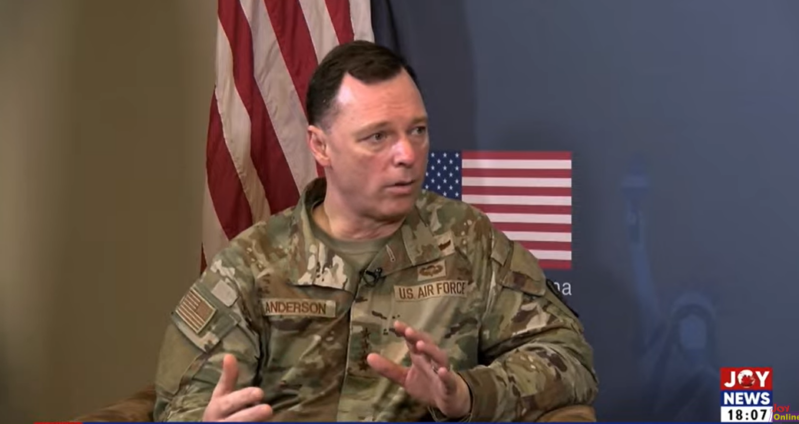
Commander of AFRICOM, Gen Dagvin Anderson, made these remarks on JoyNews' Africa Connect programme on February 24, warning that violent extremism is spreading beyond the Sahel and threatening coastal West African nations, including Ghana.
"Unfortunately, we're very concerned about it. The violent terrorist threat is continuing to spread. It's taken root in the Sahel and it's continued to expand," General Anderson stated.
The General revealed that terrorist networks previously active in other parts of the world have now found sanctuary in the Sahel's ungoverned spaces, taking advantage of limited state presence to establish new operational bases.
"One of the things that we do at AFRICOM and within the U.S. military is we look at these terrorist threats globally. So we understand how these networks evolve and move. And what we have seen is that a large portion of that network has migrated into the Sahel. They found refuge there in ungoverned space and they have taken advantage of that," he explained.
The consequences, according to the Commander, extend far beyond the immediate conflict zones. Mass migration, displacement, and spillover violence are now destabilizing neighboring countries.
General Anderson specifically referenced recent tragic incidents involving Ghanaian civilians who fell victim to extremist violence while pursuing their livelihoods across the border.
"My heart goes out to the Ghanaians that were up there just doing trade working, who were also killed by violent extremists, just doing their daily job. And so this is the terrible place that that instability brings, not just in those isolated areas," he said.
The General emphasized that the threat requires a coordinated regional response, as no single nation can effectively tackle the growing extremist challenge alone.
"We are very concerned about that. And that's a large portion of the reason why I've been traveling to many countries around the region, is to look where we can partner, because no one nation can take this threat out alone," Anderson added.
His comments come at a time when Ghana and other coastal West African states have heightened security vigilance along their northern borders, following a series of terrorist attacks in Burkina Faso, Mali, and Niger that have increasingly threatened regional stability.
Latest Stories
-
Women leaders’ wisdom and work deserve recognition – Mahama
4 minutes -
NRSA to refund surplus from auctioned vehicles of non-subscribers after deducting towing costs
6 minutes -
Ghana must integrate AI into mainstream education – DigiMarkt Project Board
6 minutes -
Armwrestling: Ghana unveils World Armwrestling Championship squad, appeals for travel support
6 minutes -
NPRA cites pensions college, data bank to justify 10-storey building project
12 minutes -
16 arrested as security team recovers guns, ammunition at Gbane mining site
12 minutes -
African group demands action on climate finance and adaptation ahead of COP 31
13 minutes -
CAF President announces 33% increase in annual subventions for the 54 CAF member associations
19 minutes -
We must account for every cedi entrusted to us as public officials – Ato Forson
52 minutes -
Supreme Court rejects Solomon Asamoah’s bid to overturn Sky Train ruling
1 hour -
Nungua Traditional Stool, WT Plastics partner to establish factory, create 1,400 jobs
1 hour -
Mahama describes Ghana’s religious diversity as its greatest treasure, defends fairness to all faiths
1 hour -
Police to arrest motorists who use pedestrian footbridges – ACP Obeng
1 hour -
KNUST announces revised reopening dates, lectures begin October 19
1 hour -
GoldBod, military engineers partner to reclaim galamsey-damaged Tano Nimri Forest
1 hour