

Audio By Carbonatix
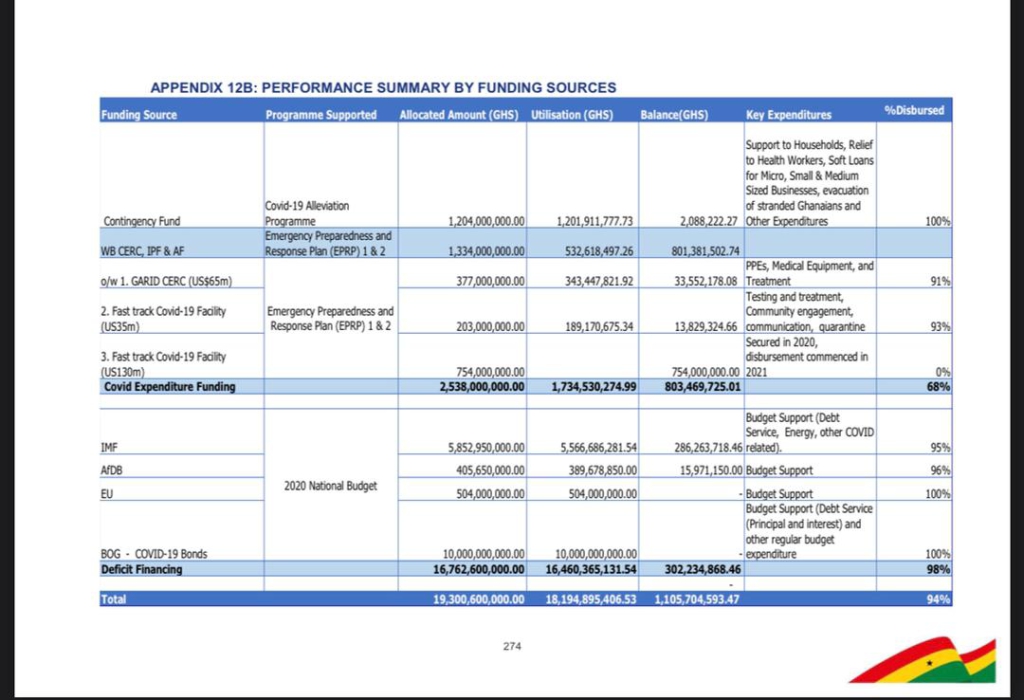
Government says it spent ¢19 billion on the fiscal impact of Covid-19, however, Joy News checks from the 2021 budget have revealed that government spent ¢1.7 billion on the pandemic.
The said amount covered relief to health workers, soft loans for Micro, Small, Medium Enterprises (MSMEs), evacuation of stranded Ghanaians, support to household, and other expenditure.
Appendix 12 A and B of the 2021 budget on Coronavirus Alleviation Program (CAP) shows that even though ¢2.5 billion was approved to support households, relief to health workers, soft loans for micro, small and medium enterprise, ¢1.7 billion was utilised.
The document has further revealed that ¢16.4 billion out of the ¢19 billion (budgeted for Covid-19 expenditure) was spent on deficit financing.
Meanwhile, government has introduced some new levies and taxes to cover up for cost of incentives introduced at the initial stage of the pandemic.
Government through the 2021 budget statement and economic policy proposed new taxes on petroleum products, 1% Covid-19 Health Levy on VAT Flat Rate Scheme and 1% on the National Health Insurance Levy (NHIL) as part of revenue measures to help the economy recover from the effects of the global pandemic.
Information Minister, Kojo Oppong Nkrumah, has explained that the move is to help stabilise the economy without engaging in more borrowing from other countries.
"The reality is that the gap between expenditure and income is widened. That widening has been compounded by Covid-19 and we are at a point where we have to make a choice to either continue to let that gap widen, if we do, we may get to a point where our economy cannot pay for basic services its debt, pay wages and salaries and do things that prior to 2016 we found ourselves doing and so the government has to take a responsible decision that we have to close this gab," he said.
The Ofoase Ayeribi MP added, "We need to get our people to understand that at some point at some point we have to get out of this economic conundrum in which we find ourselves.
"To do that, we cannot instantly borrow our way out of our problems. Domestic Resource mobilisation has to be tweaked and it has to be done in a way that you can raise resources without over burdening the people."
Latest Stories
-
Photos: Speaker Bagbin Commissions MPs constituency office under parliamentary decentralisation programme
8 minutes -
Black Stars technical advisor Winfried Schäfer sacked as GFA shakes up backroom staff
12 minutes -
Wenchi water project almost complete, critical to gov’t agenda – GWL MD
29 minutes -
Anti-LGBTQ+ bill not part of government’s legislative agenda – Inusah Fuseini
31 minutes -
Anti-LGBTQ Bill: Forget the rumour mongers, I’m a man of action, and will pass the bill – Speaker
1 hour -
Women and children among those killed in Sudanese army shelling of wedding celebration
1 hour -
President Mahama is not sincere with Ghanaians on LGBTQ bill matter – Hassan Tampuli
2 hours -
Gov’t to establish Prison Industrial Hub to equip inmates with income-generating skills – Prison Service boss
2 hours -
Alhassan Tampuli donates cement, roofing sheets to support storm victims in Gushegu
2 hours -
Alhassan Tampuli appeals for urgent support for storm victims in Gushegu
2 hours -
The hypocrisy must stop; pass Anti-LGBTQ+ Bill now – Alhassan Tampuli to Mahama
2 hours -
Imprisonment should be rehabilitative, not punitive – Ghana Prisons boss at UNGA
2 hours -
Ga Adangbe traditional priests petition Mahama over McDan aviation licence revocation
3 hours -
Anti-LGBTQ Bill: NDC’s arrogance is worrying – Hassan Tampuli
3 hours -
Let’s give OSP time to mature, not to scrap it – Hassan Tampuli
3 hours