

Audio By Carbonatix
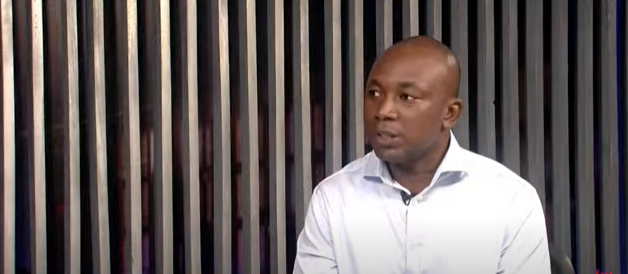
Economist and Professor of Finance, Prof Godfred A. Bokpin, has stated that the government's incessant imposition of taxes is a lazy approach to raising revenue, essentially leaving citizens financially repressed.
Speaking on Newsfile on JoyNews, he explained that although no one is against raising more money to support the economy, Ghanaians are feeling the pinch of paying new taxes introduced unpredictably.
"This is state-sponsored robbery. This is robbery that leaves the citizens financially repressed. It should not be accepted. I think in Ghana, we have allowed too many wrongs in this country," he noted.
Prof Bokpin said that it is important to explore optimal ways of raising revenue without compromising the ability of households to meet their needs and the private sector to remain competitive.
"Nobody can tell us that the only way out is to impose more taxes and taxes, as we have done. The more we impose taxes, the real effect in scaling up or our tax revenue to GDP ratio is not seen," he told the host, Samson Lardy Anyenini.
"This is a small open economy. We have more than 27 different tax handles. That is not the only thing. If since 2020 the taxes we have imposed, if you estimate the compliance cost to the taxpayer, it’s huge, configuring systems virtually every six months, there is no predictability," Prof Bokpin said.
The Economics lecturer said that the government should work harder to generate revenue for the people it aims to build the economy for.
"Are we not building it (economy) for Ghanaians? Are we not building it for Ghanaian private-sector businesses? What happens if by the time we achieve macroeconomic stability, half of Ghanaians have gone into poverty and have no way of reversing that? What economy is that? At the centre of it all are people and businesses."
"The banking sector spends millions of dollars to configure their system to allow the charging of E levy. Check the manufacturing sector, they pay so much and disruption to their production line just to fix their tax stamp or something. Virtually every six months, there's some level of disruption to planning, and to the production process. My considered view is that what Ghana is doing is not taxation," he added.
In January 2024, the government requested the Ghana Revenue Authority (GRA) to liaise with the two power distribution companies to transfer Value Added Tax (VAT) generated from consumers who have exceeded their lifeline power consumption.
In a press release, Finance Minister, Ken Ofori-Atta directed that the Electricity Company of Ghana (ECG) and the Northern Electricity Distribution Company (NEDCO) work with GRA to implement VAT on households that have consumed power above the maximum consumption level specified for block charges for the lifeline unit effective January 1, 2024.
On January 19, the Secretary-General of the Trades Union Congress (TUC), Dr Yaw Baah, said that labour cannot accept the imposition of the 15% Value Added Tax on lifeline electricity consumers as it is inimical to workers' welfare.
He wondered how the government thought it wise to further yoke the suffering worker, despite all the hardship, with the new tax.
"This country called Ghana, and all the resources we have, now the government doesn’t see anywhere else to tax; they are taxing our electricity also. Tomorrow they will tax our water, and we are not going to sit down for that to continue. That’s why I’m saying you are going to have a baptism of fire; we need to fight it until this thing is cancelled," Dr Baah said.
Latest Stories
-
Manhyia South constituents demand apology from EOCO over attempt to ‘unlawfully’ arrest MP
2 minutes -
Twelve women have been killed in one part of South Africa since July. Here’s what we know so far
5 minutes -
OMJ Foundation commits to supporting transport, safety and livelihoods of commercial riders in Akuapem South
8 minutes -
The Reciprocity crisis: Why Ghana welcomes British Professionals while the UK relegates ours
8 minutes -
GNAT rejects gov’t fresh assurances, demands implementation of August 31 agreement
18 minutes -
Gabriel Tanko Kwamigah-Atokple appointed Patron of NDC UK and Ireland Aldershot Branch
23 minutes -
Bawumia engages Ghana Medical Association on health workforce and licensing concerns
26 minutes -
SEC shuts down Nyak-City Hostels over unlicensed investment scheme
28 minutes -
The Ladder Project engages 60 UPSA student leaders on leadership and Ghana’s next chapter
30 minutes -
National Investment Quiz: St. Augustine’s, Prempeh College advance to semi-finals
35 minutes -
Leadership is about responsibility, not titles – Sammi Awuku tells UPSA students
37 minutes -
National Investment Quiz: Corpus Christi, Wesley Girls, advance to semi-finals
41 minutes -
Phone dealer murder: 3 suspects remanded as court adjourns Teshie case
44 minutes -
Seamless Technologies CEO Calls for Strategic AI adoption to transform Ghana’s financial services sector
47 minutes -
Cargill, ICI equip 111 youth with vocational skills to tackle child labour
48 minutes