

Audio By Carbonatix
Ghana is a country of extraordinary human energy. Its markets open before dawn. Its streets fill with people moving purposefully towards something: a job, a client, a school, a livelihood.
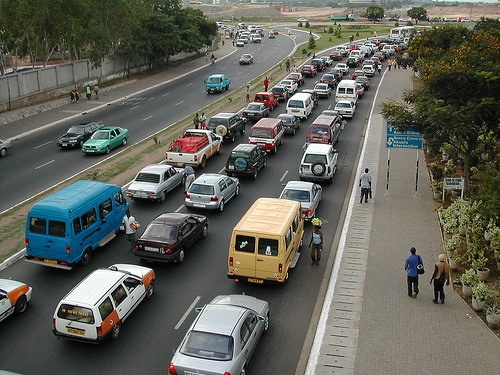
That energy deserves a city infrastructure equal to it. Instead, Accra has become a place where the act of moving through the city consumes the very productive capacity that movement is supposed to unlock.
A nurse who leaves home at four-thirty to reach a hospital twenty kilometres away by seven is not inefficient. She is being failed by a system that has grown faster than the governance designed to manage it. Accra’s traffic crisis is not a story about roads.
It is a story about the gap between a rapidly urbanising city and the institutional will to govern it well. That gap now costs the national economy many billions every year.
The scale of what is being lost is no longer a matter of anecdote. A February 2026 policy brief by Glima Research, titled The Cost of Gridlock, calculated that congestion costs Ghana’s urban economy an estimated GH₵4.5 billion annually.
Time lost in traffic accounts for GH₵3.2 billion, representing 71 per cent of total losses. Fuel waste adds GH₵434 million, and stress-driven productivity decline contributes a further GH₵815 million.
Preventable idling produces approximately 73,000 metric tons of excess carbon dioxide emissions annually, the environmental equivalent of eliminating the benefit of three million trees. Accra is not merely inconvenient. It is measurably, expensively, and avoidably broken.
The Scale of the Problem
The Greater Accra Metropolitan Area is home to more than four million people with a daily influx of 2.5 million business commuters, according to WHO Urban Health Initiative data. The metro area population stands at approximately 2.79 million as of 2025, growing at 2.46 per cent annually, whilst the broader Greater Accra Region recorded 5.46 million residents at the 2021 census.
Traffic congestion on Accra’s arterial routes is severe enough that 70 per cent of major roads operate below 20 kilometres per hour at some point during the day, a level of service that transport engineers formally classify as unacceptable.
On the Madina to 37 Military Hospital corridor alone, congestion-induced fatigue reduces effective daily productivity by approximately 30 minutes per commuter, translating into an annual output loss of GH₵72.8 million for that single route.
The Kwame Nkrumah Interchange at Circle, rebuilt as a three-tier structure to replace the original roundabout handling over 84,000 vehicles daily from its arterial roads, remains a chokepoint despite that intervention. The N1 highway, the city’s primary arterial corridor, is punctuated by traffic lights that prevent it from functioning as the expressway its design implies.
Traffic congestion is conservatively estimated to cost approximately 8.21 per cent of Ghana’s GDP, a figure that places it not in the category of urban inconvenience but of national economic emergency. Every new residential development in East Legon, Pokuase, Amasaman, or Ashaley Botwe adds commuters to roads never designed for them.
The Kasoa to Mallam Road corridor already handles over 50,000 vehicles per day at certain points, whilst 270,000 vehicle trips are made into or out of the Accra central area on a typical weekday, according to the Department of Urban Roads.
The North: Pokuase, Lapaz, and the N6 Corridor
The northern approaches to Accra, running through the N6 corridor via Lapaz, Achimota, Pokuase, and Amasaman, carry some of the city’s most intense morning congestion as residents of expanding dormitory communities funnel southward towards the central business district.
The Pokuase Interchange, completed in 2021 as the largest four-tier interchange in West Africa through African Development Bank co-financing, was a genuine achievement. But an interchange without complementary public transport creates capacity only to fill it. New vehicle ownership absorbed the efficiency gains faster than planners anticipated, and the corridor remains deeply congested during all peak hours.
The long-term solution in the north requires decentralisation of economic activity as much as road expansion. If Pokuase, Lapaz, and Achimota develop sufficient employment and commercial anchor points to retain their populations during working hours, the southward surge diminishes structurally.
This demands a deliberate zoning policy incentivising businesses to locate in northern Accra, backed by reliable utilities and commercial infrastructure. A formalised, timetabled feeder bus network must be enforced as a public service obligation, giving residents a genuine alternative to private vehicle use before they enter the congested corridor.
The South: Tema, the Motorway, and the Coastal Corridor
The southern approaches, comprising the Accra to Tema Motorway, the Teshie Link Road, the Spintex Road, and the La Beach Road corridor, carry the combined burden of Tema’s industrial traffic, East Legon’s residential volumes, and the commercial flow of the Accra to Tema axis, among the most economically significant corridors in Ghana. Spintex Road is among the most severely congested arteries identified by the Glima Research report, facing gridlock conditions comparable to or worse than the Madina to 37 corridor during peak hours.
The Flowerpot interchange flyover at Spintex, at 58 per cent physical completion as of 2023, will improve north-south motorway access when finished. But the fundamental constraint remains: infrastructure projects move in years while the population grows in months.
The long-term solution in the south is the full operationalisation of the Accra to Tema Motorway as a signal-free expressway with limited, well-spaced entry and exit points. Traffic lights on a motorway bleed the corridor of throughput daily.
The coastal route must anchor a coherent east-west mass transit corridor. A properly designed Bus Rapid Transit system, not the Quality Bus Service that launched in 2016 without dedicated bus lanes and could not escape the congestion it was meant to circumvent, but a genuine BRT with physically separated busways, off-board fare collection, and high-frequency service, would transform the commuter experience on this corridor entirely.
The West: Kasoa, Mallam, and the N1 Western Corridor
West Accra and its extension into Kasoa represent some of the most dramatic population growth in the Greater Accra Metropolitan Area, as affordability pressures push residents into Dansoman, Weija, Gbawe, and across the Kasoa interchange into the Central Region. The Mallam to Kasoa corridor is explicitly identified in the Glima Research report as one of the worst-affected gridlock routes in the country.
The junction between the N1 and the roads feeding Dansoman, Odokor, and Kaneshie remains chronically overwhelmed during peak hours, generating standstill congestion that makes the journey from Kasoa to the central business district a two-hour ordeal on routes that should take forty minutes.
The western corridor’s long-term solution requires the Obetsebi Lamptey Circle interchange, approved for a three-tier design but persistently delayed, to be completed and integrated with a western BRT feeder route connecting Kasoa and Weija commuters to rapid transit.
Park-and-ride facilities at Weija and Mallam Junction would reduce through-traffic entering the N1 substantially. The political will to restrict private vehicle access on inner-city roads during peak hours, a measure deployed successfully in London, Nairobi, and Bogotá, must form part of this package.
The East: Adenta, Madina, and the N4 Corridor
The north-eastern corridor, covering Madina, Adenta, Ashaley Botwe, Nanakrom, and the Adenta to Dodowa road, has undergone land use transformation from farmland to dense residential and commercial development at a pace that has thoroughly outrun its road infrastructure. The Glima Research report’s primary case study was the Madina to 37 corridor because it exemplifies how this quadrant has become the most productivity-damaging in the city.
The Department of Urban Roads has acknowledged that land use changes in Ashaley Botwe and School Junction have made it difficult to meet residents’ infrastructure demands. The Adenta to Dodowa road, earmarked for dualisation, remains undualised on critical stretches, while the Tetteh Quarshie to Madina to Aburi N4 route carries volumes its original design cannot accommodate.
The long-term eastern solution requires mandatory traffic impact assessments before large-scale residential development proceeds in Adenta, Ashaley Botwe, or Nanakrom, a requirement applied inconsistently at best.
The N4 corridor needs a dedicated mass transit lane serving Legon, Madina, and Adenta, integrated with a University of Ghana campus shuttle that removes thousands of private trips daily. The Adenta to Dodowa dualisation must be completed, and smart adaptive traffic signals deployed at key intersections as an immediate measure.
The Systemic Solution: Decentralisation, Mass Transit, and Land Use Reform
The four-corridor analysis points to one structural failure: Accra is a monocentric city whose central business district pulls the entire population towards it twice daily. No road-building programme alone resolves this. Bogotá solved its crisis through a world-class BRT system, land use reform, and a political commitment to public transport over private vehicle convenience. Kigali has managed comparable scale with genuine mass transit integration. Accra must absorb these lessons rather than repeatedly rediscovering the limits of road expansion.
The immediate requirement is a fully funded, legally mandated BRT network with dedicated physical lanes on the N1 and across all four cardinal corridors, operated by a professional transport authority independent from political interference. The 2008 BRT project failed because institutional alignment across multiple agencies was insufficient, a lesson that must not be repeated. A congestion pricing mechanism on private vehicles entering the central business district during peak hours would reduce demand whilst generating revenue for BRT operating costs.
In the longer term, decentralisation of government offices, universities, hospitals, and commercial anchors to northern, western, and eastern subcentres is the structural antidote to monocentrism. The Glima Research report recommends developing secondary commercial hubs in Tema, Kasoa, and Ashaiman to absorb growth that currently concentrates congestion in the capital. Every institution relocated from the central business district reduces the gravitational pull generating the morning surge.
Accra’s traffic crisis is not a commuter inconvenience. It is a daily tax on the productivity, health, and dignity of millions of people, costing GH₵4.5 billion a year, poisoning the air with 73,000 metric tons of preventable carbon emissions, and consuming irreplaceable hours of human life that no administration can return to its citizens once they have been lost.
The solutions are well known. The financing instruments, including the African Development Bank, the World Bank, and bilateral development partners, are available to any government that arrives with a credible, cross-administration plan. What has been missing is not ambition in speeches but institutional commitment in practice: the resolve to govern Accra as the city of the future it is already becoming, rather than managing it as the recurring crisis it has long been allowed to remain.
About the Author
Dominic Senayah is an International Relations professional and policy analyst based in England, specialising in African political economy, humanitarian governance, and migration diplomacy. He holds an MA in International Relations from the UK and writes on trade policy, institutional reform, and Ghana–UK relations for audiences across Africa, the United Kingdom, and the wider Global South.
Latest Stories
-
Afenyo-Markin demands Interior Minister brief Parliament over security recruitment expansion
23 minutes -
Felicia Boadu inspires gratitude with new song ‘Aseda’
31 minutes -
Conflict of interest and the President’s use of a private jet: A constitutional perspective
31 minutes -
Otto Addo names Black Stars squad for Austria and Germany friendlies
51 minutes -
Rev. Stephen Wengam urges leaders to embrace ‘servant leadership’ to transform national institutions
1 hour -
Ghana Development Awards spotlight need for intentional socio-economic transformation
1 hour -
The Private Jet Debate: When generosity becomes an alleged “Scandal”
1 hour -
IGP Cyber Vetting arrests 20-year-old woman for false publication on social media
1 hour -
Overall government debt in sub-Saharan Africa stabilises but at high level – IMF
2 hours -
We will file an appeal against Freddie Blay’s remand – Lawyer
2 hours -
Tema crash: Safety record of microlight aircraft ‘very poor’ – Aviation expert
2 hours -
Only 5% of CHPS compound in Ghana are well tooled – Agotime Ziope MP
2 hours -
PwC Ghana , UGBS call on women to embrace collaboration and take up leadership roles
2 hours -
‘My mother cried out one last time’: Palestinian boy, 12, describes how Israeli forces killed his family in car
2 hours -
National Seed System Reset Programme launched at University of Ghana to boost 24-hour economy
2 hours