

Audio By Carbonatix
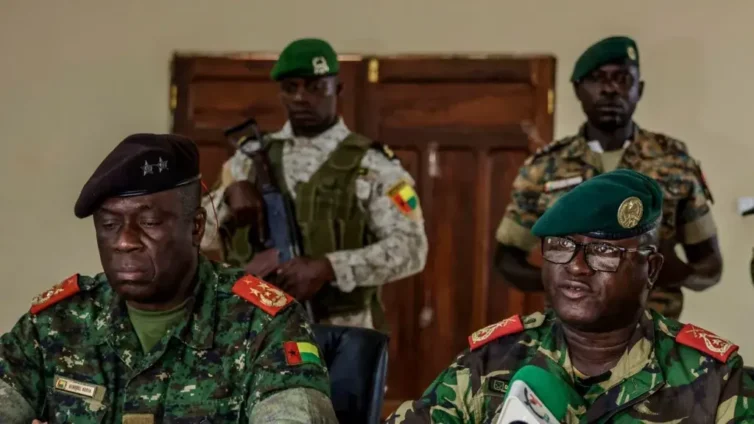
In the wake of Guinea-Bissau’s latest military takeover, the Global Security for Africa Research and Good Governance (GLOSARGG) has unveiled a comprehensive stabilisation blueprint aimed at steering the country away from recurring cycles of political upheaval, as stated in a press release dated Thursday, November 27, 2025.
The organisation’s Executive Secretary, Francis Ahovi, described the roadmap as a calibrated, multi-phase response designed to “arrest the drift, rebuild institutional legitimacy, and reinforce the nation’s democratic spine.”
His proposals, spanning short-term interventions to long-term structural reforms, call for an integrated effort by domestic actors and regional bodies such as ECOWAS and the African Union.
Short-term stabilisation (0–12 Months)
Mr Ahovi emphasised the need for an inclusive transitional architecture capable of restoring public trust while containing security risks.
“We’re looking at a transitional arrangement over the next six to twelve months,” he noted, “aiming for a civilian-led interim authority that includes everyone.”
He further proposed a Security Oversight Mechanism to prevent factional confrontations. “We must ensure redeployments are managed professionally to keep clashes at bay,” he stated.
On combating the entrenched narcotics economy, long seen as a catalyst for instability, he called for intensified cooperation with international partners. “We’ll be launching anti-narcotics financial operations with UNODC and EU partners, focusing on high-value networks,” he said.
To cushion citizens from the humanitarian fallout, he called for urgent scaling-up of relief efforts.
“A humanitarian scale-up is on the agenda to safeguard vulnerable populations and support displaced groups,” he stressed.
Medium-term reforms (6–24 months)
GLOSARGG’s plan places strong weight on depoliticising Guinea-Bissau’s security system.
“For security sector reform, we’ll focus on depoliticisation, civilian oversight, and professionalising command structures,” Mr Ahovi explained.
He urged constitutional clarity to curb executive overreach. “We’ll set clear limits on executive powers—including dissolution, decree authority, and appointments,” he added.
To strengthen electoral credibility, he proposed institutional upgrades. “We must update the register, establish an independent electoral commission, and create a judicial fast-track for disputes,” he said.
Anti-corruption reforms also feature prominently in the roadmap. “Our measures will include asset recovery, transparent budgets, and stronger AML/CFT systems,” he affirmed.
Long-term prevention measures
Looking beyond immediate crisis management, Mr Ahovi highlighted initiatives aimed at inoculating the state against future coups. “We need structured training for civil–military relations anchored in upholding constitutional order,” he remarked.
Regional coordination also formed a core part of his recommendations. “We must enhance intelligence sharing and conduct joint border operations to combat trafficking,” he suggested.
He underscored the need for civic renewal and youth empowerment. “Civic education must reinforce democratic values, while youth livelihood programmes will help deter recruitment by disruptive elements,” he warned.
Strategic recommendations for ECOWAS and the AU
Mr Ahovi called on regional bodies to adopt more assertive and predictable mechanisms.
“ECOWAS and the AU should form a rapid stabilisation force to address crises promptly,” he proposed.
He also urged the adoption of uniform penalties for anti-democratic actions. “We need automatic, criteria-based sanctions for any unconstitutional actions taken by individuals, including presidents,” he stressed.
To sustain monitoring and transparency, he recommended a new multi-partner oversight platform.
“We must establish a permanent joint monitoring commission—ECOWAS, AU, UN, CPLP—with public reports every 90 days,” he said.
Finally, he called for deeper intelligence collaboration to disrupt financing pipelines behind coup plots.
“It is imperative that we boost intelligence cooperation to tackle illicit financing and coup plotting,” he concluded.
Latest Stories
-
The truth about doing business in Ghana — Jacob West CEO Michael Kyei-Ayensu shares experience
11 minutes -
From UK losses to Ghana gains: CEO of Jacob West Limited Michael Kyei-Ayensu details real estate journey
40 minutes -
Over 1,000 Kenyans enlisted to fight in Russia-Ukraine war, report says
54 minutes -
Robert Mugabe’s son arrested in South Africa on suspicion of attempted murder
1 hour -
Minority rejects Security and Intelligence Agencies Bill, cites ‘excessive executive powers’
1 hour -
Islamist militants accused of killing 34 in raids on Nigerian villages
1 hour -
DVLA commissions new premium service centre in Kumasi to better serve customers
1 hour -
BoG warns of downside risks to cedi as a result of dividend payments
1 hour -
Consumer spending posted mixed performance in 11 months of 2025 – BoG
2 hours -
Wa District Magistrate Court convicts three for unlawful possession of firearms and ammunition
2 hours -
There is no governance gap at Defence Ministry – Kwakye Ofosu
2 hours -
Mahama to appoint Defence Minister ‘at the right time’ – Government
2 hours -
GRA boss donates to Mahama Cares
2 hours -
Education Ministry warns of severe consequences for assault on teachers
2 hours -
Absence of substantive Defence Minister a strategic risk – Amankwa-Manu
2 hours