

Audio By Carbonatix
Barely two weeks after returning as President, John Dramani Mahama and the National Democratic Congress (NDC) face an uphill task to fulfil a major election promise they made to the Zongo community.
Throughout the election campaign, President Mahama and the NDC made fees for the annual Hajj pilgrimage a major campaign issue, with a promise to drastically reduce what they described then as exorbitant fees of GHȼ75,000, charged by the Hajj Board, under the New Patriotic Party (NPP) government.
At the recent Muslim thanksgiving service following his election, President Mahama reiterated the promise to drastically reduce the fare, as he announced the setting up of an interim Hajj Task Force, headed by MP, Collins Dauda.
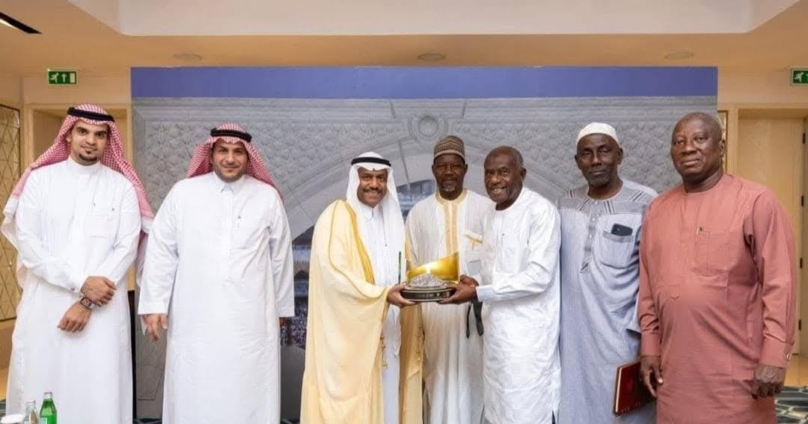
The interim Hajj Task Force, in its first assignment, participated in the 2025 Hajj Conference in Saudi Arabia, and seized the opportunity to engage with Saudi authorities and Hajj service providers.
Following the task force's engagements in Saudi Arabia with airline and transport operators, as well as food and accommodation providers, which are said to be the main component of Hajj services which consume the fees, reality has now set in, as the Collins Dauda-led task force has realised the true and total price package per pilgrim won't be too far from the existing Hajj fare.
A source from the Hajj Task Force, who disclosed the situation on strict condition of anonymity, said that with the prices quoted, the government would have to pay a heavy public subsidy for each pilgrim if Mahama's promise is to be fulfilled.
"We had the opportunity to engage with Saudi authorities and service providers during our visit and I can tell you that, from our analysis of figures quoted, each pilgrim, realistically will have to pay close to what already exists, or even more," the source said.
"The only way out for the government and the President to be able to fulfill his promise of significantly reducing the Hajj fare is for the government to heavily subsidise each pilgrim by at least $2,000 and considering the numbers involved, this is a lot of money and a big headache. Otherwise, we cannot do it and they will have to pay the realistic fee for us to start the processes," the source added.
According to the source, this new reality is being discussed between the task force and the new government for a decision to be taken before the 2025 Hajj price is announced.
With the Mahama government facing an imminent huge government subsidy to be able to fulfill its electoral promise, the source further that an alternative would be for the government to consider cutting down the number of Ghanaian pilgrims from the allocated 6,000 by signing up for 4000, or fewer "in order to reduce the amount of subsidy."
The new Hajj Task Force has already signed an MoU with Saudi Arabia to confirm the participation of Ghanaian pilgrims in this year's Hajj.
Hajj is an annual pilgrimage to Mecca, Saudi Arabia, which every Muslim, who can afford it, is enjoined to undertake, at least once in their lifetime.
Following the recent global economic crisis, Hajj fees worldwide have become expensive, with prices prior to the Covid-19 pandemic doubling around the world.
The then opposition NDC made a huge capital out of it, with the NDC and President Mahama promising a "drastic reduction" if it won power.
Hajj fares in neighbouring countries
Meanwhile, checks in some neighbouring West African countries have revealed that their Hajj prices are not entirely different from what Ghanaian pilgrims paid last year.
In Nigeria, the Nigerian Hajj Commission has announced 10 million Naira (about $6,000) as fare for this year's Hajj, which is almost the same as last year.
According to a BBC report three months ago, Nigeria's Federal Government announced it would not offer government subsidies for the 2025 Hajj, meaning each pilgrim would have to pay close to 10 million Naira.
In neighbouring Ivory Coast, which has a huge Muslim population, pilgrims paid 3.24 million CFA francs (about $5,500) for last year's Hajj, and the government announced last week that the fee would remain the same because of the "magnanimity" of President Allassane Ouattara.
Gambians are paying about 500,000 Gambian Dinar, which is equivalent to nearly $7,000. In November last year, the country's Minister for Lands and Religious Affairs announced the price would remain the same for this year.
Latest Stories
-
24-Hour Economy not just talk — Edudzi Tamakloe confirms sector-level implementation
18 minutes -
Four arrested over robbery attack on okada rider at Fomena
20 minutes -
NDC gov’t refusing to take responsibility for anything that affects Ghanaians – Miracles Aboagye
46 minutes -
Parental Presence, Not Just Provision: Why active involvement in children’s education matters
1 hour -
24-Hour economy policy fails to create promised jobs – Dennis Miracles Aboagye
1 hour -
Ghana Embassy in Doha urges nationals to take shelter after missile attack
2 hours -
Government’s macroeconomic stability commendable, but we need focus on SME growth – Victoria Bright
2 hours -
Macro stability won’t matter without food self-sufficiency- Prof. Agyeman-Duah
2 hours -
How Virtual Security Africa is strengthening safety at Mamprobi Polyclinic
2 hours -
Ghana on right track macroeconomically, but structural gaps remain – Fred Dzanku
2 hours -
ADB MD honoured for impactful leadership at PMI Ghana engagement
2 hours -
Bringing Ofori-Atta’s photo to Parliament and displaying it was unfair – Afenyo-Markin
3 hours -
Minority leader calls 24-Hour economy policy more PR than practical solution
3 hours -
Afenyo-Markin accuses government of using anti-corruption drive to target opponents
3 hours -
GPL: Kotoko announce new board of directors
4 hours