

Audio By Carbonatix
A former United Nations governance advisor, Prof. Baffour Agyeman-Duah, has warned that Ghana’s recent macroeconomic gains will count for little unless the Mahama administration takes bold steps to achieve food self-sufficiency.
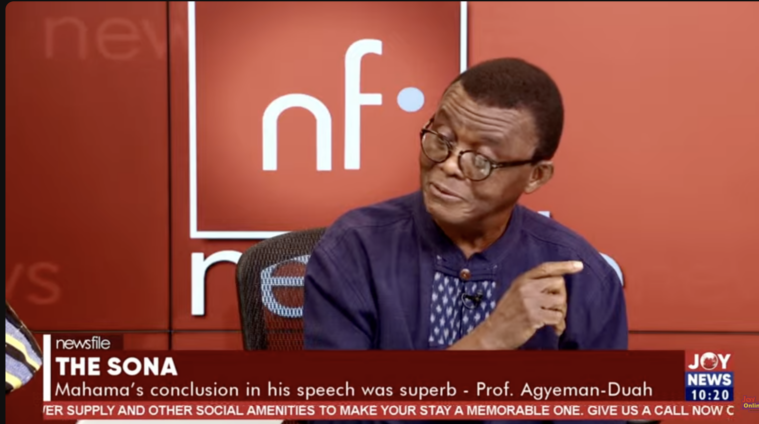
Speaking on Newsfile the morning after President Mahama’s 2026 State of the Nation Address, Prof. Agyeman-Duah, who previously championed the “Feed the Nation” initiative, said he is awaiting decisive policies to ensure Ghana can produce its own staple foods.
“I am waiting anxiously to see concrete and aggressive policies for self-sufficiency in the food that we eat — tomato, plantain, pepper, cereals. If we can do that, most of the other problems we can control,” he said.
In 2024, Ghana spent GH¢38.95 billion on imported food, with grains, meat, cereals, sugar products, and fish making up more than half of all food imports, according to the Ghana Revenue Authority.
While the country exports raw commodities, it continues to import processed foods that could theoretically be produced domestically, highlighting structural gaps in the agricultural sector.
Prof. Agyeman-Duah noted that cultural perceptions also contribute to the challenge, with many Ghanaians associating imported foods with higher quality and prestige, reducing demand for local produce even when it is competitively priced.
The Mahama administration has taken steps to address the problem.
In April 2025, the government launched the “Feed Ghana” programme, aiming to reduce the country’s dependence on imported food through mechanised farming, smart agriculture, and strengthened value chains, focusing on maize, rice, and poultry. President Mahama highlighted a “staggering $2 billion” annual food import bill and pledged to promote local production.
But Prof. Agyeman-Duah argue that intent alone is insufficient. Implementation, infrastructure, and institutional coordination must match the ambition if Ghana is to truly transform its agricultural sector.
“My point is simple. Let us begin to look at how we change the structure of the economy,” he emphasised, urging the government to turn policy into tangible action.
Latest Stories
-
Former ‘American Idol’ contestant sentenced to life without parole for wife’s murder
4 minutes -
Education Ministry commends Ghanaian teachers on World Teachers’ Day 2026
25 minutes -
NPP can reconcile with aggrieved members who want to return – Nana Akomea
38 minutes -
Tamale Child Deaths: Vehicle owner arrested as IGP deploys homicide team
53 minutes -
From ShattaFest to MoMo Fest: Entertainment takes centre stage in youth engagement
59 minutes -
Nigerian military aircraft crashes, killing 32
1 hour -
MTN encourages Ghanaians to use MoMo for saving, investing and financial planning
1 hour -
Absa Bank Ghana names Stephen Ato Frimpong as Board Chair
1 hour -
Pickford ‘almost caused crash’ with careless driving
1 hour -
Author and former politician Jeffrey Archer dies aged 86
1 hour -
No education reform can succeed without teachers – Education Ministry
2 hours -
Gauff condemns racist abuse after China Open win
2 hours -
Medvedev disqualified for hitting spectator with ball
2 hours -
Oliseh scores twice in late comeback win for France
2 hours -
Pentagon stops using Anthropic AI tools after blacklisting company, BBC told
2 hours