

Audio By Carbonatix
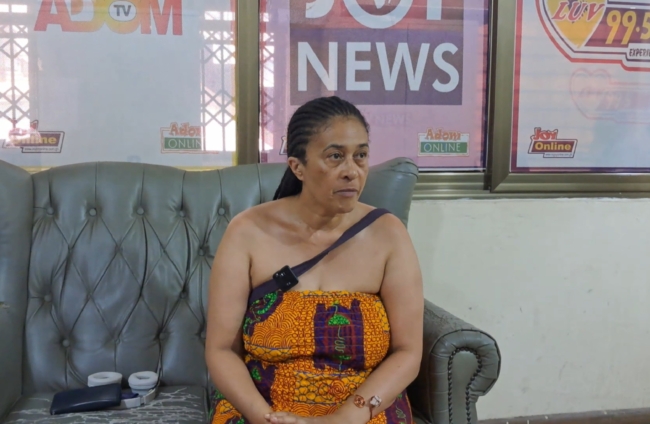
A 54-year-old woman, Afua Kesse-Amponsah, has spoken publicly for the first time about what she describes as decades of “systematic abuse” at the hands of her father, a man who later became a prominent church pastor.
“I’ve managed to find a voice, and it was not easy. I had to suffer,” Ms Kesse-Amponsah said.
Born in 1971 to an Irish mother and a Ghanaian father, she said her life took a dark turn at the age of two when her father took custody of her, allegedly motivated by a desire to secure a passport and social benefits, despite what she describes as his dislike for children.
According to her account, she was subjected to constant violence as her father attempted to force her to switch from being left-handed to right-handed.
“So he started to beat me because he was trying to get me to change from left-handed to right-handed. Akan people don’t like using their left hand. Am I lying? It’s all built into you from childhood. And so for him, it was a crime.
“One that he was determined to fix. It was a fault. And he broke my left hand first to try and persuade me to use it.”
She alleges that the abuse escalated over time, resulting in extensive injuries.
“He subjected me to constant, severe, chronic violence, and I had no idea how bad it was because he fractured my skull. So I lost my memory.
“I had amnesia as a result. I have multiple fractures to the skull, a split around my head, a broken nose, broken cheekbones, a broken jaw, six cracks along my spine, a fracture at the back by my tailbone and pelvis, and a fracture in the front. My leg came out — the thigh bone broke, the two bones here broke, and the ankle fractured. The sternum broke.”
Ms Kesse-Amponsah said she also suffered internal bleeding and ulcers after being forced to ingest powdered aspirin on an empty stomach to conceal swelling from broken limbs.
“So he would feed me aspirin, which was in powdered form in water at night after he’d beaten me. That would take down the inflammation, and no one would see that the bone was broken. It burns the inside of my stomach because he was feeding it to me without me eating. I have ulcers throughout my body. Sores inside me. I’ve been bleeding internally since I was five.”
She later received treatment at St Thomas’ Hospital for Complex Post-Traumatic Stress Disorder (CPTSD), a severe mental health condition arising from repeated interpersonal trauma.
“I started being treated at St Thomas’ for complex post-traumatic stress disorder. It is a lifelong condition. I suffer from flashbacks. I live in the seventies. I have no life of my own.”
Ms Kesse-Amponsah said she reported the alleged abuse to UK police as a historical child abuse case, but was informed that no prosecution could proceed because her father is deceased.
“I did report it to the police as a historical allegation of child abuse. They told me they couldn’t do anything because he was dead, but it is on record. They advised me to go after the institutions that failed in their duty of care — namely the schools I attended, the council that was supposed to be looking after me, the government, basically.”
Now living with severe disabilities at 54, she says she is using her voice to challenge cultural norms around discipline, particularly within Ghanaian communities.
“You get kids, and you’re abusing them. You’re raising your hand to them. Who are you? Look at your own life.
“Don’t do that ‘spare the rod’ stuff, because we’re in 2025. Child abuse exists. That book was written 15, 20 hundred years ago. It does not apply to today.
“A human being is a human being and has rights, whether it’s a baby or an adult. We need to start treating our children with more respect and restraint. Yes, you can discipline your child, but you can do that without beating them. You’re treating them as you would treat dogs — and the way you treat dogs is not acceptable either. You’re too violent against things that are smaller than you and can’t fight back.”
Ms Kesse-Amponsah is now focusing on holding schools and public institutions accountable for what she describes as a “failure in duty of care”, arguing that the safety nets designed to protect vulnerable children did not function when she needed them most.
Latest Stories
-
A source of excellence across generations – Vice President Opoku-Agyemang lauds Mfantsipim
42 minutes -
(Photos) Mfantsipim School launches historic 150th anniversary
1 hour -
Knights and Ladies of Marshall group backs Catholic Bishops’ stance on anti-LGBTQ+
2 hours -
Bright Simons writes: All the Filla in the Ibrahim Mahama/E&P – Gold Fields Saga
2 hours -
Monetise Idiocy In Ghana
3 hours -
The Ghanaian prophet and the mysterious death of his scottish wife Charmain Speirs
3 hours -
Nearly 400 sentenced in Nigeria for links to militant Islamists
4 hours -
Ghana’s recovery supported by gold strength despite global oil price pressures – Standard Bank Research
4 hours -
Methodist Church hails Mfantsipim@150; calls for “fresh consecration” to excellence
4 hours -
‘Excellence is our inheritance’ – Nana Sam Brew-Butler hails Mfantsipim’s 150-year reign in leadership
4 hours -
Kwaku Azar writes: A-G vs OSP
4 hours -
Mfantsipim–Adisadel rivalry built excellence, not division – Sam Jonah
5 hours -
Vice President launches Mfantsipim’s 150 years of shaping Ghana’s greatest mind
5 hours -
I assure Otumfuo, Mahama will join him to commission KNUST Teaching Hospital by end of this year – Haruna Iddrisu
6 hours -
Barcelona dominate derby to extend La Liga lead
6 hours