

Audio By Carbonatix
Books by pro-democracy figures have been removed from public libraries in Hong Kong in the wake of controversial new security law.
The works will be reviewed to see if they violate the new law, the authority which runs the libraries said.
The legislation targets secession, subversion and terrorism with punishments of up to life in prison.
Opponents say it erodes the territory's freedoms as a semi-autonomous region of China. Beijing rejects this.
Hong Kong's sovereignty was handed back to China by Britain in 1997 and certain rights were supposed to be guaranteed for at least 50 years under the "one country, two systems" agreement.
Since the security law came into effect on Tuesday, several leading pro-democracy activists have stepped down from their roles. One of them - one-time student leader and local legislator Nathan Law - has fled the territory.
At least nine books have become unavailable or marked as "under review", according to the South China Morning Post newspaper. They include books authored or co-authored by Joshua Wong, a prominent pro-democracy activist, and pro-democracy politician Tanya Chan.
On Saturday, Mr Wong tweeted that the new law "imposes a mainland-style censorship regime" on Hong Kong, calling it "one step away from ... actual book banning".
1/ More than just punitive measures, the national security law also imposes a mainland-style censorship regime upon this international financial city. Although my books are published years before Hong Kong's anti-extradition movement, they are now prone to book censorship. https://t.co/2fbyvtcH95
— Joshua Wong 黃之鋒 😷 (@joshuawongcf) July 4, 2020
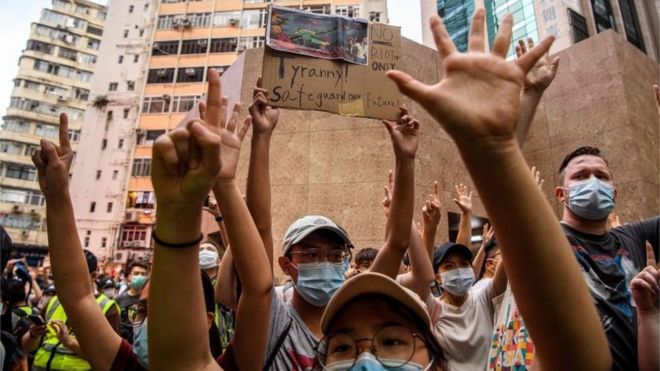
Beijing has dismissed criticism of the law, saying it is necessary to stop the type of mass pro-democracy protests seen in Hong Kong during much of 2019, which at times exploded into very violent clashes between protesters and police.
It has rejected complaints by the UK and other Western nations that it is in breach of guarantees it made to protect Hong Kong's unique freedoms as interference in its internal affairs.
What is the security law?
The law is wide-ranging, and gives Beijing powers to shape life in Hong Kong that it has never had before. The law makes inciting hatred of China's central government and Hong Kong's regional government offences.
It also allows for closed-door trials, wire-tapping of suspects and the potential for suspects to be tried on the Chinese mainland.
Acts including damaging public transport facilities - which often happened during the 2019 protests - can be considered terrorism.
There are also concerns over online freedom as internet providers might have to hand over data if requested by police.
Latest Stories
-
A source of excellence across generations – Vice President Opoku-Agyemang lauds Mfantsipim
9 minutes -
(Photos) Mfantsipim School launches historic 150th anniversary
32 minutes -
Knights and Ladies of Marshall group backs Catholic Bishops’ stance on anti-LGBTQ+
1 hour -
Bright Simons writes: All the Filla in the Ibrahim Mahama/E&P – Gold Fields Saga
2 hours -
Monetise Idiocy In Ghana
2 hours -
The Ghanaian prophet and the mysterious death of his scottish wife Charmain Speirs
3 hours -
Nearly 400 sentenced in Nigeria for links to militant Islamists
3 hours -
Ghana’s recovery supported by gold strength despite global oil price pressures – Standard Bank Research
3 hours -
Methodist Church hails Mfantsipim@150; calls for “fresh consecration” to excellence
4 hours -
‘Excellence is our inheritance’ – Nana Sam Brew-Butler hails Mfantsipim’s 150-year reign in leadership
4 hours -
Kwaku Azar writes: A-G vs OSP
4 hours -
Mfantsipim–Adisadel rivalry built excellence, not division – Sam Jonah
4 hours -
Vice President launches Mfantsipim’s 150 years of shaping Ghana’s greatest mind
4 hours -
I assure Otumfuo, Mahama will join him to commission KNUST Teaching Hospital by end of this year – Haruna Iddrisu
5 hours -
Barcelona dominate derby to extend La Liga lead
5 hours