

Audio By Carbonatix
For millions of people around the world, traditional medicine is the first place they turn when they are sick. From herbal mixtures in African markets to Indigenous healing practices passed down through generations, these systems have long supported health and survival.
Yet for decades, traditional medicine has remained on the margins of global health policy, with little funding, weak regulation, and limited scientific backing. That may now be changing.
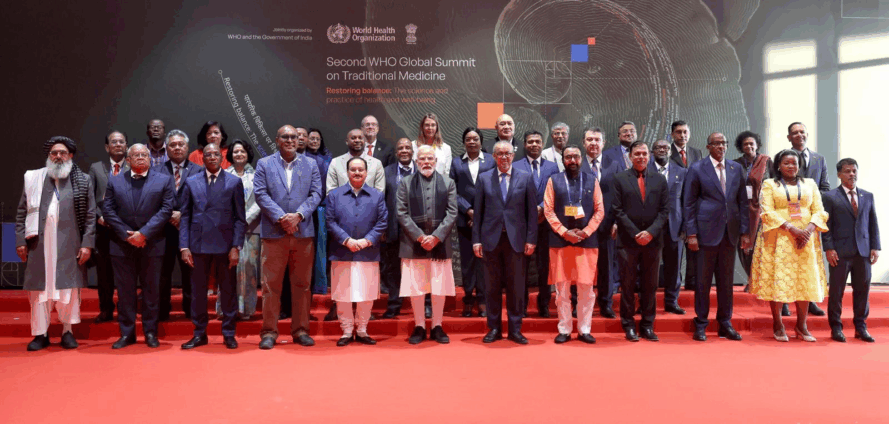
Leaders from over 100 countries met in New Delhi, New Delhi, for the Second World Health Organisation (WHO) Global Summit on Traditional Medicine.
The meeting ended with the Delhi Declaration on Traditional Medicine, a global commitment to bring traditional medicine into the heart of modern health systems — safely, ethically, and with strong scientific evidence.
Despite its widespread use, traditional medicine receives less than 1% of global health research funding. This has made it difficult to prove what works, what is safe, and how best to use these medicines alongside modern care.
In many countries, including Ghana, traditional healers operate with little research support and weak regulation, even though millions depend on them. The Delhi Declaration directly addresses this gap.
“Recognising that less than 1% of global-health research funding goes to traditional medicine, participants commit to expanding investments in traditional medicine research infrastructure, workforce, and scientifically robust, pluralistic and ethical research methods which incorporate whole-systems research, real-world evidence, and Indigenous and community-based methodologies,” the declaration said.
BUILDING STRONG EVIDENCE, NOT REPLACING TRADITION
The first major commitment focuses on strengthening research and evidence. Countries have agreed to follow the WHO’s global research roadmap for traditional medicine.
This means investing in laboratories, training researchers, and using ethical research methods that respect Indigenous knowledge and community rights.
The declaration recognises that traditional medicine cannot be studied only with Western scientific tools. It calls for whole-system research, real-world evidence, and community-based methods that reflect how conventional medicine is actually used in daily life.
There is also a strong emphasis on protecting biodiversity, cultural knowledge, and data ownership, so communities are not exploited as interest in traditional medicine grows. New digital tools, including artificial intelligence, are to be used responsibly.
“Generating evidence will focus on public-health priorities and rights-based research governance to safeguard biodiversity, cultural resources, data sovereignty and community rights, and the responsible use of digital technologies, artificial intelligence and scientific advances,” it stated.
To support this, countries will strengthen the WHO Global Traditional Medicine Library — a trusted global database for storing knowledge, protecting intellectual property, and supporting education and policy.
The second commitment focuses on regulation. Many people worry about fake products, unsafe mixtures, and untrained practitioners. The declaration responds by calling for stronger and fairer regulatory systems.
Countries have agreed to improve quality control, safety checks, and monitoring of side effects, while respecting the diversity of traditional systems. Governments are also encouraged to work together and share information, especially on safety risks.
For countries like Ghana, this could mean better oversight of herbal products, clearer standards for practitioners, and stronger public trust in traditional medicine.
The third and most ambitious commitment is integration. The declaration calls on countries to include safe and effective traditional medicine in national health systems, especially at the primary health care level.
This does not mean replacing hospitals or doctors. Instead, it promotes collaboration — where trained traditional practitioners work alongside nurses, doctors, and pharmacists. The focus is on patient safety, proper training, clear guidelines, and fair financing.
To support this, countries will improve data systems, using WHO tools such as the International Classification of Diseases (ICD-11) traditional medicine modules, so that conventional medicine can be appropriately recorded, monitored, and evaluated.
Participants commit to strengthening standardised data systems for traditional medicine, including the use of the WHO International Classification of Diseases (ICD-11) traditional medicine modules, the International Classification of Health Interventions (ICHI), and a global reference list of indicators to develop a minimum data set for conventional medicine.
Participants recognise the critical role of WHO as a data hub for systematic data collection, monitoring, evaluation and accountability at national, regional and global levels.”
The summit brought together ministers, researchers, healers, Indigenous leaders, and civil society — about 800 people in person and 20,000 online. They agreed that evidence-based traditional medicine is a living science and a shared cultural heritage, with a role to play in universal health coverage, stronger health systems, and sustainable development.
The Delhi Declaration builds on earlier global agreements and aligns with international laws on Indigenous rights, biodiversity, and intellectual property. It also reflects growing political attention within groups like the G20 and BRICS.
WHAT THIS COULD MEAN FOR COUNTRIES LIKE GHANA
For Ghana and many African countries, the declaration offers a rare opportunity. Traditional medicine is already widely used. What has been missing is strong research, proper regulation, and formal recognition.
If governments act on these commitments, traditional medicine could become safer, more trusted, and better integrated into health care — while protecting the knowledge and rights of the communities that have preserved it for generations.
The Delhi Declaration does not promise instant change. But it sends a clear signal that traditional medicine is no longer being treated as an afterthought. It is being recognised as part of the future of global health, rooted in culture, guided by science, and shaped by shared responsibility.
Latest Stories
-
Today’s Front pages: Tuesday, April 7, 2026
1 minute -
President Mahama praises GWL MD Adam Mutawakilu over Damongo Water Project progress
3 minutes -
Ghana–China Forum explores zero-tariff trade opportunities
21 minutes -
What is wrong with us?: A quiet truth we can no longer ignore
34 minutes -
What is wrong with us? : When sirens become symbols of power rather than protection and emergencies
53 minutes -
Businesses scramble to get noticed by AI search
1 hour -
From perk to performance: Why employee wellness must be a core business strategy
1 hour -
Bank of Ghana’s $1.3bn profit from gold sale could help narrow 2025 losses
2 hours -
Odau Twafohene Baffour Osei Afrifa appointed Regent of Akyem Chia
2 hours -
We are focused on engineering low interest rate regime – BoG Governor assures
2 hours -
How Sporting hero Gyokeres could end European run
2 hours -
The attack on Ghanaian traders in Burkina Faso and the blame game: Why Hybrid Security Governance Holds the Key (II)
2 hours -
Bayern face waiting game on ‘very special’ Kane
2 hours -
The Problem with Nutrition Advice on Social Media – Lessons from a study among University Students
2 hours -
Arteta calls for perspective as Arsenal look to avoid slump
2 hours