
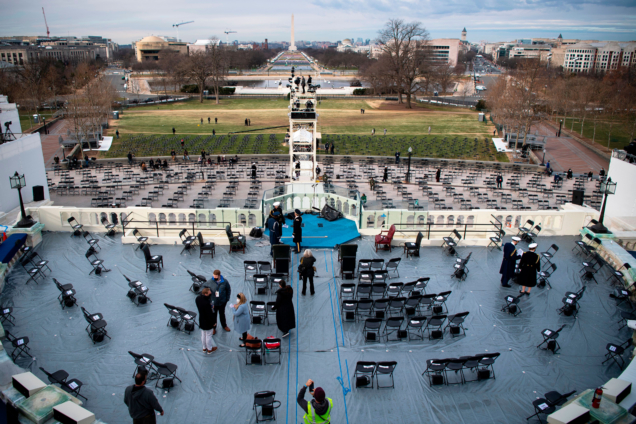
A view is seen at the US Capitol during the dress rehearsal in advance of the Inauguration of US President-elect Joe Biden at the US Capitol in Washington, DC on January 18, 2021. - The Inauguration is scheduled for January 20, 2021. (Photo by Caroline Brehman / POOL / AFP) (Photo by CAROLINE BREHMAN/POOL/AFP via Getty Images)

Audio By Carbonatix
Joe Biden's inauguration as the 46th president of the United States will be unusual this year due to the coronavirus pandemic and security concerns, but it will still be an inauguration.
Here are some key things to know about how inaugurations work in the US:
- What's actually required to make someone president? None of the pageantry — inaugural balls, inaugural parades, inaugural luncheons — is laid out in the Constitution. All you need to swear in a new president, now that the electoral votes have been counted, is for Biden to say these words, which are written in the Constitution, at noon on Jan. 20: "I do solemnly swear (or affirm) that I will faithfully execute the Office of President of the United States, and will to the best of my ability, preserve, protect and defend the Constitution of the United States."
- Who swears in the new president? Usually, the chief justice of the US Supreme Court administers the oath, but that's a custom, not a requirement. If the chief justice isn't available, it can be another judge. Calvin Coolidge's dad, a justice of the peace, gave his son the oath in the family living room in Vermont after Warren G. Harding's death. The only woman to deliver the oath of office to a president was Sarah Hughes, a federal district judge in Texas, who was called onto Air Force One after JFK's assassination to make Lyndon B. Johnson president.
- Does the president have to put his hand on a Bible? Most presidents have employed Bibles. Former President Barack Obama used two at the same time. But that's a custom. Theodore Roosevelt didn't use one.
- Is Biden required to give an inaugural address? There's not technically any need for an inaugural address, although every elected president has given one. Some are short (George Washington's second was 135 words) and some are long (William Henry Harrison's was more than 8,000 words and the lore is he caught a cold while giving it and died of pneumonia a month later). It's a valuable custom for a new president to use the address to lay out their agenda and move on from what may have been a bruising campaign.
DISCLAIMER: The Views, Comments, Opinions, Contributions and Statements made by Readers and Contributors on this platform do not necessarily represent the views or policy of Multimedia Group Limited.
DISCLAIMER: The Views, Comments, Opinions, Contributions and Statements made by Readers and Contributors on this platform do not necessarily represent the views or policy of Multimedia Group Limited.
Latest Stories
-
Catholic Bishops say moral values must match economic priorities in Anti-LGBTQ+ debate
17 minutes -
IGP Yohuno urges merit and hard work ahead of Police Academy exams
29 minutes -
Queendalyn Yurglee releases debut album ‘Clouds of Glory’
1 hour -
UDS moves to clear MPhil student wrongly linked to robbery case
1 hour -
Vodza Regatta 2026: Prof Audrey Gadzekpo rallies investors for coastal tourism growth
1 hour -
Introduction of 100 new Metro Mass buses won’t affect transport unions – GPRTU
1 hour -
Deputy Transport Minister backs Yellow Line traffic initiative
2 hours -
MTN Ashanti-Fest music concert set to hit Kumasi on Saturday
2 hours -
Authorities probe discovery of dead fish at Tema shipyard
2 hours -
Minority welcomes fuel tax cuts, demands accountability for GH¢1 levy
2 hours -
It remains a priority — Sam George on Anti-LGBTQ bill
2 hours -
Police arrest Nigerian national seen in viral videos wearing police uniforms
2 hours -
Free golf training empowers underprivileged girls in Accra
2 hours -
Why SIGA’s reset is not a market sin, but a national necessity
2 hours -
SIGA Directive: Beyond the theatre of institutional displacement
3 hours