

Audio By Carbonatix
The fundamental human rights of Ghanaian fishing communities, such as the right to adequate food and decent work, are being threatened by the government’s failure to tackle overfishing and illegal fishing by industrial trawlers, a new report by the Environmental Justice Foundation (EJF) has revealed.
The study draws on primary data collected in five fishing communities in the Central Region of Ghana where the country’s marine fisheries provide livelihoods for around 2.5-3 million people along the value chain or around 10% of the population.
Small-scale fisheries employ around 107,500 fishermen – 80% of all fishers in Ghana – with an additional 500,000 individuals engaged in processing, distribution and marketing of fish throughout Ghana, including many women.
These communities are a vulnerable and marginalised group, and urgent measures must be taken by the Ghanaian government to ensure their basic human rights are upheld, as required under international law.
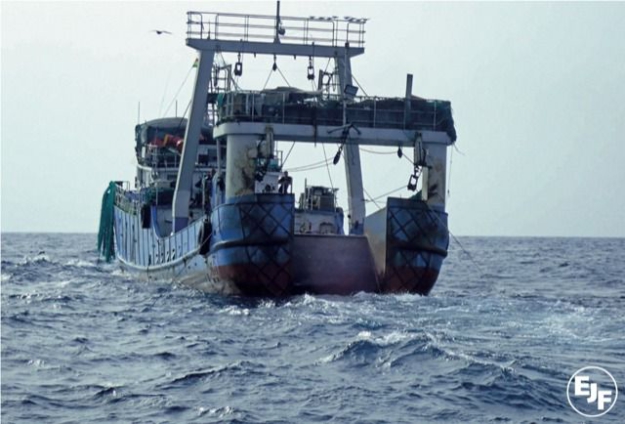
Ghana’s fish populations are in steep decline as a result of severe overcapacity trawl fleet combined with the illegal practice of Illegal Transhipment of fish at sea (saiko) – where industrial trawlers illegally target the staple catch of small-scale fishers and transfer it to specially adapted boats at sea – is driving the collapse of Ghana’s inshore fishery.
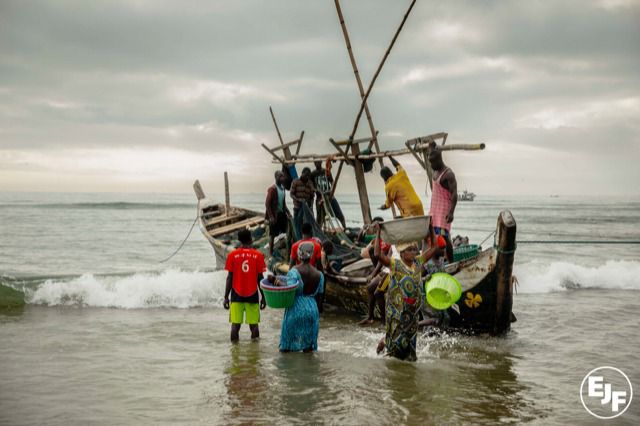
This puts the food security and income of millions of Ghanaians into jeopardy.
The new report shows that the basic human rights of Ghana’s fishing communities, including the right to adequate food, adequate standard of living and just working conditions, are under threat.
Over half the 215 small-scale fishers, processors and traders EJF spoke to reported going without sufficient food over the past year. This was especially severe among the processors and traders, the vast majority of whom are women.
Over 70% of respondents also reported a deterioration in their living conditions over the past five years, with incomes falling below the level necessary for a decent living, leaving them unable to cover basic needs.
Local fishers are increasingly having to compete with industrial vessels to survive, traveling further and further out to sea in search of catches. This puts both the fishers and the fishing equipment on which they depend, at risk. Around 70% of the fishers surveyed had suffered damage to their fishing gear by industrial trawlers.
The report stops short of stating that mismanagement of the fisheries sector by the Ghanaian government has caused a violation of fundamental human rights but calls for urgent investigation into this matter.
In failing to prevent trawling companies from violating the right to work of small-scale fishers and workers it is unclear whether Ghana is meeting its minimum obligation under international law to protect the human rights that would enable this marginalised group to live a life of dignity.
Other essential human rights, such as access to clean drinking water, education, sanitation, medical services, and social security are also under threat, the report found. While these issues are less closely related to the decline of the fishing industry, they also require swift and effective government measures to ensure the rights of small-scale fishers and their communities.
These communities rely almost entirely on fish and fishing for their survival, and at present, there are very few alternative livelihoods available to these people, an issue compounded by low school completion rates. Approximately 15-20% of children in the survey had never completed primary school, the report found.
Steve Trent, CEO and founder of the Environmental Justice Foundation, said:
“The fundamental human rights to decent work and an adequate standard of living are under threat in Ghanaian fishing communities. The government must account for and remedy any infringements of these rights.
"Alongside action to ensure sustainability and environmental security, the government of Ghana must adopt a rights-based approach to fisheries management, which prioritises the needs of vulnerable small-scale fishing communities who make up the majority of fish workers in the country yet are often marginalised in decisions concerning their livelihoods.
"Improving governance of the sector through enhanced transparency; ending illegal fishing; reducing fleet capacity; reforming subsidies; and the development of realistic alternative livelihoods for fishing communities are all key steps that must be taken immediately.
"The planned reform of Ghana’s fisheries law framework provides an opportunity to establish a clear and unequivocal legal basis to respect, protect and fulfill the human rights of small-scale fishing communities while ensuring environmental security and sustainability.”
The Environmental Justice Foundation is an international non-governmental organisation working to protect the environment and defend human rights.
Latest Stories
-
Government launches rCOMSDEP to promote responsible mining in Western Region
45 minutes -
Foreign Affairs Ministry procures 20 pickups to improve passport services
50 minutes -
Oil prices retreat as investors weigh supply outlook, Middle East tensions
58 minutes -
Mahama Ayariga highlights Jimi reclamation project as effort to tackle flooding
1 hour -
Ayine pushes duty-lawyer scheme to protect suspects at police stations
1 hour -
Fire at GRIDCo’s Mallam Substation cuts power to parts of Accra
1 hour -
Stephen Amoah criticises 20% digital services tax as excessive
1 hour -
Ghana secures $3.5bn investment commitments to revive oil and gas sector – Jinapor
1 hour -
Court to hear Wontumi’s bail application today
1 hour -
DPC flags six companies for data protection breaches
1 hour -
Chief Justice appointment from outside Supreme Court possible but unlikely – Bentil
1 hour -
NEDCo replaces faulty transformer at Saasigli
2 hours -
Dr Seidu Jasaw urges climate financiers to align funding with farmers’ planting seasons
2 hours -
Bank of Ghana urges public to uphold dignity of local currency
2 hours -
Global Chairman of World Assemblies of God Fellowship lauds Mahama’s sterling leadership
2 hours