

Audio By Carbonatix
Some 1,685 "seriously ill" inmates have been released from one of the most notorious prisons in the Democratic Republic of Congo in the latest move to tackle overcrowding.
The release began at Makala Prison in the capital, Kinshasa, on Sunday.
It was there, at the beginning of this month, that 129 prisoners died in an attempted jailbreak. Some were shot dead by security forces while others were killed in a crash, officials said.
The government pledged to speed up its plans to decongest the prison, where conditions have been described as "true hell".
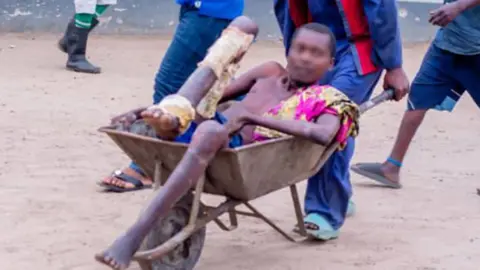
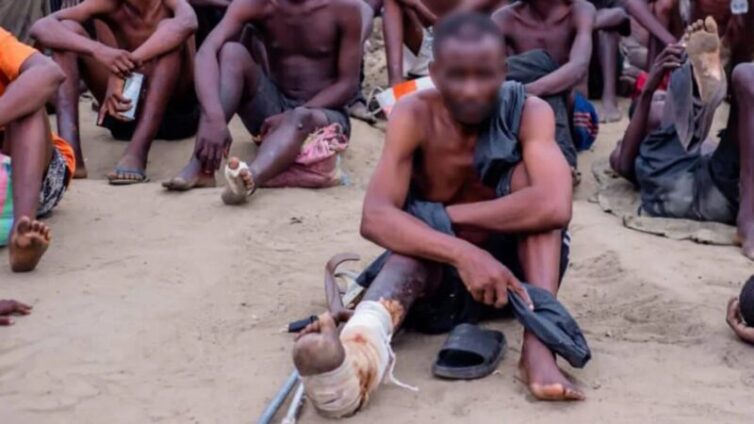
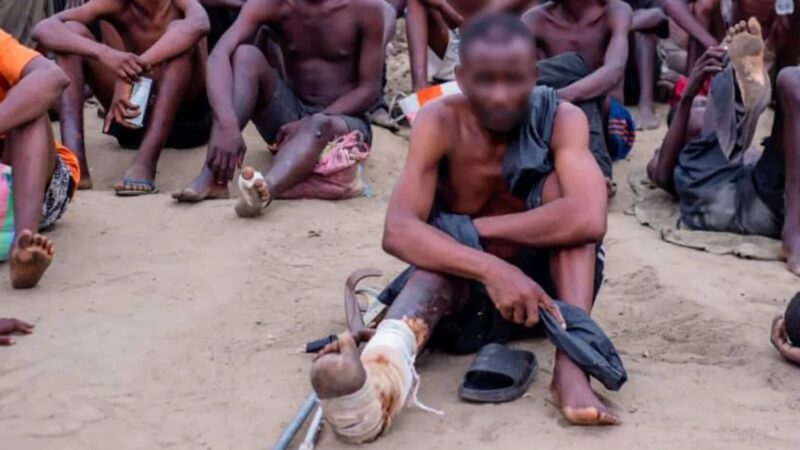
Some of the inmates identified for release can be seen in a series of images published on the justice ministry's Facebook page.
In one, an emaciated-looking man with dirty bandages around his right foot and below the knee is being pushed in a wheelbarrow.
In another, showing dozens of men all appearing malnourished, one of those in the foreground has an open wound.
In a video, a prisoner, who seems unable to stand up, is shouting that he is going to change his life and no longer cause pain to others. He also praises the official responsible, Justice Minister Constant Mutamba.
Mutamba said that those who needed medical attention would be treated while others would be sent home on buses provided by the government, the AP news agency reports.
The minister had already ordered the release of hundreds of others from Makala as he tries to get the prison population down. He has also banned the transfer of new inmates to the prison.
With a population of at least 14 million people, Kinshasa has two jails. In addition to Makala, the military prison of N’dole has an official capacity of 500.
Emmanuel Adu Cole, head of the Bill Clinton Foundation for Peace, a local NGO that focuses on prison conditions, welcomed the release but added that more needed to be done to address the problems inside.
The jail, which was built in the 1950s, has a capacity for 1,500 inmates, but before this month's attempted jailbreak it was holding at least 12,000 people, according to various estimates.
One former inmate told the BBC that conditions inside were "true hell".
“Makala is not a prison, but a detention centre resembling a concentration camp, where people are sent to die,” Stanis Bujakera said.
Videos that he secretly filmed inside showed how tightly packed everyone was, as well as the inadequacy of the daily rations.
The authorities have long acknowledged the overcrowding problem.
Some officials have blamed magistrates for sending suspects to prison. In 2020, it was estimated that only 6% of the prisoners were actually serving sentences - the rest were stuck in DR Congo's legal system where cases can drag on for years.
Latest Stories
-
Damang takeover: There is not going to be any job loss; it is a lease change – Bobby Banson
19 minutes -
Gold Fields didn’t stop mining at Damang mines; such claims are untrue – Bobby Banson
22 minutes -
Engineers and Planners currently operate only in Ghana – Bright Simons
39 minutes -
Lands Minister has no legal basis to restrict lease to Ghanaian firms – Bright Simons
44 minutes -
Gov’t’s refusal to renew Gold Fields’ lease was simply untenable – Bright Simons
47 minutes -
SOS Children’s Villages Ghana deepens partnership with Gender Ministry
1 hour -
Gender Ministry celebrates Christina Koch, reaffirms commitment to empowering girls
1 hour -
Live stream: Newsfile digs into E&P’s takeover of Damang Mines, OSP powers and Anti-LGBTQ Bill
1 hour -
Moody’s maintains Ghana’s rating at Caa1, revises outlook to positive
2 hours -
Zambia elevates tourism education to national priority as President Hichilema backs continental summit
3 hours -
Activa promotes credit insurance to boost SME export growth
3 hours -
ILTM Africa 2026 opens doors to inbound and outbound luxury travel in Cape Town
3 hours -
“BP Soul Travel and Tours scored the highest marks” – Sports Minister Kofi Adams endorses agency for World Cup travel
3 hours -
‘At the age of 12, I was teaching people and collecting money from them’ – Forty Under 40 Awards
4 hours -
I broke my virginity at the age of 26 after university – Richard Abbey Jnr.
5 hours