


Audio By Carbonatix
Ghana's former President, John Mahama has expressed his condolences to the government and people of Japan.
This follows the assassination of the country's former Prime Minister, Shinzo Abe.
According to him he is 'greatly shocked' by the news.
In expressing his condolences, Mr. Mahama said Shinzo Abe's legacy will be "remembered fondly by Ghana, Africa and the world at large for a long time to come".
In a Facebook post on Friday, Mr. Mahama recounted his moments with the former leader, describing him as "a leader passionate about opening up Japan's role on the world stage, inclusive of expanding Japan-Africa relations".
"I recall our last meeting in May of 2016, which led to the official publication of the restoration of the Yen loan portfolio to Ghana and the announcement of Japan's commitment to assist Ghana with a number of important new and ongoing projects", he added.
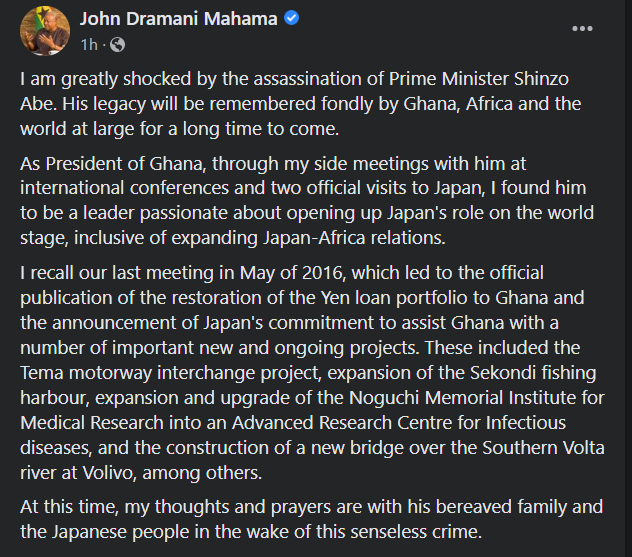
John Mahama continued: "These included the Tema motorway interchange project, expansion of the Sekondi fishing harbour, expansion and upgrade of the Noguchi Memorial Institute for Medical Research into an Advanced Research Centre for Infectious diseases, and the construction of a new bridge over the Southern Volta river at Volivo, among others".
Mr. Mahama said "At this time, my thoughts and prayers are with his bereaved family and the Japanese people in the wake of this senseless crime".
Background
According to the BBC, Japan's former prime minister, Shinzo Abe died in hospital after he was shot at a political campaign event.
Mr. Abe was shot at twice while he was giving a speech on a street in the city of Nara on Friday morning.
Security officials at the scene tackled the gunman and a 41-year-old suspect who is now in police custody.
The suspect, named as Tetsuya Yamagami, admitted shooting Abe with a homemade gun, and said he had a grudge against a "specific organisation", police said.
Several other handmade weapons, similar to those used in the attack, had been confiscated after a search of the suspect's house, police officers told a news conference.
Explosives were also found at the home and police said they had advised residents to evacuate the area.
The suspected shooter told officers he had a grudge against a specific group he believed Abe was connected to, police said, adding that they were investigating why the former PM was targeted out of other people related to the group.
Asked by a member of the Japanese media whether the gunman's intention was to kill Abe, police say only that Mr Yamagami admitted to shooting the former PM.
Prime Minister Fumio Kishida condemned the attack, saying: "It is barbaric and malicious and it cannot be tolerated."
This attack was "an act of brutality that happened during the elections - the very foundation of our democracy - and is absolutely unforgivable," Mr Kishida said, speaking before Abe's death was confirmed.
Abe suffered two bullet wounds to his neck during the attack, and also suffered damage to his heart, doctors said.
He was said to be conscious and responsive in the minutes after the attack, but the 67-year-old's condition deteriorated.
Doctors said no vital signs were detected by the time the former prime minister was transferred for treatment.
Abe received more than 100 units of blood in transfusions over four hours, before he was pronounced dead at 5.03pm local time (0803 GMT).
Abe was giving a speech for a political candidate at a road junction in the southern city of Nara when the attack happened.
Witnesses saw a man carrying what they described as a large gun fire twice at the former PM from behind. Abe fell to the ground as bystanders screamed in shock and disbelief.
Abe had a security team with him, but it appears the gunman was still able to get within a few metres of Mr Abe without any sort of checks or barrier.
Photos circulating in the aftermath of the shooting showed the suspect standing just behind Mr Abe as he gave his speech.
Security officers dived onto the attacker, who made no attempt to run, and seized his weapon.
Local reports say he is a former member of Japan's Maritime Self-Defense Force, Japan's equivalent of a navy. He is said to have left active service in 2005.
Abe's speech was part of a campaign for his former party, the Liberal Democratic Party, as upper house elections in Japan are due to take place later this week.
Ministers across the country were later reportedly told to return to Tokyo immediately.
On Japanese social media, the hashtag "We want democracy, not violence" was trending, with many social media users expressing their horror and disgust about the incident.
Latest Stories
-
GES orders SHS heads to refund unauthorised fees collected from parents
5 minutes -
AFCON 2027Q: ‘We don’t need to cry over spilled milk’ – Damba on Ghana injury concerns
9 minutes -
NDC communicator blames documentation, payroll validation for teachers’ promotion arrears delay
11 minutes -
2026 JoyNews Impact Maker Award winner brings clean water to Yoko Tsume after years of cattle dugout dependence
17 minutes -
Sarkodie commends Mahama for rejecting US health compact
18 minutes -
‘The worst hate speech comes from NDC; enough of lip service, optics politics’ – Afenyo-Markin to Mahama
18 minutes -
Tree Crops Development Authority tightens regulation of tree crop trade, targets $10bn sector
19 minutes -
Ghana’s fiscal deficit to widen to 3.9% a year through 2029 – S&P
19 minutes -
‘It’s not a matter of evidence; it was a metaphor’ – Afenyo-Markin defends ‘drug lab’ comment
31 minutes -
Borrowing costs cut by more than half – Finance Minister
35 minutes -
KNUST students urged to look beyond Ghana for AI and robotics opportunities
37 minutes -
Odeibea Foundation extends energy equity initiative with solar streetlights in Akpato and Worwonyo
38 minutes -
Customs increases surveillance at ports, warns importers against concealing restricted items
41 minutes -
WERise urges women entrepreneurs to scale businesses, increase revenue and create jobs
42 minutes -
POWA calls for end to gendered attacks on Lordina Mahama, Samira Bawumia
47 minutes