

Audio By Carbonatix
Member nations approved the biggest resource injection in the International Monetary Fund’s history, with $650 billion meant to help countries deal with mounting debt and the fallout from the Covid-19 pandemic.
The creation of the reserve assets -- known as special drawing rights -- is the first since the $250 billion issued just after the global financial crisis in 2009, with Managing Director Kristalina Georgieva billing it as “a shot in the arm for the world” that will help boost global economic stability. The SDR allocation will be effective on Aug. 23, the IMF said in a statement Monday.
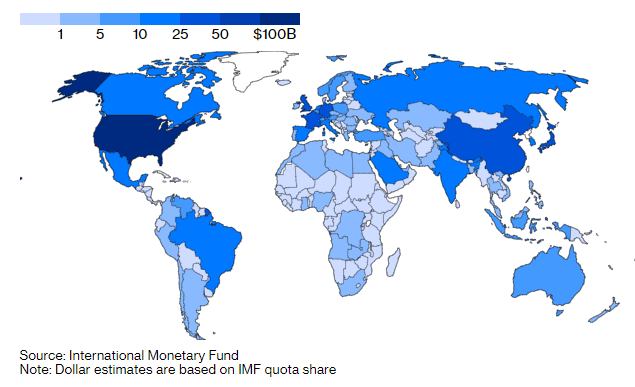
Reserves Infusion
IMF members are set to receive $650 billion in special drawing rights.
“The SDR allocation will benefit all members, address the long-term global need for reserves, build confidence, and foster the resilience and stability of the global economy,” Georgieva said. “It will particularly help our most vulnerable countries struggling to cope with the impact of the Covid-19 crisis.”
The guardians of the global economy have wrestled with the plan for more than a year. It was initially delayed when the U.S. -- the IMF’s biggest shareholder -- blocked it in early 2020. President Donald Trump’s Treasury Secretary Steven Mnuchin said that the funds wouldn’t get to the nations that most need it. Republican Representative French Hill called it a “giveaway to wealthy countries and rogue regimes” such as China, Russia and Iran.https://www.bloomberg.com/graphics/2020-coronavirus-dash/
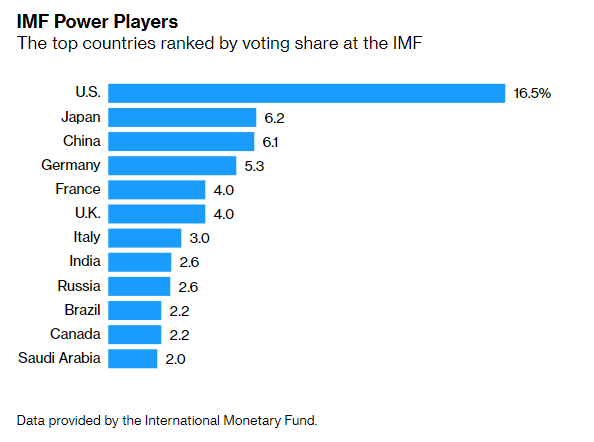
IMF Power Players
The top countries ranked by voting share at the IMF
The U.S.’s position changed under President Joe Biden and Mnuchin’s successor, Janet Yellen, and with the fund exploring options for members with strong financial positions to reallocate the reserves to support vulnerable and low-income countries. Still, a global allocation of $650 billion was about the maximum that the U.S. could support without needing to get approval from Congress.
Reserves are allocated to all 190 members of the IMF in proportion to their quota, and some 70% will go to the Group of 20 largest economies, with just 3% for low-income nations. Overall, 58% of the new SDRs go to advanced economies, with 42% for emerging and developing economies.
So of the $650 billion, about $21 billion go to low-income countries and $212 billion to other emerging market and developing countries, without counting China, according to U.S. Treasury Department calculations.
The Group of Seven advanced economies in June endorsed a plan to reallocate $100 billion of new SDRs to poorer countries, but the G-20 in July only specified support for a general allocation of $650 billion in SDRs, without detailing how much would be re-lent.
Reallocation will be crucial to help countries in Africa, for which only about $33 billion is earmarked in the SDR issuance. France has committed to reallocating part of its SDRs for countries on the continent.
South African President Cyril Ramaphosa has previously said that from the total allocation, about one-quarter -- equivalent to around $162 billion -- should be made available to African countries. He has called on rich nations to donate -- and not just on-lend -- their allotments.
Rich nations currently can use the IMF’s Poverty Reduction and Growth Trust to help channel reserves to low-income countries interest free. Fund staff also are working to set up the so-called Resilience and Stability Trust for redirecting new reserves to vulnerable low-middle-income countries and small island economies, an option that Georgieva has said she hopes will be established by year-end.
The fund will “continue to engage actively with our membership to identify viable options for voluntary channeling of SDRs from wealthier to poorer and more vulnerable member countries to support their pandemic recovery and achieve resilient and sustainable growth” Georgieva said in Monday’s statement.
More than 200 groups including the Jubilee USA Network, a non-profit organization that advocates for debt relief for developing countries, had called on the G-20 to support the creation of $3 trillion in SDRs, saying the funds are needed to help free up resources for health care and social spending.
“Developing countries need more aid to get beyond the crisis,” Eric LeCompte, the executive director of Jubilee USA Network, said in a statement late Monday. “Wealthy countries receive most of these emergency reserves and must donate them to developing countries.”
Latest Stories
-
51,000 teachers’ promotion arrears to be validated for October payment – Education Minister
26 minutes -
Kwabena Boamah appointed Board Chair for Impact Investing Ghana
33 minutes -
Striking teacher unions to meet Fair Wages and Salaries Commission on October 6
47 minutes -
EOCO working with AG to arraign Nana Baffour Awuah before weekend court
51 minutes -
Duraplast reassures customers after fire, announces October 5 reopening
59 minutes -
Call off strike, gov’t will not renege on promotion arrears pledge – Haruna Iddrisu appeals to teacher unions
1 hour -
Committee set up to validate teachers eligible for 20% deprived-area allowance – Education Minister
1 hour -
Five-member committee to search for new Black Stars coach after Sports Ministry-GFA meeting
2 hours -
Pinktober: Breast cancer survival exceeds 90% when detected early – Breast Society of Ghana
2 hours -
TCDA to adopt Upper West’s MATCO mango farm as northern prototype, issues warning against felling shea trees
2 hours -
‘Fear delegates’ tag: Afoko touts genuineness among delegates ahead of NPP delegates conference
2 hours -
John Boadu: The leader our party needs at this time – Amb. Edward Akwasi Boateng
2 hours -
Baffour Awuah: EOCO arrested, detained MP after hours of waiting, questioning – Afenyo-Markin
2 hours -
EOCO court warrant authorised search of Baffour Awuah’s law firm, not residence – Afenyo-Markin
3 hours -
NPP delegates conference: 3,000 to 4,000 police personnel deployed for security in Kumasi – Anthony Karbo
3 hours