

Audio By Carbonatix
The International Monetary Fund (IMF) says the world has almost won the battle against inflation, which reached its highest rate of 9.4 per cent in the third quarter of 2022.
“The battle against inflation is almost won; after peaking at 9.4 per cent year-on-year in the third quarter of 2022, we now project global headline inflation will fall to 3.5 per cent by the end of next year.”
Those were the words of Pierre-Olivier Gourinchas, IMF Chief Economist, who also noted that most countries were seeing their inflation rate within Central Banks’ targets.
The projected 3.5 per cent fall in inflation for 2025 is lower, compared with the 5.8 per cent that the Fund is predicting for 2024.
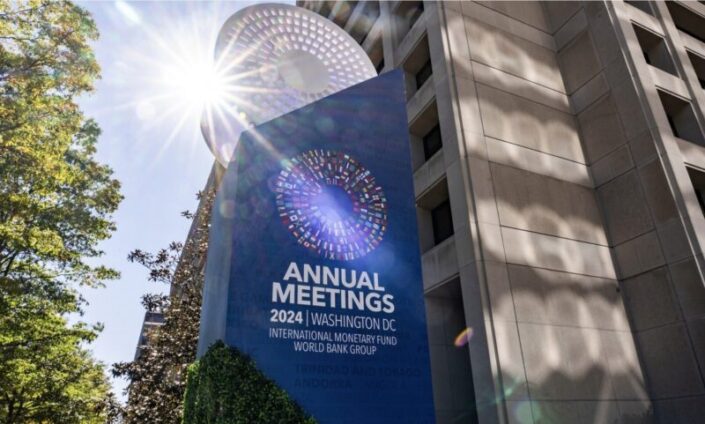
Mr Gourinchas said this at the release of the World Economic Outlook on Tuesday, October 22, in Washington, DC (USA), at the 2024 IMF/World Bank Group (WBG) Annual Meetings in Washington, DC (USA).
He attributed the slowdown in inflation without a significant recession to the resilience of the global economy, as growth was projected to be steady at 3.2 per cent for both 2024 and 2025,
The decline in inflation without a major recession is a major achievement. Much of the disinflation can be attributed to the unwinding of the unique combination of supply and demand shocks
Other contributing factors were improvements in labour supply, driven by immigration in many advanced countries, he said, adding that, “monetary policy played a decisive role in keeping inflation expectations.”
However, the IMF Chief Economist cautioned that risk remained going forward because of escalation in regional conflicts, which he said could be a serious setback to the commodity markets.
Again, undesirable trade and industrial policy shifts could also lower economic output, he said, noting that such risks could force tightening of global financial conditions, derailing the gains made.
“To mitigate these downside risks and to strengthen growth, policymakers now need to shift gears and implement a policy-triple-pivot,” Mr Gourinchas recommended.
The policy-triple-pivot included a careful easing of monetary policy rate, stabilisation of debt dynamics through fiscal policy and building buffers, and growth enhancing reforms.
He called for increased efforts in building trust between governments and citizens as well as corporate conversations, while further improving international collaborations to sustain the momentum on inflation easing and economic growth.
Latest Stories
-
Banks NPL ratio of 16.1% is still too high – S&P
19 minutes -
Guidelines, regulations of cryptocurrency in Ghana fall short of comprehensive oversight – IMF
53 minutes -
COCOBOD’S GH¢16.3bn SPV: Real progress toward a sustainable cocoa sector
1 hour -
Ghana lose Morocco friendly as Atlas Lions turn to Mali
3 hours -
2026/2027 GPL: Kelvin Nkrumah strike sends Medeama top of league table
3 hours -
Punish Manchester City this season, say other club chiefs
3 hours -
Emmanuel City crowned champions of maiden Global Game Scouting Tournament
3 hours -
MPship should not shield anyone from arrest – Felix Ofosu-Kwakye
4 hours -
Thomas Partey loses father Jacob Teye Partey
4 hours -
Gov’t rejects Baffour Awuah ‘kidnap’ claims, says EOCO officer was lawfully executing arrest
4 hours -
Martin Kpebu explains when EOCO can arrest Manhyia South MP after securing court warrant
4 hours -
EOCO’s reasons for seeking Manhyia South MP arrest warrant not justified – Kpebu
4 hours -
MTN Ghana warns SMEs against sharing PINs amid digital fraud risks
4 hours -
Yendi nursing students warn restricted access to skills lab could affect their training
4 hours -
Minority awaits formal notice of arrest warrant for Manhyia South MP – Annoh-Dompreh
4 hours