

Audio By Carbonatix
The world's advanced economies, including the UK and US, need to cut borrowing and reduce debt levels following weeks of spiralling government interest costs, the head of the International Monetary Fund (IMF) has warned.
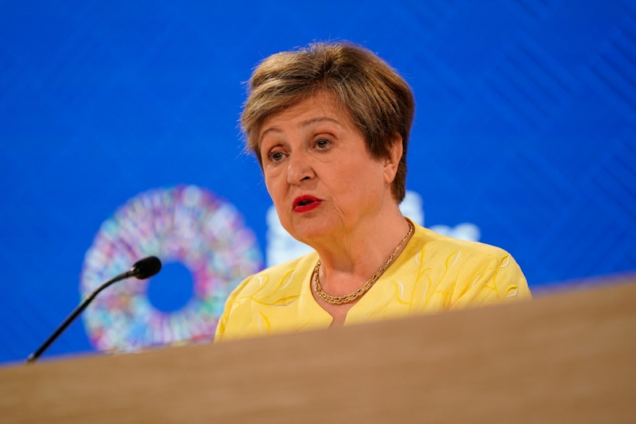
In an exclusive interview, Kristalina Georgieva said global economic shocks had been "pushing debt levels up like a staircase not to heaven" but that governments had taken "no action to contain that service cost".
"[It's] time to take that action," she said, adding that "courage" was needed by politicians to take the necessary steps.
The intervention comes as government borrowing costs have surged in response to wars that have disrupted oil supplies, fuelling inflation.
Higher global borrowing costs have hit the UK government ahead of UK Prime Minister Andy Burnham's first Budget next month, with speculation mounting over potential tax and spending policies.
The latest figures show borrowing - the difference between tax receipts and government spending - was £18.3bn ($24.4bn) in August, almost a fifth higher than the year before and higher than official forecasts. Meanwhile, debt interest for the month was the highest August figure since monthly records began in 1997.
Higher borrowing costs have also hit the US, the world's largest economy, whose debt has surpassed $40tn. The amount has doubled within the space of a decade, prompting concerns at home and abroad.
On the sidelines of the United Nations General Assembly, Georgieva said the IMF's message to advanced economies was that while there were economic factors occurring outside the control of governments, they did have command over domestic policies.
"There are these two things that must be done: bring debt levels down, put fiscal consolidation as a priority, and make sure that the central banks deliver on their mandate for price stability," she said.
"It is impossible to stress strongly enough how critical it is to get the courage to take the steps that are necessary. These are politically tough steps to take, but necessary steps to take."
Asked specifically about the UK's higher interest costs compared to other major economies, Georgieva said its position was "not very different" from others.
She pointed to "fairly consistent action" on lowering debt and praised planning and housing reforms, adding that advanced economies "don't have the cash" to boost growth and so had to rely on reforms to encourage the private sector to invest.
AI could present 'financial stability risk'
Governments around the world raise money by selling bonds - essentially an IOU - and in return pay interest to the investment funds that buy them.
Concerns over inflation eating away at returns has sent the interest rates on bonds - known as yields - higher in recent months.
But there are other factors pushing yields up, including increasing competition in the bond market from large tech companies looking to raise huge amounts of money to invest in artificial intelligence (AI) development.
On AI, Georgieva referenced recent concerns about loss of safe control over such systems as a potential financial stability problem, alongside debt levels.
"If we see more incidents when AI takes [on a] life of its own, then we can be faced with a significant financial stability risk," she said.
The IMF's managing director repeated the influential body's assessment that the global economy was affected by two forces "pushing in opposite directions" - the energy price shock and investment in AI.
She said it was important for the low exports of oil and gas from the Gulf "to resume in a durable manner, for the energy supply shock to finally be in the rearview mirror".
"That is a very significant step to normalisation," she said, but acknowledged it was yet to happen.
Latest Stories
-
UK Investment Roadshow opens in London to advance UK-Ghana growth partnership
5 minutes -
Assemblies of God requires pastors to resign before entering partisan politics – Rev. Wengam
15 minutes -
Ghana targets 20% annual reduction in maternal deaths – Health Minister
20 minutes -
Cyber attacks in Africa grow faster than global rate, report finds
22 minutes -
Ghana signs UAE deal to create 5,000 overseas jobs
29 minutes -
One Million Coders Programme targets 100,000 digital jobs in two years – Sam George
32 minutes -
John Jinapor, Italian Ambassador explore opportunities for energy sector investment
34 minutes -
NHIA seeks legal reforms to support Free Primary Healthcare
38 minutes -
Beatrice Annan defends Afi Agbenyo’s EC appointment, cites record of gender advocacy
41 minutes -
Ghana seeks investment deals in Bangkok amid global economic crises
45 minutes -
IMF raises Ghana’s 2026 growth forecast to 5.7%, sees inflation falling to 4.8%
47 minutes -
Ablakwa urges Africans not to view immigrants as threat to national progress
51 minutes -
Mahama Cares must fund treatment, not looting – Asogli chiefs
52 minutes -
Ghana’s economic salvation lies not in shifting geo-political allegiances – Dr Atuahene
55 minutes -
BoG proposes tougher rules on loan repayment assessment
60 minutes