

Audio By Carbonatix
The International Monetary Fund (IMF) has expressed worry about the continued build-up of liabilities across Ghana’s State-Owned Enterprises (SOEs) portfolio, with total aggregate liabilities reaching 25% of Gross Domestic Product (GDP).
According to the Fund, liabilities growth outpaces asset growth, rising from GH¢35 billion (19.0% of GDP) in 2015 to GH¢282 billion (about 25% of GDP) in 2024.
It said this rapid growth of liabilities compared to assets has heightened fiscal concerns.
It raised this issue in its Technical Assistance Report on Ghana titled “Advancing SOE Fiscal Risks Management, Financial Oversight, Governance and Investment Implementation".
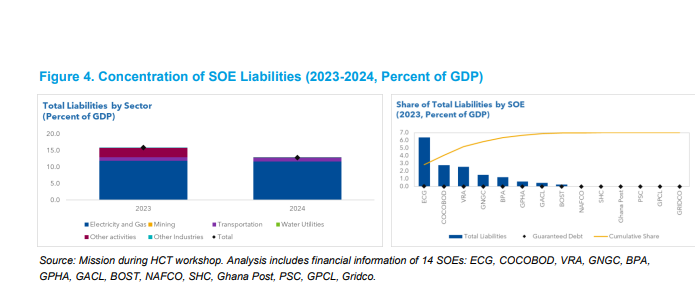
ECG alone accounted for GH¢71 billion of aggregated SOE liabilities (or 6.0% of GDP), making it the single largest contributor to the sector’s debt burden and a principal source of fiscal risk for the Government.
Other large entities such as VRA and GNPC also contributed significantly to the liability stock, underscoring a concentration of debt among a few highly leveraged SOEs.
SOEs Leverage Profile at Risk
The Fund also mentioned that SOEs’ leverage profile is particularly at risk because much of the debt is denominated in foreign-currency or carries implicit government backing.
According to the Bretton Woods institution, these factors create a key channel of fiscal and external vulnerability. “In parallel, the energy SOEs carry extensive obligations under power purchase agreements (PPAs), many of which are US dollar-indexed and backed by government guarantees, which magnify the foreign-exchange and refinancing risks and link the SOEs’ balance sheets closely to the sovereign’s own debt position”.
SOEs account for the largest share of assets and revenue among all specified entities in Ghana.
Among the specified entities reporting to State Interest and Governance Authority (SIGA), SOEs generated total revenue of GH¢133.7 billion (11.5% of GDP) in 2024.
The size of the SOE portfolio has broadly grown in line with the economy over the past decade, with total assets fluctuating around 34% of GDP and reaching GH¢395 billion in 2024.
The SOE liabilities have accumulated at a faster pace, rising from GH¢35 billion (19% of GDP) in 2015 to GH¢282 billion (about 25% of GDP) in 2024.
Latest Stories
-
Guidelines, regulations of cryptocurrency in Ghana fall short of comprehensive oversight – IMF
18 minutes -
COCOBOD’S GH¢16.3bn SPV: Real progress toward a sustainable cocoa sector
39 minutes -
Ghana lose Morocco friendly as Atlas Lions turn to Mali
3 hours -
2026/2027 GPL: Kelvin Nkrumah strike sends Medeama top of league table
3 hours -
Emmanuel City crowned champions of maiden Global Game Scouting Tournament
3 hours -
Thomas Partey loses father Jacob Teye Partey
3 hours -
Martin Kpebu explains when EOCO can arrest Manhyia South MP after securing court warrant
3 hours -
EOCO’s reasons for seeking Manhyia South MP arrest warrant not justified – Kpebu
3 hours -
MTN Ghana warns SMEs against sharing PINs amid digital fraud risks
3 hours -
Yendi nursing students warn restricted access to skills lab could affect their training
3 hours -
Minority awaits formal notice of arrest warrant for Manhyia South MP – Annoh-Dompreh
4 hours -
LTIF announces 2026 Pan-African edition in Accra from October 6-7
4 hours -
Mfantsipim needs broader funding partnerships to bridge infrastructure gap – Prof Baiden
4 hours -
MP status must not shield anyone from law enforcement – Kwakye Ofosu
4 hours -
EOCO had tactical team ready to arrest Baffour Awuah – Felix Kwakye Ofosu
4 hours