

Audio By Carbonatix
The International Monetary Fund (IMF) is projecting a 4.2 per cent growth for Africa by 2025, as it sees a stable but slow growth on the continent.
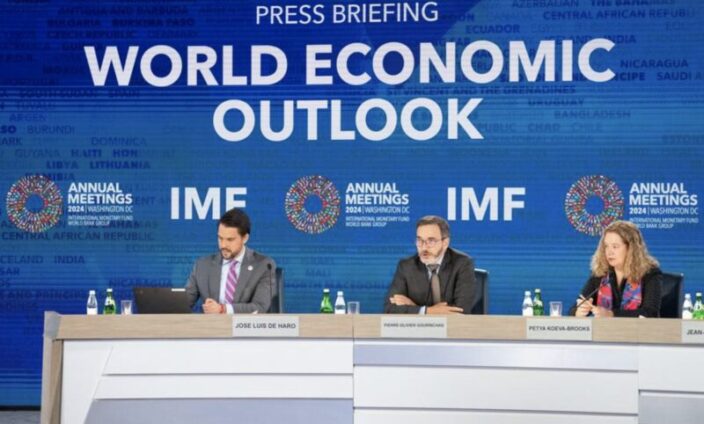
This was observed in the Fund’s October 2024 World Economic Outlook, released on the sidelines of the ongoing Annual Meetings in Washington, DC (USA).
The Annual Meetings, a joint IMF event with the World Bank Group (WBG), provides Finance Chiefs the platform to take stock of the previous year’s happenings in the global economy, providing solutions to the challenges thereof.
According to the Fund, while the end year 2024 growth is projected to remain at 3.6 per cent like in 2023, it is expecting Sub-Saharan Africa’s Gross Domestic Product (GDP) to rise to 4.2 per cent by the end of 2025.
“Sub-Saharan African region is one that is seeing growth rates that are fairly steady this year, compared to last year, at about 3.6 per cent, and then expected to increase to about 4.2 per cent next year,” said, Pierre-Olivier Gourinchas, IMF Chief Economist.
“We’re seeing some pickup in growth from this year to next year. But now, this is certainly a region that’s been adversely impacted by weather shocks and, in some cases, conflict. So, the growth remains subdued and somewhat uneven, and that’s certainly something that we are concerned about,” he stated.
Jean-Marc Natal, Division Chief, Research Department, IMF, also noted that while there has been progress in the region in the last year and a half, the growth been recorded remained “uneven… and too low.”
“Inflation [is] stabilising in some countries… and reaching levels close to the target, but half of them is still at a large distance from the target, and a third of them are still having doubledigital inflation,” he said.
Raising concern about debt levels in the region, he said, “the other issue is debt in the region. Obviously, it is still high. It has not increased. It has stopped increasing, and in some countries already starting to consolidate. But it’s still too high.”
The IMF Division Chief called for tight monetary policy and fiscal consolidation, particularly in countries where inflation was very high, to contain inflation and its rippling effects.
“It’s complicated. In many countries, there are tradeoffs… consolidating fiscal is difficult when you also have to provide for relief, like in Nigeria, for example, due to the flooding. So, targeting the support to the poor and the vulnerable is part of the package when you consolidate,” said Mr Natal.
In the October World Economic Outlook, the IMF projected global economy growth to hold steady at 3.2 per cent in 2024 and 2025.
The United States was expected to cool down, while other advanced economies will rebound, with performance in emerging Asia remaining robust, despite the slight downward revision for China to 4.8 percent in 2024.
The growth for lowincome countries were revised downwards, largely attributed to some conflicts and climate shocks in the region.
The Bretton Wood institution in its World Economic Outlook observed that the battle against inflation, which peaked at 9.4 per cent year-on-year in the third quarter of 2022 had almost won.
The IMF projected headline inflation to fall to 3.5 per cent by the end of next year, as inflation in many countries were now hovering close to central bank targets.
The report recommended a policy triple pivot of balancing monetary policy with fiscal policy and structural reforms to return of inflation to near central bank targets.
Latest Stories
-
Banks NPL ratio of 16.1% is still too high – S&P
20 minutes -
Guidelines, regulations of cryptocurrency in Ghana fall short of comprehensive oversight – IMF
54 minutes -
COCOBOD’S GH¢16.3bn SPV: Real progress toward a sustainable cocoa sector
1 hour -
Ghana lose Morocco friendly as Atlas Lions turn to Mali
3 hours -
2026/2027 GPL: Kelvin Nkrumah strike sends Medeama top of league table
3 hours -
Punish Manchester City this season, say other club chiefs
3 hours -
Emmanuel City crowned champions of maiden Global Game Scouting Tournament
3 hours -
MPship should not shield anyone from arrest – Felix Ofosu-Kwakye
4 hours -
Thomas Partey loses father Jacob Teye Partey
4 hours -
Gov’t rejects Baffour Awuah ‘kidnap’ claims, says EOCO officer was lawfully executing arrest
4 hours -
Martin Kpebu explains when EOCO can arrest Manhyia South MP after securing court warrant
4 hours -
EOCO’s reasons for seeking Manhyia South MP arrest warrant not justified – Kpebu
4 hours -
MTN Ghana warns SMEs against sharing PINs amid digital fraud risks
4 hours -
Yendi nursing students warn restricted access to skills lab could affect their training
4 hours -
Minority awaits formal notice of arrest warrant for Manhyia South MP – Annoh-Dompreh
4 hours