

Audio By Carbonatix
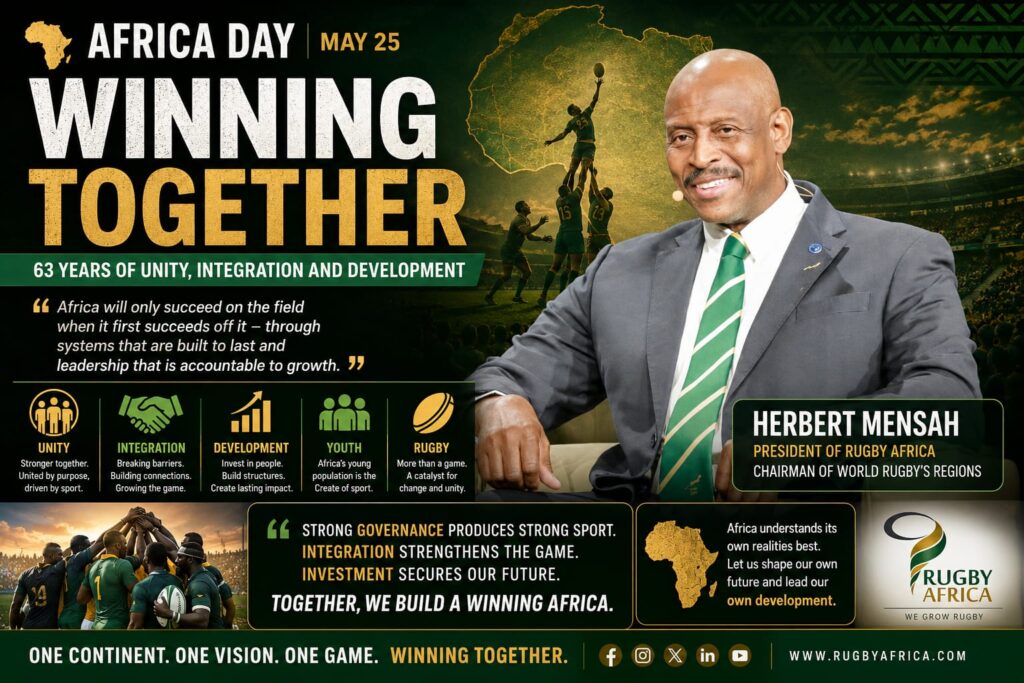
President of Rugby Africa and Chairman of World Rugby’s Regions, Herbert Mensah, has called on African nations to strengthen governance, infrastructure, and youth development systems if the continent is to achieve sustainable growth in sports and broader development.
In a statement issued to mark Africa Day under the theme “63 Years of Unity, Integration and Development,” Mr Mensah argued that Africa’s aspirations for unity and integration must translate into measurable outcomes rather than symbolic declarations.
According to him, uneven investment, weak structures, and inadequate infrastructure continue to limit the continent’s ability to achieve shared growth and competitive success.
“As President of Rugby Africa, I see this reality up close,” he stated.
“Sport does not develop by chance. It develops when leadership is disciplined, structures are built properly, and investment is directed where it matters most.”
Mr Mensah stressed that success in sports is determined not only by performances on the field but by the quality of systems operating behind the scenes, including governance, planning, coaching structures, player welfare, and long-term investment.
“The reality is simple: winning off the field matters just as much as winning on it,” he noted.
“When those foundations are weak, success becomes episodic rather than sustainable.”
Drawing from his experience in rugby and football administration, the former football executive warned that pressure for immediate results often leads to poor decision-making and weak long-term planning.
He said sustainable sporting success requires disciplined structures rather than short-term urgency.
“In sport, as in business, planning is what prevents chaos,” he said.
“When finances are mismanaged, development pathways are weak, or investment in people is neglected, performance eventually suffers.”
Mr Mensah also highlighted the importance of integration across African sports systems, arguing that geography, language barriers, and outdated selection models continue to restrict talent development across the continent.
According to him, stronger regional cooperation can help create coordinated development pathways, improve competition structures, and expand opportunities for athletes beyond national boundaries.
He cited South Africa as an example of how inclusive systems can strengthen sporting excellence.
“As four-time Rugby World Cup champions, South Africa has shown how rugby can be both excellent and inclusive,” he stated.
“That integration widened the talent base, strengthened credibility, and ultimately made the sport more competitive.”
Mr Mensah argued that inclusion should not be treated merely as a social objective but as a key driver of performance and growth.
He further cautioned against development models imposed without regard for Africa’s unique realities, stressing that African countries face different economic, logistical, and infrastructural challenges that require tailored solutions.
“A one-size-fits-all development model cannot work,” he said.
“Africa understands its own realities best.”
The Rugby Africa President also underscored the strategic importance of investing in Africa’s youth population, describing it as central to the future of global sport.
Citing United Nations data indicating that Africa has the world’s youngest population with a median age of about 19 years, he said sports organisations must invest heavily in schools, academies, and youth development systems if they hope to remain relevant.
“Rugby is competing for attention, participation, and relevance,” he said.
“If investment is directed into youth systems, school programmes, academies, and accessible pathways, Africa will become central to the future growth of the game.”
Mr Mensah urged African leaders and sporting institutions to move beyond rhetoric and focus on measurable impact.
“It is no longer enough to speak about development in abstract terms,” he said.
“Investment must translate into stronger coaching systems, better competitions, safer player welfare structures, and visible pathways for young athletes.”
He added that Africa’s long-term success in sports and development would ultimately depend on accountable leadership and durable systems capable of delivering lasting growth.
Latest Stories
-
6th Western Gospel Awards unveils nominees ahead of November ceremony
2 minutes -
GMTF, GNPC open talks on stronger support for specialised healthcare
3 minutes -
Adu-Boahene case: Atta Akyea files no-case submission, cites evidential gaps, inconsistencies and failure to call material witnesses
21 minutes -
Manchester City ‘found guilty of majority of 115 charges’
29 minutes -
From abandoned ruins to model residence: How Techiman North DCE fulfilled 9-month promise
32 minutes -
Francis Spio Jungo appointed to FanteFest 2026 planning committee
36 minutes -
Roots and Routes uses health walks, air sensors and tree planting to tackle air pollution in Ghana
40 minutes -
Stanbic Bank moves to boost electric vehicle through ‘Be Powered’ campaign
46 minutes -
Tears in Damongo court as accused persons show alleged torture wounds while in police custody
47 minutes -
Telecel Business Runaway in Takoradi equips SMEs with practical tools for growth
52 minutes -
Education Ministry to meet teacher unions on Monday as strike begins over promotion arrears
57 minutes -
Gender Minister calls for stronger financing, accountability to improve lives of Africa’s children
1 hour -
Shoot to maim illegal miners if ‘shoot to kill’ is opposed – Kwame Jantuah
1 hour -
24-hour Economy Secretariat to support 2026 Inter Tourism Expo
1 hour -
Ghana must produce more of what it imports to create jobs – Mahama
1 hour