

Audio By Carbonatix
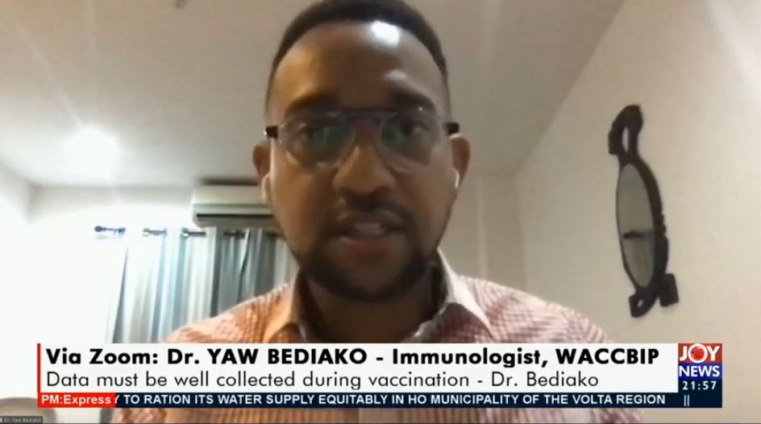
Immunologist and Research Fellow at the West Africa Centre for Cell Biology of Infectious Pathogens (WACCBIP), has called for a data collection on the Covid-19 vaccination and a research programme.
This, according to Dr Yaw Bediako, is critical at this time if “we are going to really understand how these vaccines are working” and what to do to achieve herd immunity.
“It’s important that we begin to collect data on the vaccine response and to be honest we can only do that if we develop a research program alongside this vaccination programme.”
Speaking on PM: Express Monday, Dr Bediako indicated that the collection of data will also help derive some answers that will better inform researchers on how the Covid-19 vaccines work.
“With that information then we can really begin to answer some of the questions you are asking; how long will the immunity last, what does the immunity looks like,” he told host Ayisha Ibrahim.
“We may have different numbers from what is been reported elsewhere, and that is fine, once we have the data, we can plan accordingly,” he stressed.
He noted that the Covid-19 vaccine maybe unlike the “vaccine for measles” where one could have life-long protection.
“The assumption is that we won’t have this luxury with this [Covid-19] vaccine, we probably have a finite amount of time but exactly how long it is, to be honest, we don’t know,” he said.
"But that is why, and I want to hammer on this again in support of Dr Amuasi’s point we really do need to be collecting samples,” he stressed.
Dr Bediako observed that vaccines do not work uniformly well in every population, “the length of protection can vary from geography to geography.”
“Malaria vaccines have worked phenomenally well in volunteer Oxford but failed in our part of the world which is why we need to be collecting our own data,” he cited.
He said: “These vaccines were developed within a year so we haven’t had enough time to know exactly how long the immunity will last.”
While expressing confidence in the safety of AstraZeneca vaccines with proving 70 percent, however, data collection is vital in achieving herd immunity.
“In terms of how well a vaccine works, that has to do a lot with your pre-existing immune function, pre-existing immune stimulation and that vary from geography to geography-based on what we are exposed to.”
He further stressed that “without the data, we are running blind.”
“So I just want to hammer that again, that it’s really imperative as we are rolling out what is in actual fact, could be a large clinical study across our country, we can’t waste this data, we have to collect samples and we have to put out resources,” he added.
Latest Stories
-
Mahama’s push for visa-free Africa reflects Nkrumah’s Pan-African vision – Rashid Tanko-Computer
5 minutes -
Redefining sweetness: Why our celebrations must heal, not harm
6 minutes -
IMANI urges Mahama to reaffirm his 2014 directive on competitive state insurance placements
7 minutes -
Maiden Katon Praise comes off at Accra Sports Stadium on April 17
19 minutes -
Families flock to Luv FM Easter party at Rattray park in Kumasi
35 minutes -
Rural health worker laments overwhelming burden at CHPS compounds
55 minutes -
Katon Meet to stream Accra stadium Katon Praise Concert worldwide
57 minutes -
Gov’t considers exploring local raw materials to stabilise production costs of sachet water prices
1 hour -
Mahama in Paris: Turning Diplomacy into Delivery
1 hour -
Middle East crisis shows Ghana needs to diversify energy sources – Energy expert
2 hours -
Government of Ghana Internal Revenue Generation cannot fund Big Push in Four Years
2 hours -
EPCG Moderator urges leaders to serve with courage and humility in Easter message
3 hours -
The Cobra at the gate: When good intentions overrun the system
3 hours -
Easter service disrupted in Nyanyano as suspected land guards storm church event
3 hours -
Price surge exposing NDC gov’ts dishonesty -Titus Glover
3 hours