

Audio By Carbonatix
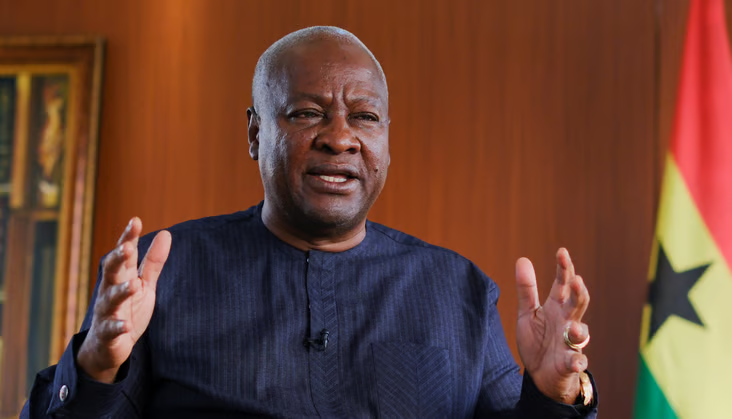
President John Dramani Mahama has warned that Ghana is not immune to the escalating global crude oil prices triggered by the recent exchange of missiles between Israel and Iran in the Middle East.
Speaking during his 'Thank You Tour' in the Savannah Region on Saturday, June 14, the President acknowledged the potential economic fallout and outlined steps his administration is taking to mitigate the impact on domestic fuel prices.
"Despite the work we have done in stabilising the economy, Ghana is not immune from the shocks of global events," President Mahama stated, highlighting the nation's vulnerability to international geopolitical developments.
He specifically pointed to "recent events in the Middle East which involve an exchange of missiles between Israel and Iran," noting that these developments "have started to escalate crude oil prices dramatically."
Global crude oil benchmarks, such as Brent crude, have seen significant surges in response to heightened tensions in the Middle East, a region critical to a substantial portion of the world's oil supply.
This instability directly impacts countries like Ghana, which, despite being a crude oil producer, remains a net importer of refined petroleum products.
Data from the International Energy Agency (IEA) indicates that oil constitutes a significant portion of Ghana's total energy supply, with the transport sector being the largest consumer of refined oil products.
To safeguard Ghana's economy and protect consumers, President Mahama revealed that he has issued directives to his key ministers.
"I've asked our Minister of Finance and Minister of Energy to keep a close eye on the development and model the possible impacts on our petroleum prices," he disclosed.
The current Minister for Finance is Dr. Cassiel Ato Forson, while the Minister of Energy is John Abdulai Jinapor.
The President's directive underscores a proactive approach to potential economic headwinds.
Ghana is currently engaged in an Extended Credit Facility (ECF) programme with the International Monetary Fund (IMF), aimed at achieving macroeconomic stability and fiscal discipline.
The government's 2025 budget targets a 1.5% primary surplus, making the management of external shocks like rising oil prices crucial to maintaining these hard-won economic gains.
The ministers have been tasked not only with monitoring the situation but also with preparing "measures to protect the recent gains that we have made."
These measures could potentially include strategic reserves, targeted subsidies, or other fiscal interventions to cushion the Ghanaian public from sharp increases at the pump.
Latest Stories
-
Padel for Parkinson’s cycling event promotes awareness at University of Ghana
1 minute -
GPL 2025/26:Samuel Tetteh brace fires Nations FC past Basake Holy Stars
10 minutes -
Ghana’s oil trade position close to net neutral in near term – Fitch
32 minutes -
IMANI Africa President urges greater awareness and support for Parkinson’s Disease patients
42 minutes -
T-bills: Government records 29% undersubscription; interest rates continue to surge
44 minutes -
Perceptions of Judicial partisanship ‘unfortunate’ – Justice Adjei-Frimpong urges greater public engagement to build trust
47 minutes -
Ghana to honour Christina Hammock Koch for historic Artemis II mission
2 hours -
Supreme Court appointments require more than 15 years’ experience – Justice Adjei-Frimpong
2 hours -
Fire destroys 3-bedroom house at Bogyawe
2 hours -
Why the Supreme Court is a “policy court” – Justice Richard Adjei-Frimpong breaks it down
3 hours -
Playback: The Law discussed Supreme Court @150
4 hours -
MTN Momo staff walk to promote wellness and fitness
4 hours -
Assafuah: Sedina Attionu’s return from Nevada will test government’s commitment to accountability
4 hours -
How GRA’s Modified Taxation Scheme is boosting revenue compliance & SMEs competitiveness
4 hours -
Stonebwoy Can Do It: A call to unite behind 2026 BHIM Fest
5 hours