

Audio By Carbonatix
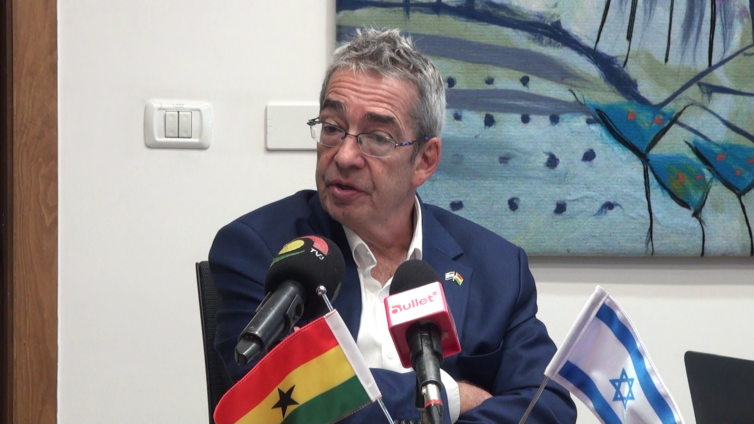
The Ambassador of Israel to Ghana, Liberia and Sierra Leone, Roey Gilad, has disclosed new details about the scale of Iranian retaliatory attacks on Israel amid the ongoing US–Israel–Iran conflict, revealing that hundreds of missiles and drones have targeted Israeli territory since the latest escalation began.
Speaking during a briefing in Accra today, March 5, the ambassador said Israel has endured some casualties following waves of Iranian retaliation after joint military strikes by the United States and Israel against Iranian military and nuclear-related targets.
"Until yesterday, 180+ missiles hit Israel and more than 120 UAVs. UAVs are unmanned aerial vehicles, essentially large military drones,” Ambassador Gilad said while addressing the issue.
According to the envoy, the attacks have resulted in casualties among Israeli civilians.
“We suffered 11 Israelis killed and about 120 injured,” he said. “We pay a price. I’m not hiding it. We did pay a price, and we will pay a price. That’s not the end of it.”
The ambassador stressed that despite the losses, Israeli society remains determined to confront what he described as a strategic threat from Iran’s leadership.
“What you find in Israel is stamina and resilience of the civil population that understands that you need to put an end to this challenge once and for all,” he said.
The remarks come as the conflict between the United States, Israel and Iran enters one of the most dangerous phases in decades, with military operations spreading across multiple parts of the Middle East.
Israel’s Position
Despite mounting casualties and ongoing missile attacks, Ambassador Gilad insisted that Israel remains committed to confronting Iran’s military and political leadership.
“It’s too early to say how this will end,” he said. “But people of goodwill should pray that this will bring an end to the regime of the Mullahs in Tehran.”
The current conflict intensified in late February 2026 when the United States and Israel launched coordinated airstrikes against Iranian military infrastructure, missile systems and facilities linked to Tehran’s nuclear programme.
The attacks reportedly targeted more than 2,000 strategic locations, including missile batteries, command centres, air defence systems and naval assets.
The strikes were aimed at weakening Iran’s military capabilities and preventing what Washington and Tel Aviv described as an emerging strategic threat.
In response, Iran launched large-scale retaliatory attacks using ballistic missiles and armed drones targeting Israel and US military facilities across the Middle East.
Reports indicate that hundreds of missiles and drones have been fired during the ongoing exchanges, with some penetrating Israeli air defence systems and hitting civilian areas in cities such as Tel Aviv and surrounding regions.
Iran has also expanded its retaliation beyond Israel by striking or attempting to strike US military installations and allied infrastructure across the Gulf region.
Missiles and drones have targeted locations in Qatar, the United Arab Emirates, Saudi Arabia and Iraq, forcing several countries to activate air defence systems and temporarily close their airspace.
In one wave of attacks, Gulf defence systems reportedly intercepted more than 186 ballistic missiles and over 800 drones launched by Iran toward regional targets.
Rising Casualties and Humanitarian Concerns
The war has already caused heavy casualties, particularly inside Iran, where large-scale bombing campaigns have struck multiple cities.
Human rights monitors estimate that more than 900 people have been killed and over 6,000 injured in Iran since the strikes began, while some groups suggest the death toll could exceed 1,000 civilians, including children.
The bombardments have affected more than 150 cities and hundreds of locations, including military bases, government buildings and infrastructure sites.
Humanitarian organisations and United Nations officials have raised concerns about potential violations of international humanitarian law, particularly following reports that schools, hospitals and residential areas have been hit during the fighting.
Regional Fallout
The conflict has rapidly expanded into a wider regional crisis.
Iran-backed groups across the Middle East have begun launching attacks against Israel and US interests. In Lebanon, Hezbollah has fired rockets toward northern Israel, prompting Israeli airstrikes in Beirut and other locations.
Meanwhile, global aviation routes and energy markets have been severely affected. Several countries in the Gulf temporarily closed airspace, while rising tensions around the Strait of Hormuz have pushed oil prices higher due to fears of disruptions to global energy supplies.
The United Nations Security Council has held emergency meetings urging restraint, while world powers, including China and European states, have called for an immediate ceasefire to prevent a broader regional war.
Latest Stories
-
Economic Zones Chamber applauds CBI for launching world’s largest Calcined Clay Cement plant in Tema
16 minutes -
Residents attack fire officers for arriving late to a fire outbreak at Konongo
24 minutes -
President Mahama adds rice, tomato puree, mackerel to land transit ban, proposes pasta next
39 minutes -
Daily Insight for CEOs: Disciplined Capital Allocation for Growth
53 minutes -
Beyond the School Gate: How old student associations are quietly shaping Ghana’s future
1 hour -
Rauf Munah: Eleven Wonders teen forward turning survival football into a personal breakout
2 hours -
Piracy threat in Senya Beraku: Why Ghana needs stronger maritime protection and legal reforms
2 hours -
Police announce road closures in Accra for 69th Independence Day celebrations
2 hours -
Vice President honours 52 students at President’s Independence Day Awards
2 hours -
GRA Customs seizes 560 suspected galamsey engines at Tema Port
2 hours -
Students, parents advised against risky activities during Independence Day celebrations
2 hours -
We paid a price but will tackle Iran threat — Israeli Ambassador reveals as 11 Israelis killed, 121 injured
2 hours -
Ghana to face Wales in Cardiff as World Cup preparations intensify
3 hours -
Healey visits Cyprus after criticism of UK response to drone attacks
3 hours -
DR Congo government says 200 killed after landslide at rebel-held mine
3 hours