

Audio By Carbonatix
The Ambassador of Israel to Ghana, Liberia and Sierra Leone, Roey Gilad, has disclosed new details about the scale of Iranian retaliatory attacks on Israel amid the ongoing US–Israel–Iran conflict, revealing that hundreds of missiles and drones have targeted Israeli territory since the latest escalation began.
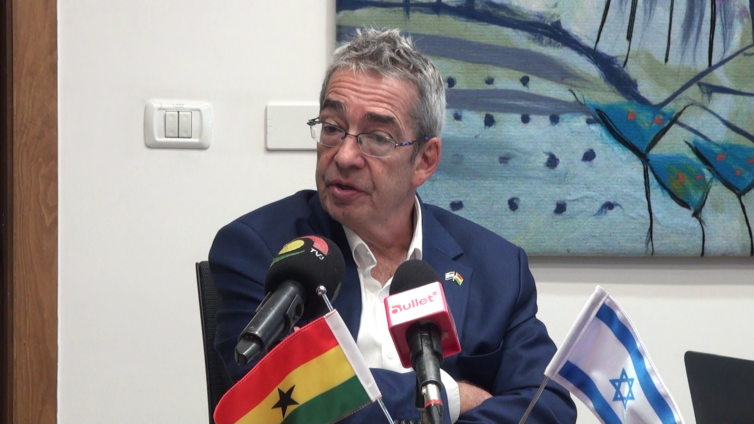
Speaking during a briefing in Accra today, March 5, the ambassador said Israel has endured some casualties following waves of Iranian retaliation after joint military strikes by the United States and Israel against Iranian military and nuclear-related targets.
"Until yesterday, 180+ missiles hit Israel and more than 120 UAVs. UAVs are unmanned aerial vehicles, essentially large military drones,” Ambassador Gilad said while addressing the issue.
According to the envoy, the attacks have resulted in casualties among Israeli civilians.
“We suffered 11 Israelis killed and about 120 injured,” he said. “We pay a price. I’m not hiding it. We did pay a price, and we will pay a price. That’s not the end of it.”
The ambassador stressed that despite the losses, Israeli society remains determined to confront what he described as a strategic threat from Iran’s leadership.
“What you find in Israel is stamina and resilience of the civil population that understands that you need to put an end to this challenge once and for all,” he said.
The remarks come as the conflict between the United States, Israel and Iran enters one of the most dangerous phases in decades, with military operations spreading across multiple parts of the Middle East.
Israel’s Position
Despite mounting casualties and ongoing missile attacks, Ambassador Gilad insisted that Israel remains committed to confronting Iran’s military and political leadership.
“It’s too early to say how this will end,” he said. “But people of goodwill should pray that this will bring an end to the regime of the Mullahs in Tehran.”
The current conflict intensified in late February 2026 when the United States and Israel launched coordinated airstrikes against Iranian military infrastructure, missile systems and facilities linked to Tehran’s nuclear programme.
The attacks reportedly targeted more than 2,000 strategic locations, including missile batteries, command centres, air defence systems and naval assets.
The strikes were aimed at weakening Iran’s military capabilities and preventing what Washington and Tel Aviv described as an emerging strategic threat.
In response, Iran launched large-scale retaliatory attacks using ballistic missiles and armed drones targeting Israel and US military facilities across the Middle East.
Reports indicate that hundreds of missiles and drones have been fired during the ongoing exchanges, with some penetrating Israeli air defence systems and hitting civilian areas in cities such as Tel Aviv and surrounding regions.
Iran has also expanded its retaliation beyond Israel by striking or attempting to strike US military installations and allied infrastructure across the Gulf region.
Missiles and drones have targeted locations in Qatar, the United Arab Emirates, Saudi Arabia and Iraq, forcing several countries to activate air defence systems and temporarily close their airspace.
In one wave of attacks, Gulf defence systems reportedly intercepted more than 186 ballistic missiles and over 800 drones launched by Iran toward regional targets.
Rising Casualties and Humanitarian Concerns
The war has already caused heavy casualties, particularly inside Iran, where large-scale bombing campaigns have struck multiple cities.
Human rights monitors estimate that more than 900 people have been killed and over 6,000 injured in Iran since the strikes began, while some groups suggest the death toll could exceed 1,000 civilians, including children.
The bombardments have affected more than 150 cities and hundreds of locations, including military bases, government buildings and infrastructure sites.
Humanitarian organisations and United Nations officials have raised concerns about potential violations of international humanitarian law, particularly following reports that schools, hospitals and residential areas have been hit during the fighting.
Regional Fallout
The conflict has rapidly expanded into a wider regional crisis.
Iran-backed groups across the Middle East have begun launching attacks against Israel and US interests. In Lebanon, Hezbollah has fired rockets toward northern Israel, prompting Israeli airstrikes in Beirut and other locations.
Meanwhile, global aviation routes and energy markets have been severely affected. Several countries in the Gulf temporarily closed airspace, while rising tensions around the Strait of Hormuz have pushed oil prices higher due to fears of disruptions to global energy supplies.
The United Nations Security Council has held emergency meetings urging restraint, while world powers, including China and European states, have called for an immediate ceasefire to prevent a broader regional war.
Latest Stories
-
Ghana is 5th largest crypto market in sub-Saharan Africa; annual transactions around $21bn
26 seconds -
Russia launches largest attack on Ukraine energy infrastructure since spring
45 seconds -
GHABA launches first national Hair and Beauty Festival to promote skills and enterprise development
48 seconds -
ICU urges GHABA members to transform hairdressing skills into sustainable enterprises
14 minutes -
Ghana eyes stronger trade ties as Australia hosts multicultural trade and investment forum
24 minutes -
Margaret-Marie Krakue
27 minutes -
Ayariga announces plans for live broadcast of MMDAs’ meetings on local radio stations
30 minutes -
Mrs Anna Tackie
32 minutes -
Ghana links Afghan heroin and Brazilian cocaine to global drug markets – Global Organised Crime Index
39 minutes -
NHIA launches nationwide inter-school quiz to deepen students’ knowledge of NHIS
45 minutes -
Political protection could be masking Ghana’s cocaine trade – Global Organised Crime Index
50 minutes -
AFCON 2027Q: ‘We have to dissolve the GFA’ – Effia MP after Black Stars lose to Gambia
52 minutes -
NPP announces voting schedule and ID requirements for October 3 national elections
54 minutes -
Lupus can mimic HIV symptoms and damage kidneys if untreated – KNUST expert
57 minutes -
Focus on Sickle Cell Foundation seeks to introduce sickle cell education through comics in Ghanaian schools
1 hour