

Audio By Carbonatix
President Donald Trump has said the US will "substantially reduce" joint military exercises with South Korea, citing his "very good relationship" with North Korea's leader Kim Jong Un.
He also noted on Truth Social that South Korea had recently declined to join the US in the "denuclearisation" of Iran.
"These exercises are not only costly, with much of these costs paid for by the United States of America (as usual!), but send a signal that is totally inappropriate and hostile," Trump posted.
Seoul said it was reviewing Trump's comments, adding it hoped a favourable relationship between Washington and Pyongyang could lead to meaningful talks. Pyongyang has not yet commented.
Earlier, South Korea said the drills with the US would proceed "as scheduled".
It comes after North Korea this month conducted ballistic missile tests banned by the United Nations.
Trump said in his social media post on Sunday that it was "too late to cancel", as the US and South Korea were due to start their annual military exercises on Monday.
He added: "While somewhat unrelated (?), I recently asked the President of South Korea if they would like to join us in the Denuclearization of the Islamic Republic of Iran, and they said, 'No thanks!'"
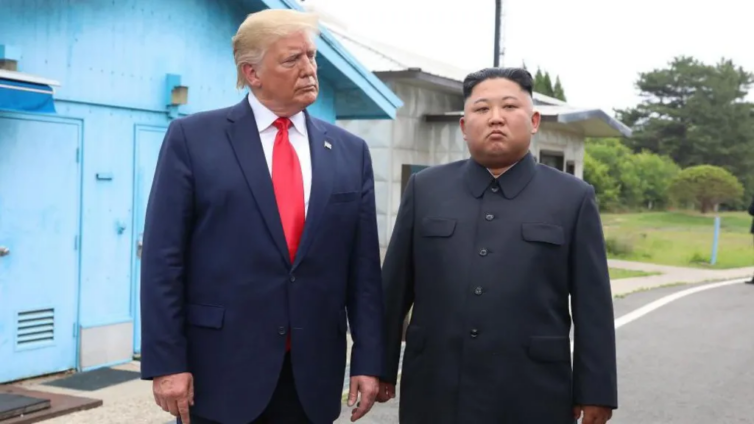
Trump's announcement came less than 24 hours after he posted an old photograph of himself and Kim from 2019, writing the two were great friends "despite the unfriendly look on this particular picture".
In its statement, South Korea's presidential Blue House said it would continue diplomatic consultations on US-Korea military cooperation related to the Strait of Hormuz, while discussing details on joint military drills with the United States.
Experts suggest the walking back of joint military exercises could carry a high cost with relatively little benefit.
"US-South Korea combined defence exercises are essential for military forces to be ready and capable of doing their jobs," said Leif-Eric Easley, a professor at Ewha University in Seoul.
"Scaling them back can damage alliance coordination, slow the process of South Korea taking on greater responsibility for its own defence, and weaken deterrence against possible conflicts in Asia.
"The cost savings from downsizing drills are marginal, while the diplomatic benefits for relations with North Korea are doubtful."
Last week, US and South Korean military leaders held a joint press conference announcing Ulchi Freedom Shield.
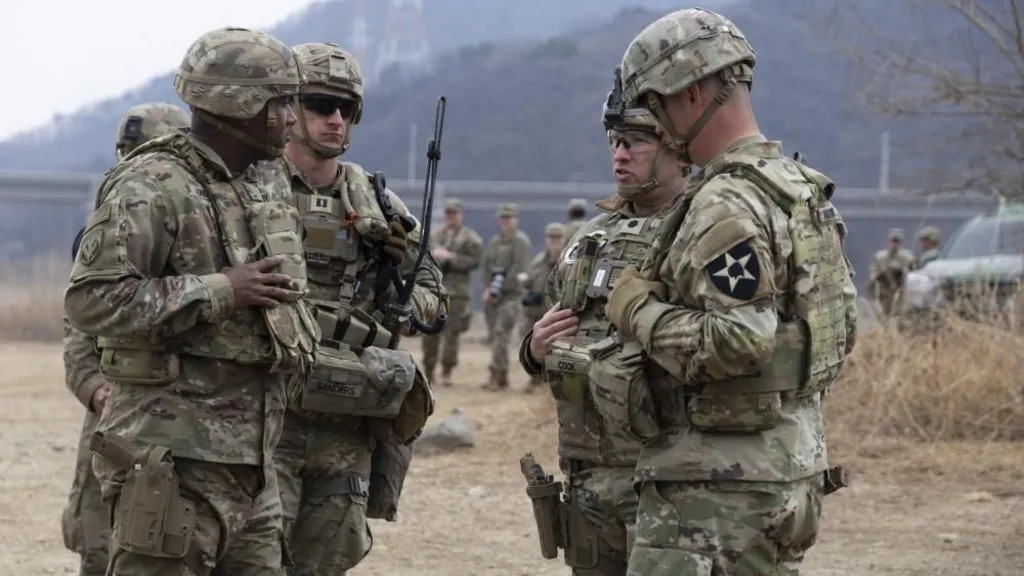
They said the 11-day event would be similar in scale to previous years, with about 18,000 South Korean soldiers participating.
During the news conference, military leaders also mentioned North Korea's deployment of troops to aid Russia's war against Ukraine.
US military spokesperson Ryan Donald said "our training accounts for that threat", referring to North Korean soldiers returning from the battlefield. About 28,500 American military personnel are stationed in South Korea.
On Friday, North Korea's foreign ministry condemned the joint military drills as "a rehearsal for an aggressive war".
The joint exercises come days after South Korea, the US and Japan detected the second North Korean missile test in days.
Pyongyang has accelerated efforts to expand its nuclear and missile programmes since the collapse in 2019 of Kim's high-profile diplomacy with Trump during his first term in the White House.
He became the first ever sitting US president to set foot in North Korea when he visited seven years ago.
For Seoul, Trump's post is a mixed message. On the one hand, they have been requesting Trump engage with Pyongyang and the post raises hope that he might bring Kim back to the table.
But Trump is also hinting that he is unhappy with South Korea's unwillingness to make direct military or logistical contributions to the US hostilities with Iran.
He has also expressed displeasure with other allies for their hesitance to get involved in the conflict, including Japan, France and the UK.
Trump's move to downsize joint military exercises with South Korea is not without precedent.
He suspended the exercises entirely in 2018, during denuclearisation negotiations with Kim. He said at the time that the annual drills were "provocative" towards North Korea and stopping the "war games" would save the US a "tremendous amount of money."
The exercises were again scaled back in 2020 during the Covid-19 pandemic.
It was predicted that President Trump would suspend or scale down US-SK joint exercise, or even reduce the size of US troops in Korea.
Last week, South Korea's president proposed talks with its northern neighbour on officially ending the war between the two, which is technically still active since an armistice was signed in 1953.
Trump has noted multiple times in the past that the US is providing security to South Korea without getting much in return.
He has criticised the number of troops it has stationed in the peninsula and the money spent.
This has complicated Washington's relationship with Seoul, which sees the troops as core to its alliance with the US.
Seoul tried to defuse the tension earlier this year, committing $350bn to investing in the US. And last year President Lee Jae Myung described Trump as a peacemaker.
Latest Stories
-
RCI Immanuel Temple donates supplies to Motherly Love Orphanage
30 minutes -
COCOBOD asks investors to fund cocoa purchases, but proceeds may also repay old debt
53 minutes -
Gov’t hands over site for construction of 160-bed Savannah Regional Hospital
60 minutes -
NCPTA clarifies GH¢200 cap on PTA dues and levies per parent
1 hour -
Asante Kotoko part ways with coach Eric Tinkler
1 hour -
GTA calls for ultra-modern Cocoa Museum in Western North
1 hour -
NPP says concerns over delegates’ register addressed ahead of October 3 polls
1 hour -
PwC Ghana appoints George Arhin as Country Senior Partner
1 hour -
New Economy will turn imports into opportunities for Ghanaian production – Ato Forson
1 hour -
Two Ada SHS students convicted, placed on 12-month good behaviour bond
1 hour -
Samson’s Take: Verify the badge – and verify the story
1 hour -
Treasury bill demand rebounds as investors submit GH¢3.66bn in bids
1 hour -
Listing 10 SOEs will strengthen governance, limit political interference – Mahama
1 hour -
Mahama announces 1,200MW state-owned gas power plant deal by end of 2026
1 hour -
COCOBOD sets up Cocoa Capital PLC to raise GH¢16.3bn for cocoa sector
1 hour