

Audio By Carbonatix
The Institute of Statistical, Social, and Economic Research (ISSER) has raised concerns about the environmental impact of Ghana’s gold exports, which now account for over half of the country’s export revenue.
In its latest State of the Ghanaian Economy Report, ISSER calls for urgent steps to evaluate and address these environmental costs to ensure sustainable practices in mining and agriculture, cautioning that failure to act could harm Ghana’s tourism sector.
“Gold exports account for over 50% of export revenue, but there is a need to ascertain the environmental costs and address them to ensure sustainable mining and agricultural practices,” ISSER stated.
The report underscores that while gold mining brings significant revenue, it also presents environmental challenges that could disrupt agriculture and hinder tourism, two other key pillars of Ghana’s economy.
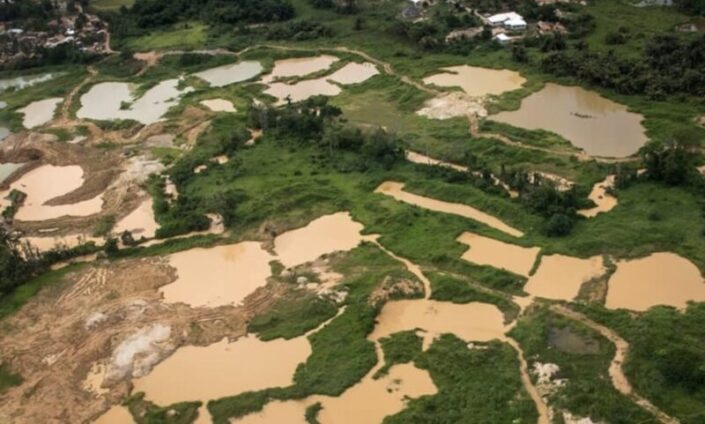
The environmental impact of mining, especially small-scale and illegal mining activities, has become a pressing issue for Ghana, affecting river bodies, farmlands, and forest reserves.
ISSER’s Director, Professor Peter Quartey, highlighted the interconnected risks that unregulated mining poses.
“The effects on tourism cannot be discounted,” he warned, noting that Ghana’s natural landscapes and biodiversity, which attract visitors, are at risk of degradation from unsustainable mining practices.
The report also emphasizes the importance of balancing economic gain from gold exports with environmental sustainability.
“To sustain the benefits of gold exports, we must integrate environmentally conscious practices that will not compromise agriculture or tourism,” ISSER suggests.
The institute’s assessment points to the need for stricter regulatory frameworks and enforcement to curb the negative impact of mining on critical natural resources.
In a bid to protect tourism and agriculture, ISSER recommends that policymakers implement measures to limit mining activities in sensitive areas, such as near water bodies and protected forests.
According to the report, preserving Ghana’s tourism potential is vital for diversification and long-term economic resilience.
“Tourism relies heavily on our natural resources, and if these are compromised by unchecked mining, we stand to lose more than we gain from gold exports,” ISSER cautioned.
Latest Stories
-
Ghana to begin camping with 12 athletes after Accra Open Championships – Bawa Fuseni
2 minutes -
Anthony Joshua declines showdown with Tyson Fury but admits they ‘probably’ clash next
15 minutes -
Tyson Fury dominates Makhmudov, calls out Joshua next
34 minutes -
I have supported highway authority financially to fix roads in my constituency – A Plus
2 hours -
US, Iran fail to reach peace agreement after marathon talks in Pakistan
2 hours -
ECG kicks off Phase Two of transformer upgrades at Lashibi; brief outages expected
3 hours -
Port crises loom as 11,000 drivers threaten four-day strike
3 hours -
A source of excellence across generations – Vice President Opoku-Agyemang lauds Mfantsipim
4 hours -
(Photos) Mfantsipim School launches historic 150th anniversary
5 hours -
Knights and Ladies of Marshall group backs Catholic Bishops’ stance on anti-LGBTQ+
6 hours -
Bright Simons writes: All the Filla in the Ibrahim Mahama/E&P – Gold Fields Saga
6 hours -
Monetise Idiocy In Ghana
6 hours -
The Ghanaian prophet and the mysterious death of his scottish wife Charmain Speirs
7 hours -
Nearly 400 sentenced in Nigeria for links to militant Islamists
7 hours -
Ghana’s recovery supported by gold strength despite global oil price pressures – Standard Bank Research
7 hours