

Audio By Carbonatix
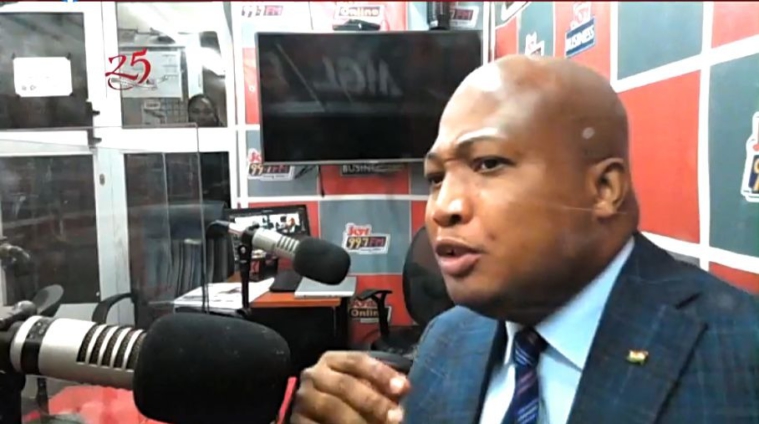
North Tongu MP, Samuel Okudzeto Ablakwa has called on government to roll out immediate measures to bridge the high salary inequalities between Article 71 officeholders and public servants.
Expressing his concerns in an interview with JoyNews' Joseph Opoku Gakpo on Tuesday, Mr. Ablakwa noted that the average pay of an Article 71 officeholder is much higher than the salary of workers in the public service.
"We should also be looking at the disparities, let's bridge the gap. We should not have the situation where just a few people in some specialised category appear to be taking all the remuneration."
The Ranking Member of Parliament's Foreign Affairs Committee's comment comes on the back of a report by the Ntiamoah Emoluments Committee indicating that as of 2016, ordinary public sector workers earned about six per cent of the monthly average salary of Article 71 officeholders.
The report observes that the highest-paid public servant in that year earned 28% of the salary of a Member of Parliament.
Reacting to that, Mr Ablakwa said the situation is worrying and has to be reversed as soon as possible.
For him, a pay cut as a solution to the high salary inequalities could be a better option.
"Let the independent committee determine if we don’t have enough resources as a country. And if some people would have to take a pay cut why not, I would not mind at all.
"At the end of the day this 6% that is what the other public sectors workers who are really in the majority are taking when you compare with what we are taking, it’s most unfair. I mean it can’t sit well with your conscience.
"I mean every other jurisdiction they are aligning and making sure that those who govern are not earning unnecessarily and unreasonably high remuneration which leaves the people agitated, leaves the people impoverished and leaves the people justifiable angry," he stated.
Meanwhile, Mr Ablakwa has been criticizing government for over-spending its 2020 approved budget by 8.8 billion Ghana Cedis.
Who is an Article 71 Office Holder
Article 71 Office Holders include the President, the Vice-President, the Speaker of Parliament, the Chief Justice and Justices of the Supreme Court.
The rest are; Members of Parliament (MPs), Ministers of State, political appointees, and public servants with salaries charged to the Consolidated Fund but enjoying special constitutional privileges.
A public sector workers
On the other hand, per the Public Services Commission Act, 1994 (Act 482), public sector workers are persons who work in; the Civil Service; Judicial Service; Audit Service; Education Service; the Prisons Service; Parliamentary Service; the Health Service; Statistical Service; National Fire Service; Customs, Excise and Preventive Service; Internal Revenue Service; Police Service and Immigration Service among others.
Latest Stories
-
Calls for royal meeting with Epstein survivors grow ahead of US visit
2 minutes -
Ibn Chambas advocates blend of technology and human values in education
3 minutes -
UMA improves healthcare access in Asutifi North with GH₵700k ‘Kim Taylor Legacy’ Walkway
8 minutes -
Scholarships Authority and Fanaka University offer sponsorship for procurement and supply chain studies
12 minutes -
Bisa Kdei drops new single ‘Go N Look’ featuring Medikal
18 minutes -
Benin facing rising terrorism in north as French military presence faces growing criticism
19 minutes -
UEW Public Lecture Series 2026: Education debate ‘about the soul of Ghana’s future’ — Dr Ibn Chambas
20 minutes -
EU fingerprint and photo travel rules come into force from today
47 minutes -
Anti-LGBTQ+ Bill: Ghanaians demand expedited passage, not dialogue – Ntim Fordjour to Mahama
55 minutes -
EU airline industry warns of fuel shortages if Strait of Hormuz stays closed
58 minutes -
White House staff told not to place bets on prediction markets
1 hour -
Auctioneers petition Prez Mahama over ‘interference’ in public auctions
1 hour -
GEA, Mastercard Foundation drive market access for MSMEs at Kwahu Business Forum
1 hour -
Education Ministry begins review of Ghana Library Authority law
1 hour -
Ghana U-15 girls clinch back-to-back CAF Schools titles
1 hour