

Audio By Carbonatix
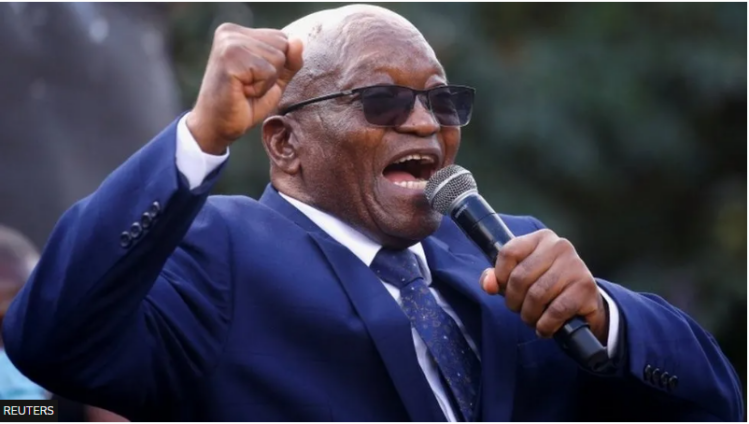
By announcing he will not vote or campaign for South Africa's governing African National Congress (ANC) in next year's general election, former president Jacob Zuma is seeking to portray himself as its saviour.
This might seem a contradiction in terms, but the strategy appears clear from his words, including the highly personal attack on his successor, President Cyril Ramaphosa.
Many South Africans see Mr Zuma as representing what is wrong with the recent past, and with having tainted the ANC by presiding over widespread corruption in government.
He is a highly divisive figure, dismissed by many as sinister and irrelevant but loved by his supporters.
His statement on Saturday highlighted social problems and divisions in South Africa which, for some, have never gone away.
His intervention comes ahead of an election widely seen as the most competitive for the ANC since it first came to power nearly 30 years ago, following the end of the racist system of apartheid.
The ANC was born in opposition to racial injustice and oppression, and still regards itself as a national liberation movement.
But, according to Mr Zuma, the ANC of President Ramaphosa has betrayed its revolutionary heritage. In saying so, he is seeking to appeal to ANC voters unhappy with its record in power.
The personal history between the men is important.
In 2014 then President Zuma appointed Mr Ramaphosa as his deputy.
Four years later, amid significant pressure from within the ANC as he was dogged by corruption allegations, he resigned as president and was succeeded by Mr Ramaphosa.
The 81-year-old Mr Zuma, who joined the ANC as a teenager, was an anti-apartheid activist and spent a decade in jail as a political prisoner. He was part of its armed wing, uMkhonto we Sizwe (MK), or Spear of the Nation.
President Ramaphosa was also an anti-apartheid activist and had key ANC roles during the early 1990s, including being its chief negotiator in talks with the apartheid regime.
But, unlike Mr Zuma, he was not associated with MK and he spent years out of politics from the mid-1990s when he made a fortune as a businessman.
Mr Zuma is casting himself as a true revolutionary, and characterising President Ramaphosa as a sell-out.
The many controversies surrounding Mr Zuma have not receded in the years since he left office, and he is still facing charges of corruption over a 1999 arms deal. He denies the charges.
Some South Africans will regard Mr Zuma's new intervention as a distraction from these personal challenges.
He was jailed in 2021 for contempt of court after refusing to testify before an inquiry investigating financial sleaze and cronyism under his presidency.
He spent two months in prison before being released on medical grounds. The release was later ruled illegal, but he did not return to prison due to overcrowding in the system.
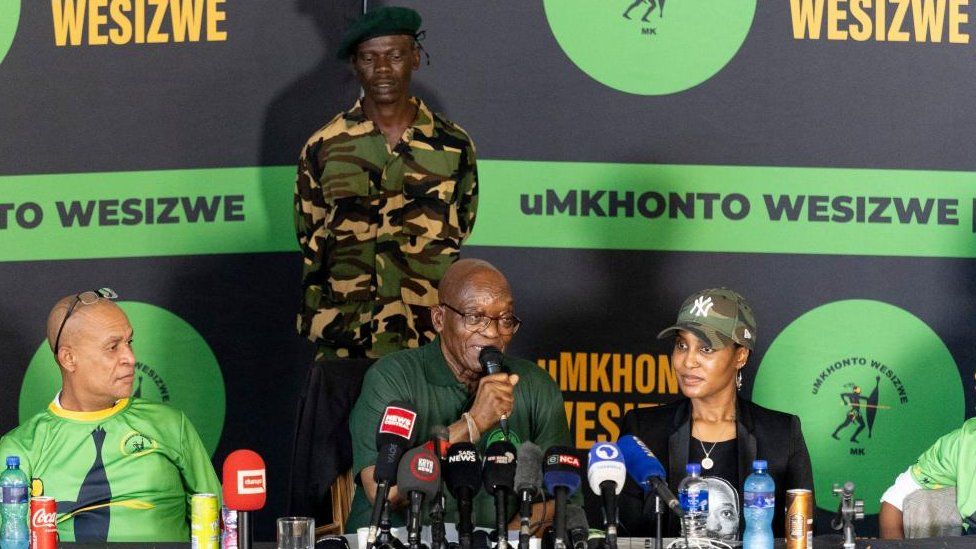
The new party which Mr Zuma says he will support bears the name of the ANC's former armed wing, uMkhonto we Sizwe, and uses the same abbreviation, MK.
There is a deep symbolism in adopting it, and in the date and location - 16 December in Soweto - of Mr Zuma's announcement.
This date was the anniversary of MK's founding in 1961, which was itself the anniversary of a highly contentious event in South African history - the 1838 Battle of Blood River between white settlers and Zulu people in what is now the province of KwaZulu-Natal.
The battle's outcome was seen by white Afrikaners as showing divine approval of them and for decades they marked it during apartheid as a public holiday called the Day of the Vow.
After the end of apartheid, the public holiday remained but its name was changed to the Day of Reconciliation, with the aim of encouraging national unity and racial harmony.
Soweto, the location of Mr Zuma's announcement, is where MK was disbanded in a ceremony 30 years ago to the day, on 16 December 1993.
MK's disbandment came ahead of South Africa's first democratic election in 1994, and what was seen as the miraculous birth of a "rainbow nation" under the presidency of anti-apartheid icon Nelson Mandela.
Mr Zuma now says there can "never be reconciliation without socio-economic justice and equality" and that the new MK party is seeking the "return of our land to its rightful owners, the African people".
By adopting the MK name and with his statements, he is showing he thinks post-apartheid South Africa has not delivered all it should have done for black people.
Mr Zuma spoke of a "new people's war" but said it would involve ballots rather than bullets.
His rhetoric was incendiary. He characterised President Ramaphosa as a "proxy" of "white capitalist interests" and said voting for the ANC will lead to government by "sell-outs and apartheid collaborators".
There will be concern among some that violence and instability could be triggered, depending on how political events play out from now on.
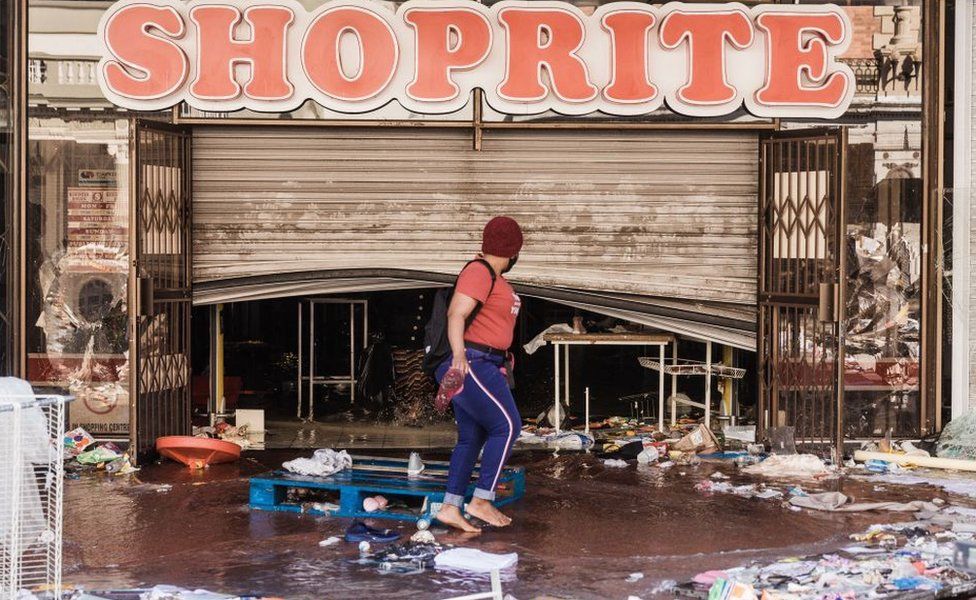
The worst unrest in post-apartheid South Africa, which saw more than 350 people die, took place in 2021 after Mr Zuma was arrested and jailed.
Much of it took place in his home province of KwaZulu-Natal, where he still enjoys significant support.
South Africa faces huge challenges: high levels of unemployment and violent crime, vast inequality and failing infrastructure.
Polls indicate that in next year's elections, the ANC could fall below 50% for the first time since it took power in 1994, raising the prospect of a coalition government.
It will be a challenge for the MK party to quickly build a national campaign network, and it is too early to know where it will stand or how much support it can realistically achieve.
Mr Zuma referred to discussions about the formation of a "patriotic front" and "voting bloc" after the 2024 elections, indicating he sees a need to collaborate with other parties, either to form a government or provide opposition to the ANC.
Mr Zuma said he will "die a member of the ANC", while saying he will campaign for the new MK party.
He did so only hours after the governing party had itself celebrated the anniversary of its disbanded military wing, saying "we hold the collective members of MK in the highest regard, venerating them as the heroines and heroes of our struggle".
The ANC has not formally responded to Mr Zuma's statement, but its secretary general previously said that MK "belongs to the ANC" and it would take legal action to keep ownership of the name.
"If you want to form a party, you can go, but leave MK with us," he said.
The fresh division between Mr Zuma and the ANC of Mr Ramaphosa has injected a bitter dynamic into South Africa's big election year.
Latest Stories
-
MTN set to deploy 5G services after winning spectrum licenses worth US$202m
32 minutes -
NPP national elections: 3,000–4,000 police to handle security, traffic in Kumasi – Karbo
3 hours -
Atta Akyea fumes as Manhyia MP is to spend another night in EOCO custody
3 hours -
SSNIT says La Beach clearance was to protect hotel investments, beaches to remain public
4 hours -
APSU congratulates St Augustine’s College after back-to-back National Investment Quiz wins
4 hours -
Renewed flood intervention at Mallam Junction raises hopes among residents, businesses
5 hours -
St Augustine’s College retain National Investment Quiz title after nail-biting grand finale
5 hours -
Education infrastructure investment will drive Banda’s development – Ahmed Ibrahim
5 hours -
Teacher unions strike: Gov’t presents fresh proposals as talks end inconclusively
6 hours -
51,000 teachers’ promotion arrears to be validated for October payment – Education Minister
6 hours -
Kwabena Boamah appointed Board Chair for Impact Investing Ghana
6 hours -
Striking teacher unions to meet Fair Wages and Salaries Commission on October 6
7 hours -
EOCO working with AG to arraign Nana Baffour Awuah before weekend court
7 hours -
Duraplast reassures customers after fire, announces October 5 reopening
7 hours -
Call off strike, gov’t will not renege on promotion arrears pledge – Haruna Iddrisu to teacher unions
7 hours