

Audio By Carbonatix
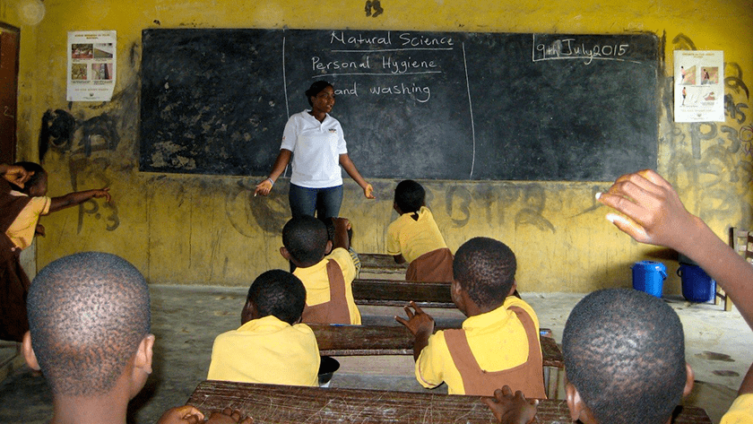
In a world where young people are retreating more and more into virtual unreality, the teaching profession has become more important than it ever was.
It is teaching that keeps it real – teaching that keeps young people alive.
It is the talk of the town – when you say the word “future”, you hear “robots”.
Artificial intelligence is rapidly growing, and that fear of losing your job to technology has become very real, but the most important thing is a person.
A person who incites your curiosity and feeds your curiosity; and machines cannot do that in the same way that people can.
My dad, John-Paul, a computer keyboard wizard and instructor himself who taught in a business college, Manifold Tutorial College, Accra, to be precise, for a period of fifteen years, believes that while technology can solve many societal problems, it is not as simple as handing it over to a computer when it comes to teaching and learning. I asked my dad why?
And he explained that he once introduced his students to a computer keyboard training software; Mavis Beacon, so that he could save time and energy for some other subjects he would handle in his department.
According to him, the Mavis Beacon Software could not explain to the students certain important and advanced sessions of their keyboard lessons.
The software lacked the ability to elucidate types of business letter layout, appropriate font styles and sizes, and spacing to use for what correspondence.
He concluded that the students were scared that they would not perform well in their exams, especially, external ones and eventually halted the Mavis Beacon in the college.
Gin Tan, a former English teacher at the Mont Kiara International School in Kuala Lumpur, Malaysia, believes teamwork further educates students, and that this goes way beyond the classroom.
Tan in her contribution says, “Teachers are not only there to support and gauge the needs of students in terms of their skill level and basic knowledge – teachers create situations for students to work together and collaborate. With teamwork comes social interaction between students, teachers, administrators and parents”.
As the late psychologist Albert Bandura explains in the Bandura Theory, children learn in social environments by observing and imitating the behaviour and influence of others.
Individuals need to feel a sense of belonging and have meaningful connections, all of which a machine cannot provide.
And the fact is, teachers are mentors. They are supporters. They are our inspirations. Inside and outside of the classroom for informative excursions, they are there for us. Better yet, they entertain us.
So my cherished readers imagine, living in a world where teachers are replaced with computers how are we going to cope with humanly interactive absences.
****
About the author; Johnpaul Eyiram is a year 6 pupil of North Hills International School.
Latest Stories
-
MamaCare CEO warns unresolved conflicts among health workers could undermine maternal and neonatal care
20 minutes -
Health professionals urged to translate medical knowledge into practice to save mothers
26 minutes -
Conflicts among care providers linked to maternal, neonatal deaths – Expert
2 hours -
GIS marks 10th TIME conference, champions improved teaching practices
2 hours -
BRICS Or Balance? What Ghana’s bid really means
3 hours -
GPRTU wants full TRAFFITECH-GH implementation to start in 2027
3 hours -
Mahama announces plans to import electric wheelchairs for PWDs
3 hours -
KGL U17 Colts 2026: Western beat Prempeh Elite Academy to set up final final with Greater Accra Region
3 hours -
Late Solanke strike salvages 10-man Spurs draw at Man United
3 hours -
Gender Ministry to monitor welfare of Nana Akua Addo’s children amid domestic violence case
4 hours -
Benedict Okyere Yeboah: Ghana’s football problem goes beyond sacking a coach
4 hours -
GPL 2026/27: Darkwah Wiafe’s winner sees All Blacks beat Kotoko
4 hours -
ITF World Tour : Patel Wins Boys’ Singles Final at J100 Accra
4 hours -
Ghana must pursue BRICS partnership if it brings economic benefits – Kpebu
4 hours -
Success and Wright Claims J100 Accra Girls’ Doubles Championship
4 hours