

Audio By Carbonatix
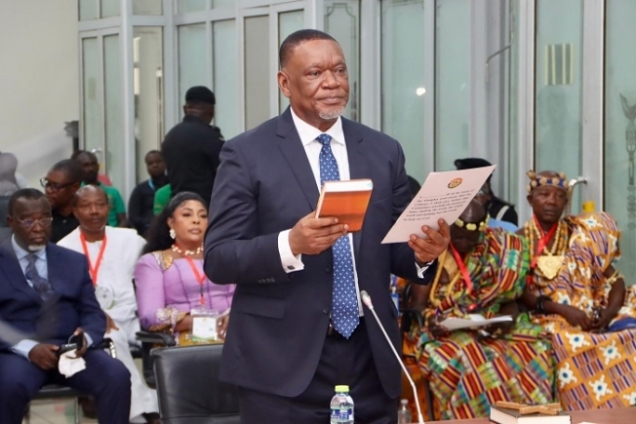
Supreme Court nominee and Court of Appeal Judge, Justice Senyo Dzamefe, has endorsed the use of Artificial Intelligence (AI) and virtual court systems as effective tools to help reduce delays in Ghana’s justice delivery system.
Appearing before Parliament’s Appointments Committee on Monday, 16 June 2025, Justice Dzamefe proposed a combination of judicial reforms and digital innovation to address the growing backlog of cases and ensure faster access to justice.
“We need more courts to spread the workload and make justice faster,” he said, stressing the urgent need for infrastructural and technological expansion across the judiciary.
He recommended the adoption of real-time audio and video recordings in courtrooms, supported by AI, to enable instant transcription of proceedings.
“By the end of a court sitting, records should be ready,” he argued, adding that virtual hearings could reduce transportation costs for litigants, lawyers, and court staff.
Justice Dzamefe also advocated fixed timelines for resolving cases, proposing a maximum of three months for criminal matters and six months for civil cases.
On the matter of property and family disputes, the nominee explained the courts’ responsibility in ensuring fairness during divorce proceedings and inheritance claims.
“Where property is acquired jointly, it is shared equitably. Inheritance matters are handled under PNDC Law 111 or valid wills, ensuring protection for surviving spouses,” he said in response to MP Alhassan Sayibu Suhuyini.
When asked about the relevance of public tribunals, Justice Dzamefe backed the idea of empowering community-level adjudication, highlighting the important role of laypersons in the justice system.
“Law is 20% technical knowledge and 80% wisdom. Lay people bring wisdom to cases and cannot be bullied,” he noted, underscoring the value of practical judgment in grassroots justice.
Justice Dzamefe also addressed the judiciary’s financial dependence on Parliament, calling it a major impediment to judicial independence.
“Judicially and administratively, we are independent. Financially, I don’t think we are, because Parliament allocates our budget,” he stated in response to MP Hassan Tampuli, adding that improved financial autonomy is necessary to enhance judicial efficiency.
With years of judicial experience spanning High Courts in Sekondi, Swedru, and Accra, and having served as President of the Association of Magistrates and Judges, Justice Dzamefe brings substantial courtroom and administrative expertise to the Supreme Court bench, pending his confirmation.
Latest Stories
-
A source of excellence across generations – Vice President Opoku-Agyemang lauds Mfantsipim
6 minutes -
(Photos) Mfantsipim School launches historic 150th anniversary
29 minutes -
Knights and Ladies of Marshall group backs Catholic Bishops’ stance on anti-LGBTQ+
1 hour -
Bright Simons writes: All the Filla in the Ibrahim Mahama/E&P – Gold Fields Saga
2 hours -
Monetise Idiocy In Ghana
2 hours -
The Ghanaian prophet and the mysterious death of his scottish wife Charmain Speirs
3 hours -
Nearly 400 sentenced in Nigeria for links to militant Islamists
3 hours -
Ghana’s recovery supported by gold strength despite global oil price pressures – Standard Bank Research
3 hours -
Methodist Church hails Mfantsipim@150; calls for “fresh consecration” to excellence
3 hours -
‘Excellence is our inheritance’ – Nana Sam Brew-Butler hails Mfantsipim’s 150-year reign in leadership
4 hours -
Kwaku Azar writes: A-G vs OSP
4 hours -
Mfantsipim–Adisadel rivalry built excellence, not division – Sam Jonah
4 hours -
Vice President launches Mfantsipim’s 150 years of shaping Ghana’s greatest mind
4 hours -
I assure Otumfuo, Mahama will join him to commission KNUST Teaching Hospital by end of this year – Haruna Iddrisu
5 hours -
Barcelona dominate derby to extend La Liga lead
5 hours