

Audio By Carbonatix
Kenya has received 17 mountain bongos – a very rare type of antelope – from a conservation centre in the United States.
The antelopes are third-generation descendants of mountain bongos taken from Kenya in the 1960s.
The return of the critically endangered animals, from the Rare Species Conservation Foundation in Florida, was hailed as a "monumental step" in Kenya's conservation efforts.
From about 500 in the 1970s, less than 100 mountain bongos are estimated to remain in the wild in Kenya, according to the Kenya Wildlife Service.
The KWS said this was due to habitat loss, poaching, illegal activities, disease, and small fragmented populations.
Tourism Minister Rebecca Miano described the arrival of the bongos at the country's main airport on Sunday night as "emotional and so cool", and a benefit for Kenya's tourism and conservation sectors.
The animals were taken to wildlife sanctuaries in Meru County near Mount Kenya, where they will be nurtured before they are gradually introduced to their natural habitat.
Ms Miano said the mountain bongo, "a species originally only found in Kenya, has suffered untold grief over the decades... dwindling to alarming proportions".
She said the plan was to grow the population to 700 by 2050.
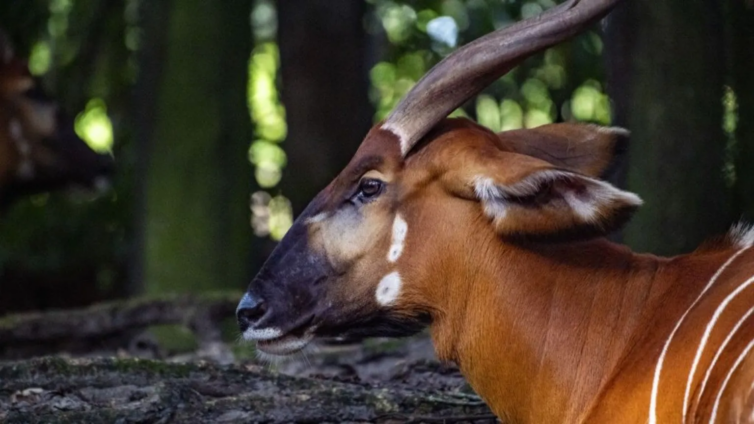
The mountain bongo, which has a bright chestnut-red colour with narrow white stripes, is the largest African forest-dwelling antelope, according to the KWS.
It is listed by the International Union for Conservation of Nature (IUCN) as a Critically Endangered species - with more individuals in captivity than in the wild.
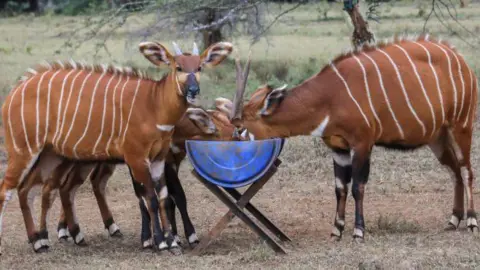
The first repatriation to Kenya was in 2004 when 18 mountain bongos were flown into the country.
KWS director-general Erastus Kanga said Kenya was expecting another batch of the mountain bongos from zoos in Europe in the next three months.
From captivity, the bongos have to go through a series of adaptation phases for them to build the immunity needed to survive in the wild.
In 2022, the head of the conservancy at Mount Kenya Wildlife Conservancy (MKWC) told a Kenyan TV station that some of the bongos repatriated in 2004 had successfully been integrated into the wild and had started breeding.
The MKWC official, Robert Aruho, however, said that others had died from tick-borne diseases, adding that building immunity takes time.
Latest Stories
-
Ghana’s public sector pay exceeds ECOWAS threshold – Finance Minister
2 hours -
Man City suffer Champions League exit to Real Madrid
2 hours -
Chelsea blown away by PSG to exit Champions League
2 hours -
Thiago and Rayan receive first Brazil call-ups
2 hours -
VAR error cost Brighton penalty against Arsenal
3 hours -
FIFA appears to rule out moving Iran’s matches to Mexico
3 hours -
CAF declare Morocco AFCON 2025 winners with final results overturned
3 hours -
Sporting Lisbon’s superb comeback ends Bodo/Glimt’s run
3 hours -
Ali Larijani, Iran’s ultimate backroom powerbroker, dies at 67
3 hours -
Gov’t urges reforms in education sector to boost competitiveness
4 hours -
No full renegotiation of conditions of service across public sector in 2026 – Mahama to Organised Labour
4 hours -
Osabarimba Kwesi Atta II to grace Gomoa Easter Carnival
4 hours -
High public sector wage bill leaves Ghana with little room to hire new workers
4 hours -
Employees compensation the largest share of gov’t expenditure – Finance Minister
4 hours -
Early indications show Israel tank fire hit UN Lebanon base injuring Ghanaian peacekeepers, source says
4 hours