

Audio By Carbonatix
In a strategic move to reduce Ghana’s soaring unemployment rate, the government has launched a labour export programme starting with the deployment of 2,000 workers abroad.
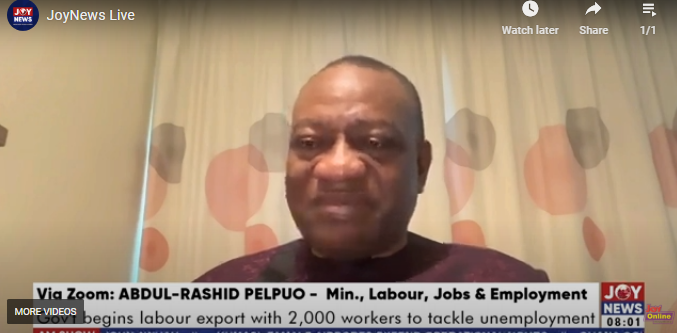
Minister for Labour, Employment and Jobs, Rashid Pelpuo, speaking in an interview on JoyNews' AM Show today, June 2, explained that this initiative forms part of broader efforts to create sustainable employment opportunities for Ghanaians both locally and internationally.
Mr Pelpuo emphasised that the programme is being carried out in full compliance with Ghana’s labour laws.
“In our labour law, the right exists for every person to work in dignity, with respect, and to retain what they have worked for. The laws are very clear,” he stated.
“So, any time we are sending anybody out under this regime, we insist that there must be a memorandum of understanding with the companies receiving them to ensure compliance with the existing laws within our legal system and labour framework.”
He stressed that the labour export initiative is not being undertaken arbitrarily, but through a structured, legal process.
READ ALSO: Ghana to roll out Labour Export Initiative – Mahama announces
“We insist that for anybody to leave this country for another, there must be bilateral relations with that country regarding the export of labour. In other words, we can’t just go into another country and work en masse. As President John Dramani Mahama has rightly pointed out, there must be an established relationship with that country.”
He clarified that the arrangements are evaluated at both the governmental and company levels.
“We’ve looked at it on two fronts: at the bilateral level and at the individual level, where the Ministry must sign agreements with the companies dealing with Ghanaian workers.”
The Minister also explained the criteria used to identify suitable partner countries.
“The criteria will be based on the interest of the country. In labour relations, we consider if there’s interest from our side in providing labour and whether the external country has interest in employing it. When the two align, we consider it legitimate to proceed.”
“These countries express interest in Ghanaian labour and, where we determine the people we are sending are not too critical to our economy, we agree to do so. It helps solve two problems — first, to fill the employment gap and second, to provide jobs for those currently unemployed.”
When asked by host Sweety Aborchie about the number of Ghanaians that might be considered for export beyond the initial 2,000, Mr Pelpuo cited statistics from the period prior to the current administration.
“At the time we were campaigning, the labour gap stood at 29 percent — that is, 29.7 percent of young people, defined from age 15 upwards, were unemployed. That means nearly 30 percent of our youth had no work. These are individuals who have completed university, SHS, or vocational training and yet remained jobless.”
He added that the government’s approach is to first create employment opportunities locally, and then export surplus labour where appropriate.
“We have more than a million people today who still want a place in the workforce. We cannot absorb them all, so it’s only logical to give them opportunities to work elsewhere.”
Mr Pelpuo also warned against irregular migration and outlined the government’s plan to offer safer, regulated alternatives.
“Rather than the situation where people are trying to walk through deserts or cross seas dangerously, we’re creating a legal and logical system. That way, they go through the proper channels and are respected when they arrive, with them not exploited, cheated or abused.”
He assured the public that the wellbeing of Ghanaian workers abroad remains a key concern.
“We’re developing a system where, after sending workers abroad, labour officers or senior officials can visit to monitor their welfare. We’re building platforms to keep in touch, take their numbers, and listen to them. When needed, we’ll go and see how they’re doing.
"We want them to feel confident — and also ensure that we do not end up in a situation where they are abused or harmed simply for seeking an honest living,” he concluded.
Latest Stories
-
Knights and Ladies of Marshall group backs Catholic Bishops’ stance on anti-LGBTQ+
9 minutes -
Bright Simons writes: All the Filla in the Ibrahim Mahama/E&P – Gold Fields Saga
33 minutes -
Monetise Idiocy In Ghana
40 minutes -
The Ghanaian prophet and the mysterious death of his scottish wife Charmain Speirs
1 hour -
Nearly 400 sentenced in Nigeria for links to militant Islamists
2 hours -
Ghana’s recovery supported by gold strength despite global oil price pressures – Standard Bank Research
2 hours -
‘Excellence is our inheritance’ – Nana Sam Brew-Butler hails Mfantsipim’s 150-year reign in leadership
2 hours -
Kwaku Azar writes: A-G vs OSP
2 hours -
Mfantsipim–Adisadel rivalry built excellence, not division – Sam Jonah
3 hours -
Vice President launches Mfantsipim’s 150 years of shaping Ghana’s greatest mind
3 hours -
I assure Otumfuo, Mahama will join him to commission KNUST Teaching Hospital by end of this year – Haruna Iddrisu
4 hours -
Barcelona dominate derby to extend La Liga lead
4 hours -
Gov’t to roll out free special education for persons with disabilities from July 1 – Education Minister
4 hours -
Importers and Exporters Association declares full support for Publican AI port system
4 hours -
“We used it to test our officiating officials’ readiness” – Bawah Fuseini after CAA Athletics event
5 hours