

Audio By Carbonatix
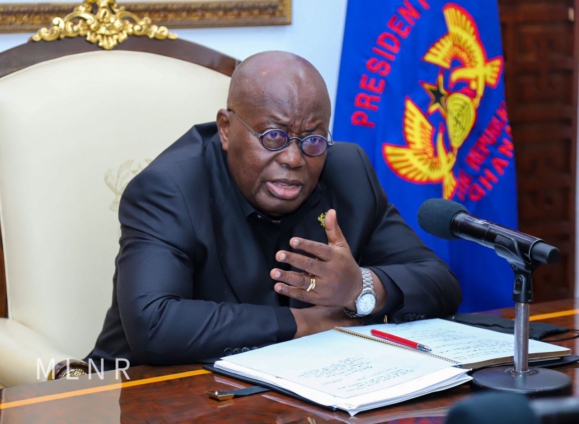
President Nana Akufo-Addo has urged African leaders to guard against the continuing consequential power of rating agencies on African economies.
The credit ratings by these rating agencies, he described, has affected the cost of borrowing and access to the international capital markets.
Speaking at the African Union meeting in Addis Ababa, Ethiopia, President Akufo-Addo charged African leaders to help reform the global financial architecture.
“We need to guard against the continuing consequential strangle of the rating agencies which has affected the costing, access to capital markets for African countries. It has during this COVID-19 period resulted in the downgrading of many African countries, exacerbating even more their funding challenges”.
“Furthermore, it is of the utmost importance that the G20 leaders stick to their commitment to reallocate to Africa SDR 100 billion they made, reached at the Paris Summit in May 2020”, he pointed out.
President Akufo-Addo continued that the IMF should not be the sole beneficiary of such rechanneling, noting “we believe that our own continental institutions, such as the African Development Bank (AFDB) and Afreximbank, should be recipients of the recycling of these SDRs. Our Finance Ministers and the United Nations Economic Commission for Africa (UNECA) have advocated for the use of regional development agencies to be included in this rechanneling.”
He also told the Assembly that African Finance Ministers, with UNECA, have consistently championed the allocation of SDRs to capitalize AfDB and AfreximBank, to help establish an African Stability Mechanism, and to initiate a Liquidity Support Facility (LSF).
The President of the Republic of Ghana advanced his argument that “we [African leaders] need to work collectively as the African Union to reform the global financial architecture even if we build and strengthen our financial institutions”.
This the President believes will address the financial challenges of some African countries.
According to the President, “the major challenges towards the establishment of the AUFIs include the slow rate of signature and ratification of the legal instruments, and the limited capacity of Member States to finance the establishment of the AUFIs. Regrettably, none of the AUFIs has reached the minimum number of ratifications required for the enabling legal instruments to enter into force, and, thereby, facilitate their substantive establishment.”
Latest Stories
-
A source of excellence across generations – Vice President Opoku-Agyemang lauds Mfantsipim
1 hour -
(Photos) Mfantsipim School launches historic 150th anniversary
1 hour -
Knights and Ladies of Marshall group backs Catholic Bishops’ stance on anti-LGBTQ+
2 hours -
Bright Simons writes: All the Filla in the Ibrahim Mahama/E&P – Gold Fields Saga
3 hours -
Monetise Idiocy In Ghana
3 hours -
The Ghanaian prophet and the mysterious death of his scottish wife Charmain Speirs
4 hours -
Nearly 400 sentenced in Nigeria for links to militant Islamists
4 hours -
Ghana’s recovery supported by gold strength despite global oil price pressures – Standard Bank Research
4 hours -
Methodist Church hails Mfantsipim@150; calls for “fresh consecration” to excellence
4 hours -
‘Excellence is our inheritance’ – Nana Sam Brew-Butler hails Mfantsipim’s 150-year reign in leadership
5 hours -
Kwaku Azar writes: A-G vs OSP
5 hours -
Mfantsipim–Adisadel rivalry built excellence, not division – Sam Jonah
5 hours -
Vice President launches Mfantsipim’s 150 years of shaping Ghana’s greatest mind
5 hours -
I assure Otumfuo, Mahama will join him to commission KNUST Teaching Hospital by end of this year – Haruna Iddrisu
6 hours -
Barcelona dominate derby to extend La Liga lead
6 hours