

Audio By Carbonatix
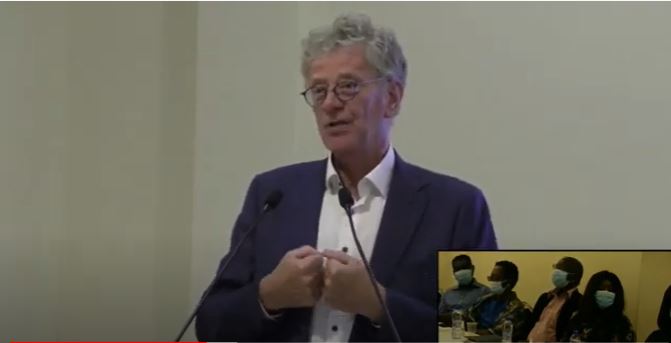
Dutch Economist and Honorary President of Solidaridad Network, Nico Roozen, says linking child labour, and in extreme cases, slavery to the Cocoa production industry in West Africa is a dent in the brand image of Cocoa from the region.
This, he says, could have devastating effects on the Cocoa industry in the region, with Cocoa farmers being the most affected.
Speaking at a Roundtable discussion on Cocoa attended by Cocoa stakeholders in Cote d’Ivoire, Ghana, Liberia and Sierra Leone, Thursday, Accra, on the topic "Recent Cocoa Development in Europe and its Implications for Sustainable Market Access", he called for West African governments, non-governmental organisations and farmers’ communities to work to end the bad narrative.
“If you don’t raise the right questions if you don’t see that the solution for child labour is linked to creating an alternative for labour which is necessary and which cannot be paid for because the farmer has no money if this is your perspective, you’re looking for economic solutions, and it’s applicable for all the issues which are on the table. So we have to be more powerful and more self-confident as NGOs as farmer communities to engage ourselves in the discussion,” he said.
This discussion comes on the heels of recent concerns in Cocoa producing countries that relate to human rights, environmental degradation, and governance, for which the European Commission, through the European parliament, has been at the forefront of the decisive response.
These developments are set to have implications for producer countries, especially Ghana and Cote d’Ivoire, leading world producers.
Nico Roozen said West African stakeholders leaving the decision making to foreign stakeholders in the Cocoa district would not produce desired results for the producer countries.
“The other challenge is ‘okay if Brussels or Washington or New Delhi’ no matter where is deciding criteria for your production, for your ecological ambitions, for your social ambitions, this one-sided agenda will not work and this one-sided agenda doesn’t fit in the relations we want to have in a global environment. Colonial times are a structure of the past,” he said.
He advised that “You countries have to be much more self-confident to take and to demand a place, a seat at the table. And have a … dialogue with Brussels on how to sculpture regulations. Regulations which will help you in the process of innovation and adaptation and challenging the real issues.”
“If you don’t follow that path, you will be confronted with bureaucratic rules, with costly rules, with conceptual thinking which is not related to your daily realities, it is not related with your ambitions and with your priorities. And then we get a clash. A clash in the dialogue, a clash in implementing regulations and in the end the result will be very poor,” he said.
Latest Stories
-
US, Iran fail to reach peace agreement after marathon talks in Pakistan
18 minutes -
ECG kicks off Phase Two of transformer upgrades at Lashibi; brief outages expected
52 minutes -
Port crises loom as 11,000 drivers threaten four-day strike
2 hours -
A source of excellence across generations – Vice President Opoku-Agyemang lauds Mfantsipim
3 hours -
(Photos) Mfantsipim School launches historic 150th anniversary
3 hours -
Knights and Ladies of Marshall group backs Catholic Bishops’ stance on anti-LGBTQ+
4 hours -
Bright Simons writes: All the Filla in the Ibrahim Mahama/E&P – Gold Fields Saga
4 hours -
Monetise Idiocy In Ghana
4 hours -
The Ghanaian prophet and the mysterious death of his scottish wife Charmain Speirs
5 hours -
Nearly 400 sentenced in Nigeria for links to militant Islamists
6 hours -
Ghana’s recovery supported by gold strength despite global oil price pressures – Standard Bank Research
6 hours -
Methodist Church hails Mfantsipim@150; calls for “fresh consecration” to excellence
6 hours -
‘Excellence is our inheritance’ – Nana Sam Brew-Butler hails Mfantsipim’s 150-year reign in leadership
6 hours -
Kwaku Azar writes: A-G vs OSP
6 hours -
Mfantsipim–Adisadel rivalry built excellence, not division – Sam Jonah
7 hours