

Audio By Carbonatix
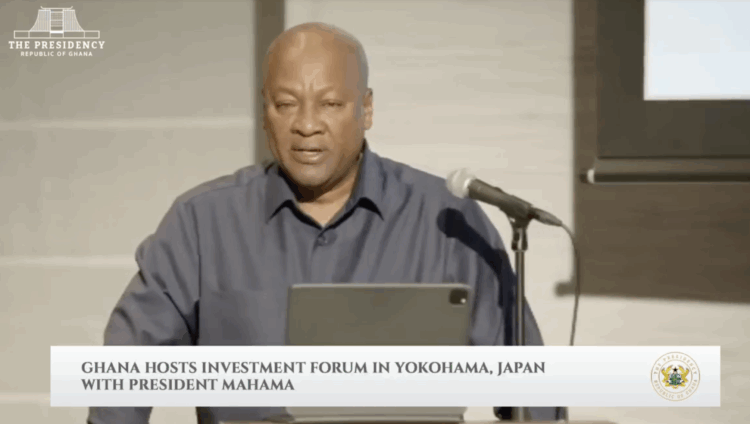
President John Mahama has urged Japanese businesses to seize Ghana’s strategic position as a gateway to Africa and take advantage of a continental market of 1.4 billion people.
He described Ghana as “a stable, democratic, business-friendly gateway to West Africa and the continent,” with a growing consumer market, improving macroeconomic fundamentals, and clear reforms to reduce the cost of doing business.
The President was speaking at the Ghana Presidential Investment Forum on the sidelines of the 9th Tokyo International Conference on African Development (TICAD IX) in Japan on Wednesday.
He pointed to Ghana’s strategic geographical location and its status as the host of the African Continental Free Trade Area (AfCFTA) Secretariat, which enables duty-free, tariff-free trade across almost 50 African countries.
“The sub-regional market, which is West Africa, is 400 million people. Ghana is 33 million people. And the continental market is 1.4 billion people. With the vehicle of the African continental free trade area, you potentially can export into 1.4 billion markets,” he said.
President Mahama underscored Ghana’s progress in restoring macroeconomic stability, noting that inflation, which peaked at almost 23 per cent in 2024, had dropped to 13.7 per cent and was projected to fall into single digits by the end of the year.
He added that the Ghanaian cedi had stabilised, describing it as “the best performing currency in the world this year,” with the country’s credit rating upgraded from junk status to B minus with a stable outlook.
On investment reforms, he announced that Ghana was revising its Investment Promotion Centre Act to remove minimum capital requirements for foreign investors, making it easier for businesses of all sizes to establish operations in the country.
“This will enable any investor, however little money you have, $100,000, $50,000, to be able to come in and set up a business in Ghana,” he explained.
The President also highlighted opportunities for Japanese businesses in sectors such as automobile assembly, agribusiness, agro-processing, energy, manufacturing, and digital innovation.
He noted that global brands like Toyota and Honda were already assembling in Ghana, with potential for expansion into both local and regional markets.
Touching on Ghana’s comparative advantage in agriculture, Mr. Mahama outlined plans for the Volta Economic Corridor, which would leverage vast arable lands and the Volta Lake to bring millions of hectares under irrigation while hosting industrial parks for agro-processing and textile manufacturing.
He also emphasised Ghana’s strength in energy production, citing hydro, thermal, and gas-to-power investments, alongside the country’s integration into the West African Power Pool, which allows surplus power exports to neighbouring countries.
On infrastructure, Mr. Mahama pointed to Ghana’s modern ports in Tema and Takoradi, particularly the recently built MPS Port in Tema, which he described as “one of the best performing ports in Africa,” capable of hosting the world’s largest cargo ships.
He further highlighted the opportunities in Ghana’s fast-growing digital economy, driven by a young, English-speaking workforce and a vibrant fintech sector.
To facilitate investment, he assured Japanese businesses of expedited processes at the Ghana Investment Promotion Centre (GIPC), promising approvals and registrations within 24 hours.
President Mahama stressed that Ghana offered a secure investment environment, with options for public-private partnerships, blended finance, and joint ventures with local businesses.
“Your business will be protected and will not be expropriated,” he assured.
Encouraging Japanese investors to look to Ghana as their hub for Africa, he said: “Africa is the next frontier for investment. Most parts of the world are saturated when it comes to investment.
"Africa is opening up, is growing, and is a place that Japan should be looking at. Let us marry Japanese precision with Ghanaian potential and create a win-win situation for ourselves.”
The President concluded by reiterating that “Ghana is open for business 24 hours a day” and outlined his $10 billion “Big Push” programme, which will focus on infrastructure, agro-processing, industrial growth, and the country’s new 24-hour economy policy aimed at boosting productivity and exports.
Latest Stories
-
Mobile Money Fintech LTD, UMB train hairdressers and beauticians
3 hours -
Badenoch welcomes expanded grooming gangs inquiry
4 hours -
GACL MD sues Samuel Buabeng over alleged Facebook defamation
4 hours -
Asylum votes show people want help, says Kemi Badenoch
4 hours -
Christa Pike in critical condition after surviving two lethal injections, lawyer says
4 hours -
Kemi Badenoch backs face covering ban at protest
4 hours -
Man City not ‘above the rules’, says No 10 after backlash to Burnham remarks
4 hours -
Real Madrid submit ‘substantial’ dossier in Barca payments case
5 hours -
Messi completes purchase of second Spanish club
5 hours -
Government must engage horticulturists on tomato crisis – GhIH
5 hours -
King Promise’s ‘Can’t Tame Us’ becomes official Chelsea anthem
5 hours -
Afenyo-Markin demands Baffour Awuah’s release from EOCO’s custody, end to alleged political intimidation
5 hours -
Rapper Rick Ross arrested on domestic violence charges
5 hours -
Minority demands security review of Ghana-Colombia visa waiver and port deals
5 hours -
Pursue drug kingpins, not persecute political opponents – Afenyo-Markin tells EOCO
5 hours